

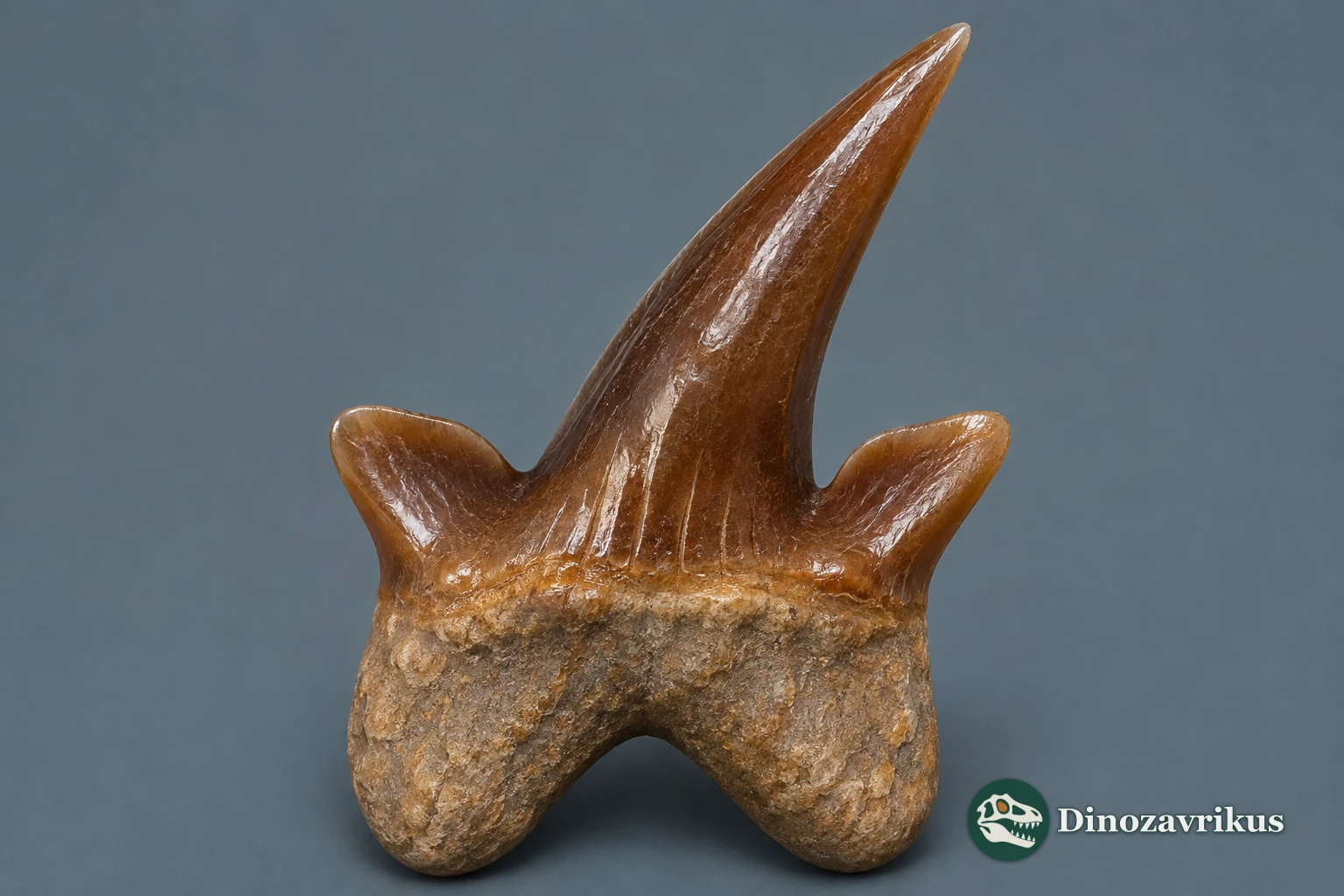
Sylvestrilamia was an extinct sand tiger shark. Its upper lateral teeth are especially informative: an inclined main cusp is flanked by low, broad cusplets. A tooth of that kind was identified in a Late Paleocene assemblage in Chile.
Quick facts
| Group | Sand tiger sharks |
|---|---|
| Type species | Sylvestrilamia teretidens |
| Fossils | Isolated teeth |
| Type locality | Abbey Wood, England |
| Age of type material | Ypresian, Early Eocene |
| Height of the Chilean tooth | 10.2 mm |
What can the fossils tell us?
Henri Cappetta and Dirk Nolf established the genus in 2005. Its name alludes to the wooded locality of Abbey Wood.
Upper lateral teeth have inclined crowns and broader, lower cusplets. Their positions were inferred by comparison.
Its broad cusplets and faint folds on the inner face helped identify the Chilean specimen.
From an English species to a separate genus
Errol White described the Abbey Wood teeth in 1931, using the name teretidens under an older classification. Henri Cappetta and Dirk Nolf reviewed hundreds of teeth and established Sylvestrilamia in 2005. The Latin sylvestris refers to wooded country and alludes to Abbey Wood. The English specimens come from the Lower Ypresian Blackheath Beds.
Front teeth have a nearly straight cusp in profile and fine folds on the convex inner face. A deep groove crosses the thick inner part of the root. Upper lateral teeth have a wider, more inclined cusp with fewer folds. Cappetta and Nolf found the shape of the lateral cusplets especially helpful for identification.
A lateral tooth from Chile
The Late Paleocene assemblage at Talcahuano in south-central Chile yielded a complete upper lateral tooth, CPUC/4005. It is 10.2 mm high and 8.6 mm wide. A few faint striations rise along the inner face. The cutting edge continues onto the broad, spatula-shaped cusplets on either side of the main cusp.
Megalolamna also had lateral cusplets. Palaeontologists distinguish its teeth by a different combination of crown, cusplet and root proportions. In Sylvestrilamia the cusplets vary along the jaw, so comparing teeth from the same inferred position is especially useful.
The coastal record
European records include Late Paleocene and Early Eocene deposits. The authors who described the Chilean specimen observed that the teeth turn up more often in coastal and marginal marine deposits than in open-marine beds. Younger material assigned to the same species has been reported from the Lutetian Fürstenau Formation in Germany.
Frequently asked questions
Where did the original material come from?
It came from the Lower Ypresian Blackheath Beds at Abbey Wood, England.
What does an upper lateral tooth look like?
It has an inclined central cusp and broad, low lateral cusplets. Fine folds may be present on the inner face.
What was found in Chile?
A complete upper lateral tooth 10.2 mm high came from Late Paleocene deposits at Talcahuano.
Can the shark’s length be estimated?
The fossils give the dimensions of individual teeth. The proportions of the shark’s body remain unknown.