

Tangvayosaurus hoffeti was a large sauropod from the Early Cretaceous of Laos. Two partial skeletons were recovered near Tang Vay in Savannakhet Province. Their pelvic bones, leg elements and vertebrae provided evidence for a new genus and a comparison with other long-necked dinosaurs from Southeast Asia.
Quick facts
| Group | Sauropods (Titanosauriformes) |
|---|---|
| Age | Early Cretaceous (Aptian to Albian) |
| Region | Asia (Savannakhet Province, Laos) |
| Diet | Herbivore |
| Type species | Tangvayosaurus hoffeti |
| Holotype | TV4-1 to TV4-36 |
| Estimated length | About 15 m in the original description |
| Formation | Grès supérieurs Formation |
What can the fossils tell us?
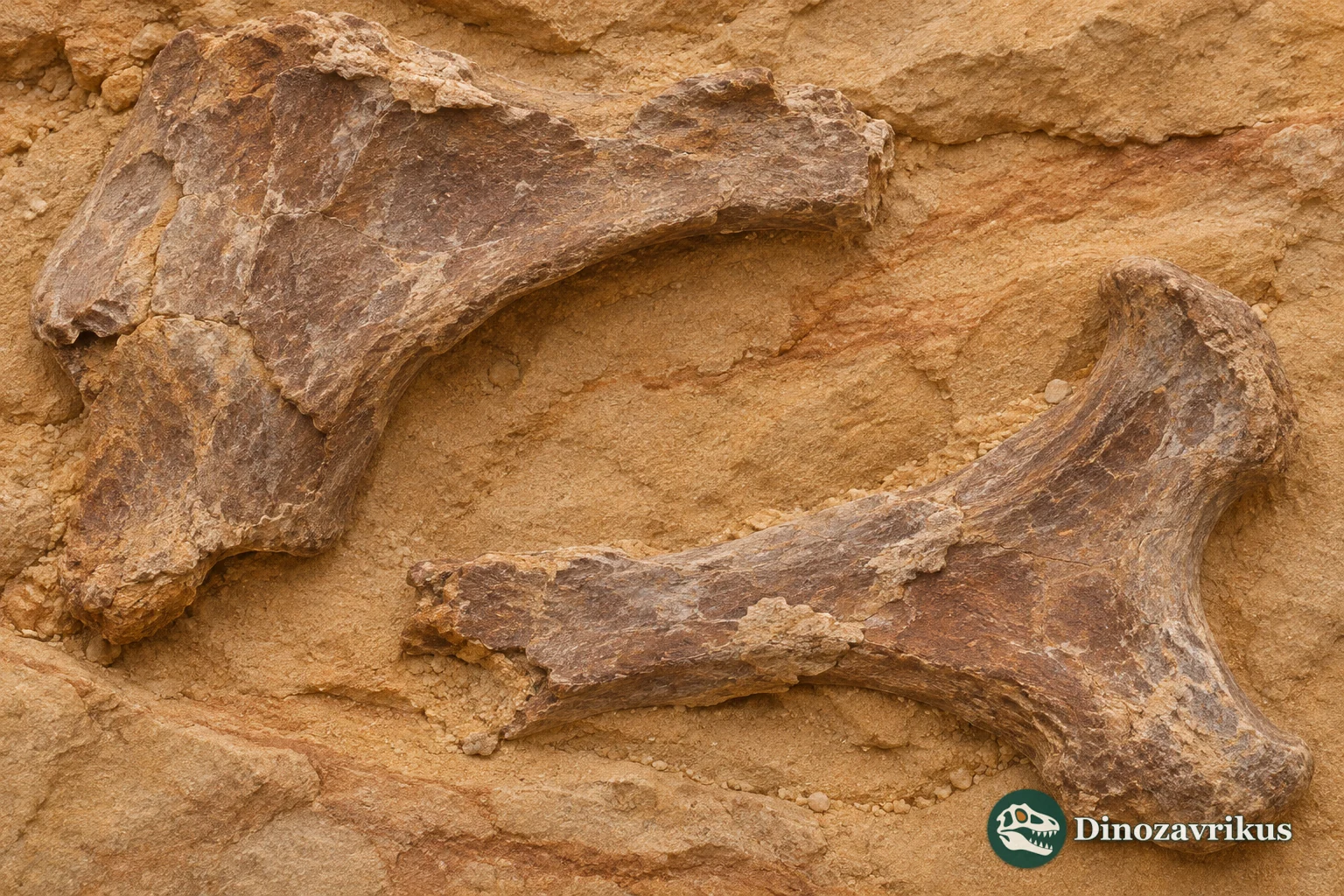
The contact between the pubis and ischium is tall from top to bottom. Its proportions are useful when comparing Tangvayosaurus with neighbouring sauropods.
Some tail vertebrae have concave joint surfaces at both ends. In the middle and rear parts of the tail, the arch sits nearer the front of the centrum.
TV4-1 to TV4-36 is the type series. Bones from Tang Vay 2 supplied a separate comparison. Both finds are partial skeletons.
The two finds at Tang Vay
Ronan Allain and colleagues described the animal in 1999. The genus refers to Tang Vay, and the species honours Josué-Heilmann Hoffet, who studied fossil vertebrates in Indochina. The Dinosaur Museum in Savannakhet houses the type series, including a right femur and parts of the pelvis.
Material from Tang Vay 2 includes a tail vertebra, a tibia and a fibula. The authors used it to compare the sauropods from the two sites. The formal species diagnosis was based on the Tang Vay 4 material. Both localities lie high in the Grès supérieurs Formation. Freshwater bivalves were used to support an Aptian to Albian age.
The pelvis, thigh and tail
The pubis and ischium meet along a tall surface. The lower ends of the ischia are flattened and lie almost in the same plane. Several tail vertebrae have concave faces at both ends. In the type femur, the upper part of the outer margin bends inward. These forms help distinguish the sauropod independently of body size.
The original authors gave an approximate length of 15 metres. The fossils allow direct comparison of individual pelvic and limb bones. An overall length requires a reconstruction from incomplete material. Its sauropod affinities support a plant-based diet, with specific food plants unknown.
Comparisons across Southeast Asia
The original description placed Tangvayosaurus among early titanosaurs. Later analyses offered several arrangements of the titanosauriform branches. In a 2026 study, Tangvayosaurus fell within Euhelopodidae alongside Phuwiangosaurus and Nagatitan. That association is a result of the anatomical comparisons. The broader placement in Titanosauriformes is shared across alternative results.
Hoffet had named isolated Laotian thigh bones Titanosaurus falloti. Reassessment found too few distinguishing features in that type material to identify a separate species. One of the old femora was compared with Tangvayosaurus at genus level. The holotype of Tangvayosaurus hoffeti came from the later discoveries at Tang Vay.
Frequently asked questions
What does Tangvayosaurus mean?
It combines Tang Vay, the name of the type locality, with the Greek word for lizard.
How large was Tangvayosaurus?
The original description estimated a length of about 15 metres. The known skeletons are incomplete.
Where is the holotype kept?
The Dinosaur Museum in Savannakhet holds the series TV4-1 to TV4-36.
Is the skull known?
The material from Tang Vay preserves parts of the trunk and limbs. The appearance of the head remains uncertain.