

Taphrosphys was a side-necked turtle in the family Bothremydidae. Its shell bones occur in eastern North America and on the African coast. A skull from Morocco represents a third species. The series of shells from Angola shows how individuals of one species differed.
Quick facts
| Group | Turtles, side-necked turtles |
|---|---|
| Age | Paleocene |
| Region | Africa and North America: Angola, Morocco and the United States |
| Type species | Taphrosphys sulcatus |
| Lectotype from Angola | MRAC 196, part of the front rim of the carapace |
| Scientific name | Taphrosphys |
| Diet | No direct evidence |
What can the fossils tell us?
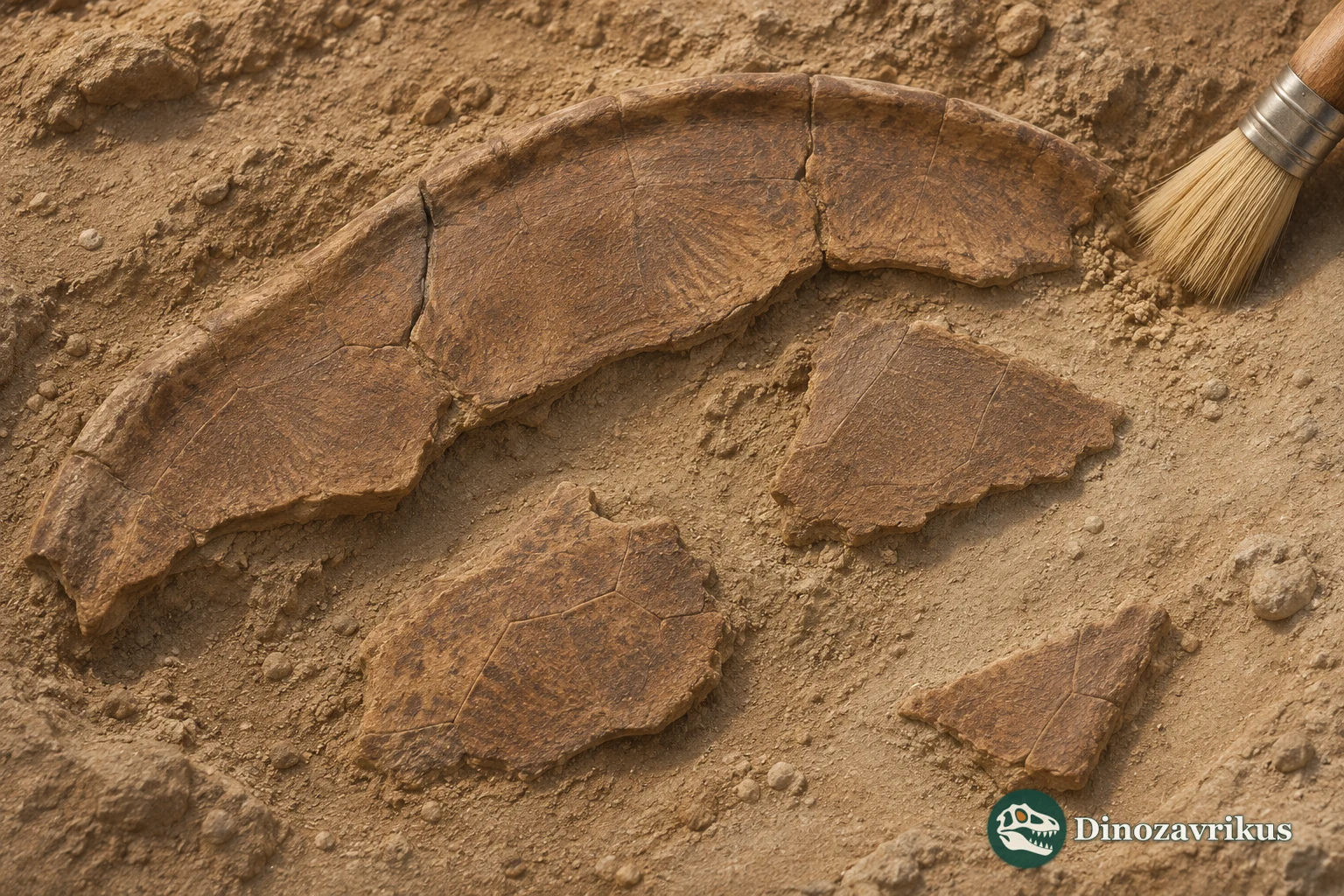
Bones on the right side of this carapace from Landana stayed connected. The specimen is the lectotype of the Angolan species T. congolensis.
Bed 11 at Landana yielded MRAC 4795, part of a rear carapace, and MRAC 4794, part of a plastron. They preserve different parts of a turtle shell from the same horizon.
The skull from the Ouled Abdoun Basin is the holotype of T. ippolitoi. No shell has been described for this species.
The type species from New Jersey
Joseph Leidy described the type species in 1856 as Platemys sulcatus. It later became the type of Taphrosphys. Its material comes from the Hornerstown Formation in New Jersey. Dating of fossil localities has changed since early reports attributed some occurrences to the Cretaceous. A modern revision confines the three well-supported species to the Paleocene.
The Hornerstown Formation also yielded Osteopygis. Identifying specimens from that formation requires checking the anatomy of each shell and recording where it lay in the succession. The formation name alone gives limited information about the date of an individual fossil.
The shells from Landana
The lectotype of T. congolensis from Landana, in Angola’s Cabinda province, preserves the right front rim with adjacent elements still joined. A revision examined dozens of specimens from numbered horizons along with a few well-preserved pieces with less precise locality records.
Bed 11 yielded the back of a carapace, MRAC 4795, and part of a plastron, MRAC 4794. Together with other finds, they helped clarify the shell outline and which characters vary between individuals. The specimens with bed numbers also show where the species occurs in the succession.
A skull from Morocco
The Moroccan species T. ippolitoi is known from AMNH 30042, a skull from Danian deposits in the Ouled Abdoun Basin. Skull anatomy provides the basis for its assignment. The morphology of its shell remains undocumented.
Frequently asked questions
What kind of turtle was Taphrosphys?
It belonged to Bothremydidae, an extinct family of side-necked turtles. Living side-necked turtles bend the neck sideways to draw back the head.
Did it live in the Cretaceous?
Some older accounts report Cretaceous dates. A revision places the three well-supported species in the Paleocene.
What does the Angolan lectotype preserve?
It preserves part of the right front rim of the upper shell. Several adjacent bones remain in place.
What did Taphrosphys eat?
Direct evidence of its diet is unavailable. The shells and skull primarily document anatomy.