

Tertremoides was an Early Triassic trematosaurid from Madagascar. The Paris collections hold the type material of two names applied to similar amphibians from the island. Differences in snout proportions and sensory grooves may partly reflect growth.
Quick facts
| Group | Temnospondyls, trematosaurids |
|---|---|
| Age | Early Triassic |
| Region | Africa (Madagascar) |
| Type species | Tertremoides ambilobensis |
| Scientific name | Tertremoides |
| Diet | Undetermined |
What can the fossils tell us?
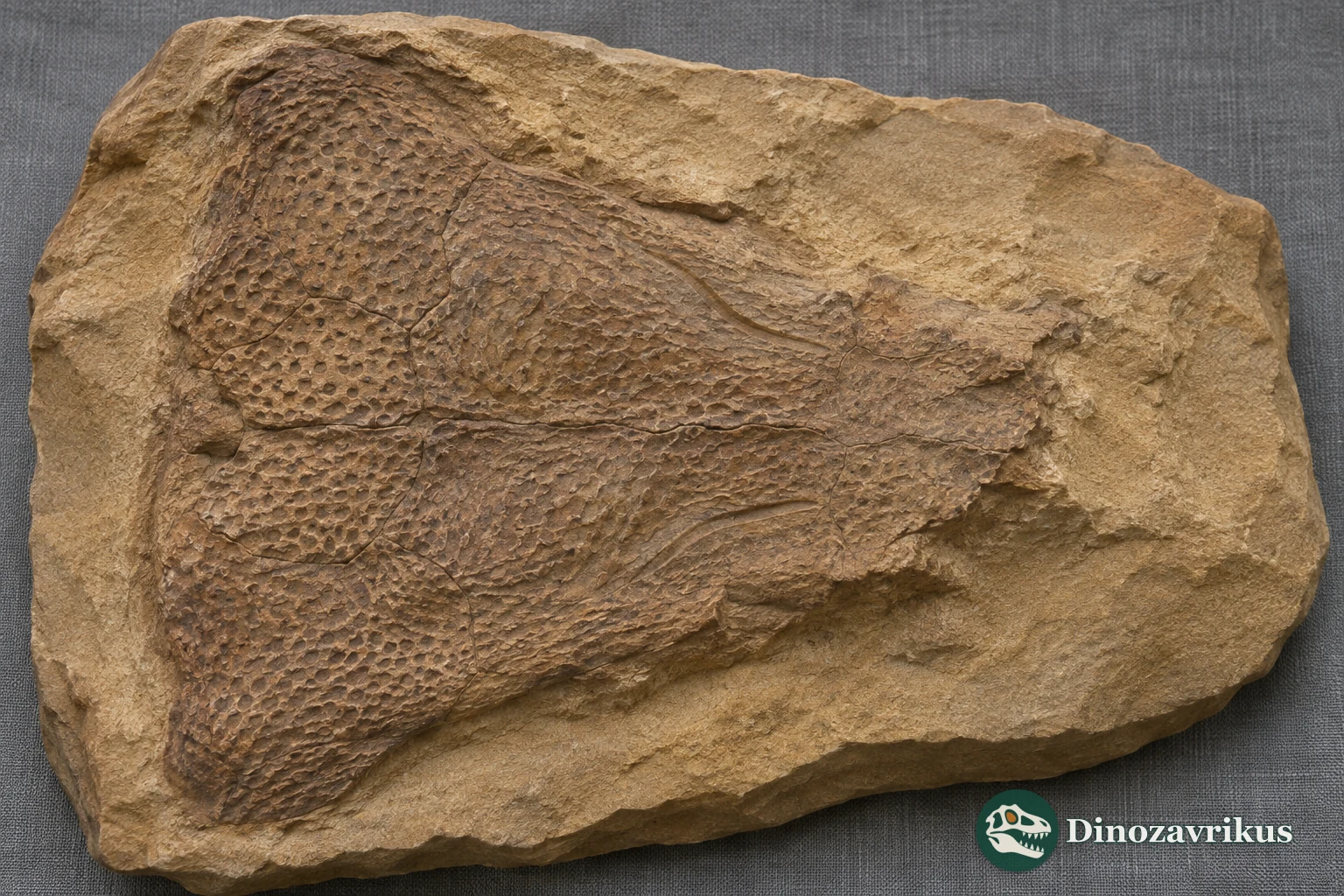
The type lot of Tertremoides includes natural moulds of the skull roof and parts of the interior of the skull. Jaw material is also catalogued under MNHN.F.MAE3040.
Similarities behind the eye sockets and in the course of the lateral-line grooves led researchers to unite the two Malagasy forms under one name.
Eye socket proportions and groove depth can change as trematosaurids grow. A comparable growth series would help test whether the Malagasy material belongs to one species.
Two names and their fossils
In 1966 Jean-Pierre Lehman named the Malagasy species Trematosaurus madagascariensis. Its type, a skull with parts of the lower jaws, is held in Paris as MNHN.F.MAE3039. Lehman erected Tertremoides in 1979 from a different lot. The holotype of T. ambilobensis, MNHN.F.MAE3040, includes a natural mould of the skull roof, jaw elements and relief from inside the skull.
Why the names were combined
In 2000 Rainer Schoch and Andrew Milner compared the region behind the eyes and the paths of the sensory grooves. They grouped the Malagasy fossils as Tertremoides madagascariensis, retaining the earlier species epithet from 1966. The articulated German trematosaurid Trematolestes offers further comparisons because its skull and much of its skeleton are preserved together.
How growth complicates identification
In 2002 Sébastien Steyer noted that the T. ambilobensis type has a more elongated snout and shallower grooves. Both differences could be related to growth. In 2009 Simone Maganuco and Giovanni Pasini studied the palate of MSNM V2993, a newly reported incomplete skull from northwestern Madagascar. They tentatively referred it to T. madagascariensis and retained the combined species pending a revision of Lehman’s specimens. The skulls alone leave whole-body proportions uncertain.
Frequently asked questions
Where was Tertremoides found?
The material comes from Early Triassic deposits on Madagascar. One of the more recently studied skulls came from the northwest of the island.
Which fossil gave Tertremoides its name?
Lehman erected the genus in 1979 using skull and jaw material catalogued as MNHN.F.MAE3040 in Paris.
What do the grooves on the skull record?
They trace part of the lateral-line sensory system and give researchers landmarks they can compare among skulls.
Why is the name Tertremoides madagascariensis used?
A 2000 revision combined two sets of specimens and kept the older species epithet from 1966. The limits of the combined species are still debated.