

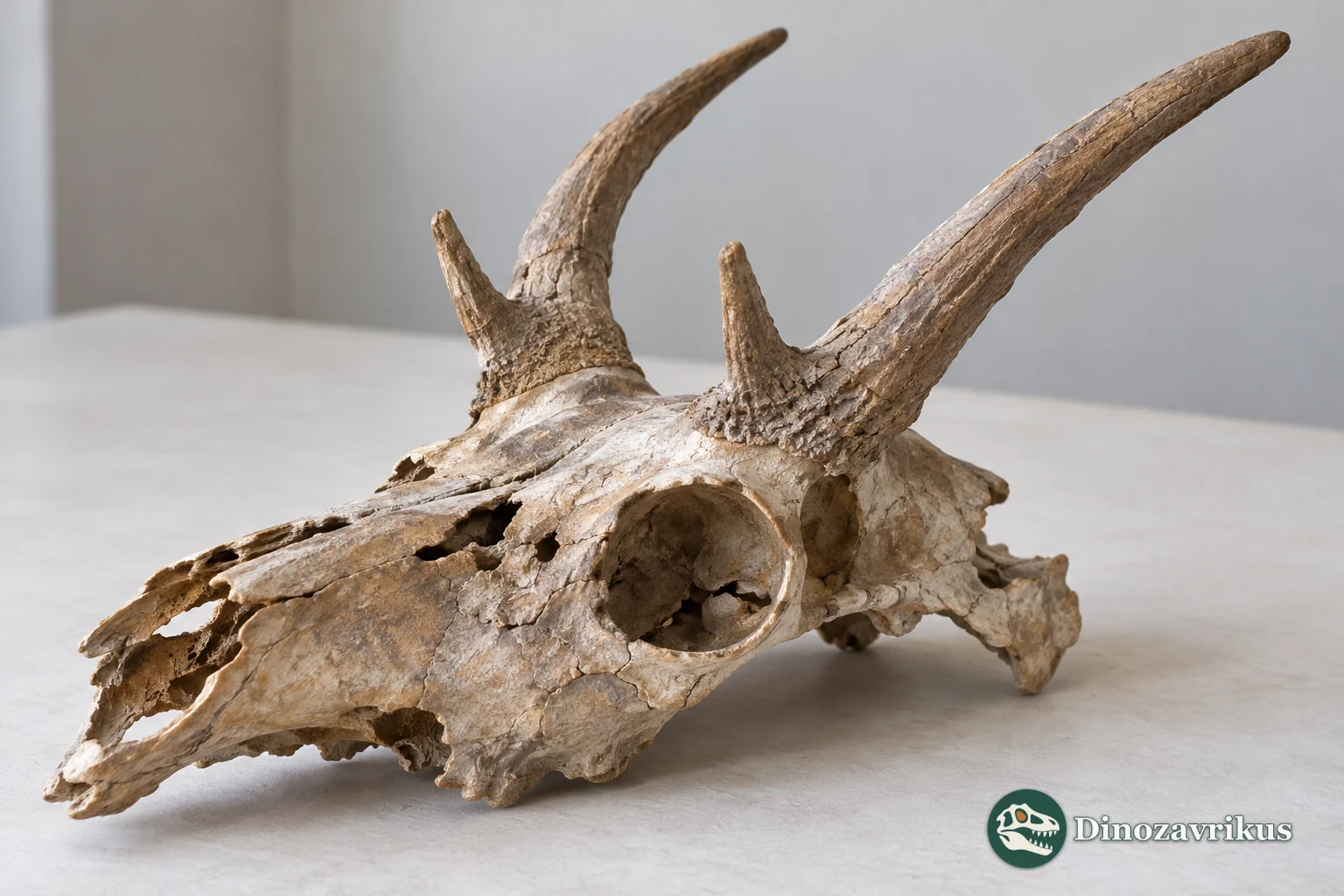
Tetrameryx was a Pleistocene North American pronghorn relative known especially from skulls and bony horn cores. Its apparent four horns were two separate bases, one over each eye, each dividing into a front and rear branch. The rear branches could be strikingly long. This contrasts with Stockoceros, whose low-forked branches are more nearly equal.
Bone preserves the branching pattern, but rarely the full keratin sheath. The cover is an artistic life reconstruction rather than a portrait of a particular museum animal. Horn proportions by themselves provide no measured running speed or body mass.
Quick facts
| Family | Antilocapridae, pronghorn relatives |
|---|---|
| Genus | Tetrameryx Lull, 1921 |
| Age | Pleistocene, site ages vary |
| Range | Southern and western North America, including Mexico |
| Key feature | Rear branch of each horn core longer than the front |
| Best evidence | Horn cores and skull pieces; isolated limb bones are harder to assign |
What can the fossils tell us?
A skull has one forked bony core above each orbit. In well studied forms the rear branch is much longer than the front, but the complete outer keratin sheath is poorly known.
Large pronghorn relatives can have similar limb bones. A size match alone cannot securely identify Tetrameryx, still less a particular species.
Type skull fragments of T. mooseri and T. tacubayensis have been located and redescribed. A 2026 study calls for testing whether their proposed diagnostic features are sufficient.
What distinguishes the horn cores
Richard Lull established Tetrameryx in 1921. Each side of the skull bore one core split into anterior and posterior branches. In selected specimens referred to T. shuleri, the rear branch was reported as roughly three to four times the anterior branch's length. That ratio describes particular surviving bones, not every species or the missing keratin covering.
Branch position, direction, cross section and attached skull material all help identify a specimen. The small Capromeryx had its own paired prongs. Once a horn is badly broken, resemblance increases and a species label becomes less secure. The illustration below shows the anatomical contrast without claiming to depict a type specimen.
Why an isolated leg bone is difficult
Skulls and horn cores offer clearer diagnostic characters than unassociated postcranial bones. A review of North American pronghorn relatives cautions that many isolated limb bones of large forms cannot be tied securely to Tetrameryx. Assigning all large bones from a locality to the same horn-bearing genus would produce unsupported estimates of body size, speed and abundance.
The US National Park Service notes that Tule Springs pronghorn material often cannot be assigned confidently to species, and some historical Tetrameryx records there remain uncertain. A large tooth can aid comparison, but does not automatically establish a genus. Other herbivores such as Palaeolama occupied broad North American regions; regional overlap alone documents no direct encounter.
Mexican names and the limits of reconstruction
Oswaldo Mooser and Walter Dalquest named T. mooseri and T. tacubayensis from Aguascalientes material. A 2026 reassessment located their type specimens, TMM 42428-9921 and TMM 42428-2, including skull pieces with horn cores. It argues that the features used to separate these names require further morphometric testing. Historical lists of five proposed species are not a settled count of valid species.
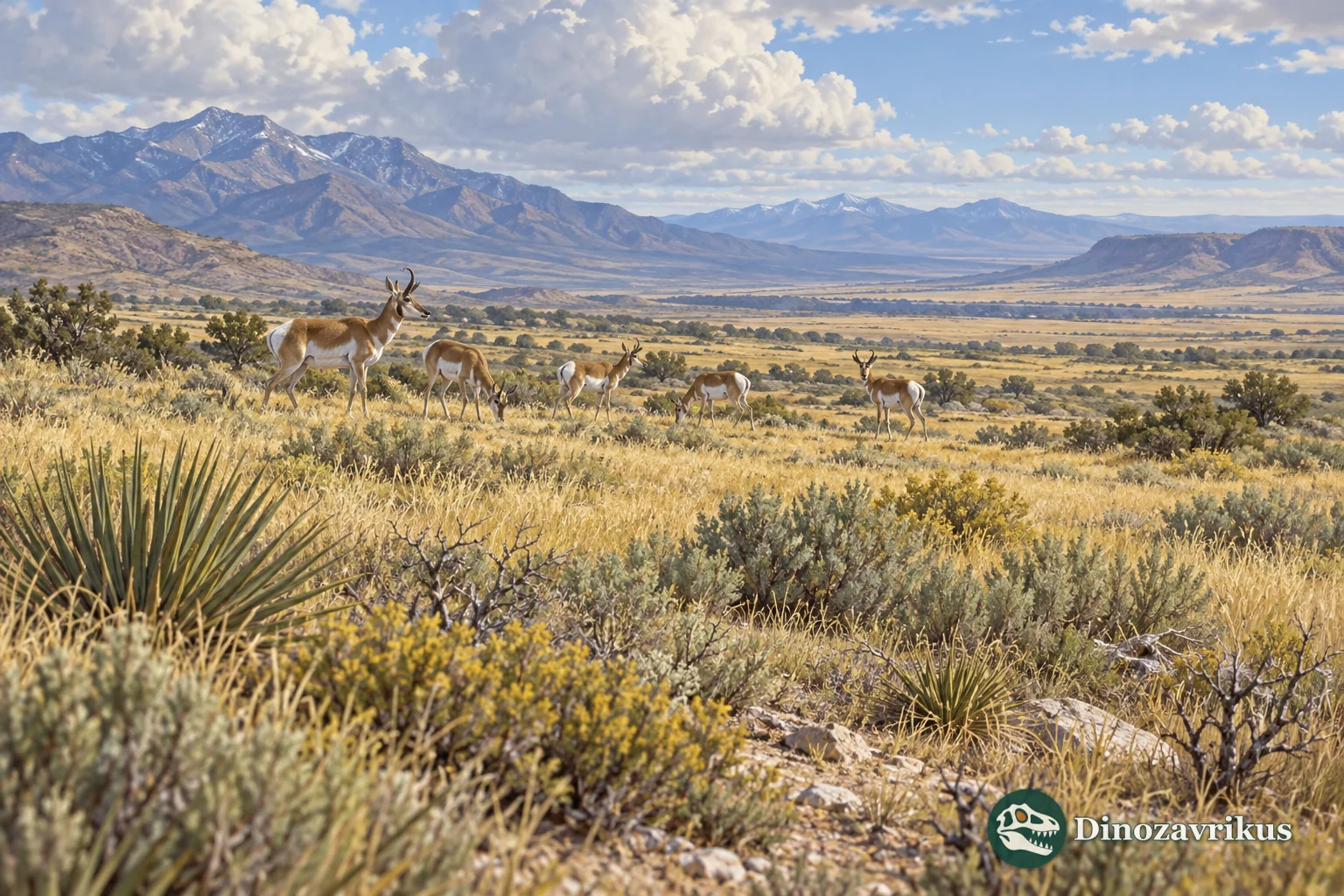
Pronghorn teeth indicate plant feeding, but horn shape cannot fix the ratio of grass to leaves for every named Tetrameryx. Wear studies of properly identified samples could refine that question. Coat colour, seasonal movements and social behaviour remain conjectural. The landscape and group in the illustration are artistic choices, not a documented site or proof of herding.
Frequently asked questions
Did Tetrameryx have four separate horns?
No. One bony core above each eye forked into two branches, making two bases and four apparent tips.
How is it distinguished from Stockoceros?
In well studied Tetrameryx material, each rear horn branch is much longer than its front branch; the two Stockoceros branches are closer in length.
Can any large pronghorn leg bone identify Tetrameryx?
No. Without an associated skull, many similarly sized pronghorn limb bones cannot be confidently assigned to a genus or species.
Are all Mexican Tetrameryx species accepted?
No. The type specimens of T. mooseri and T. tacubayensis have been revisited, but their distinguishing features still require testing.