

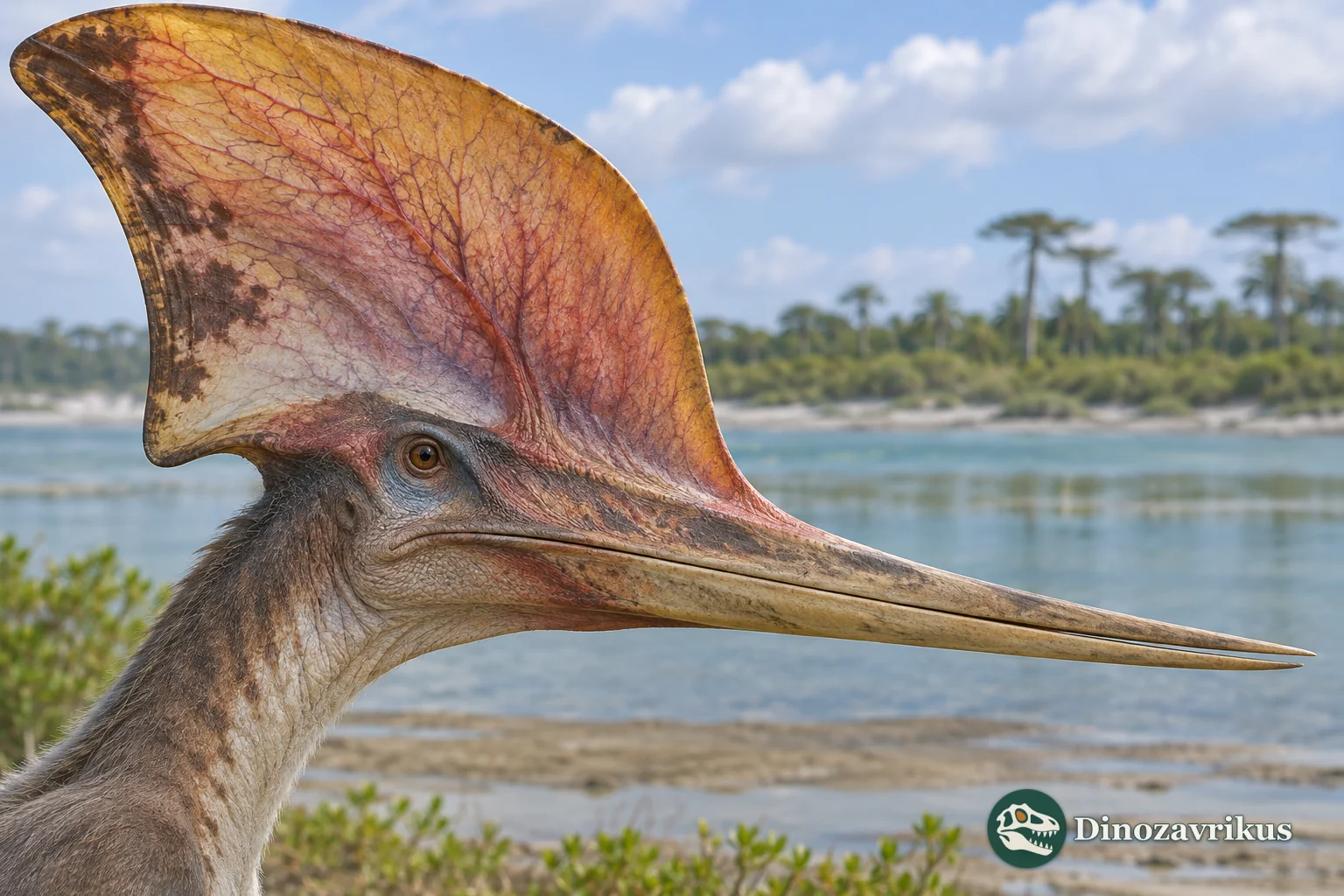
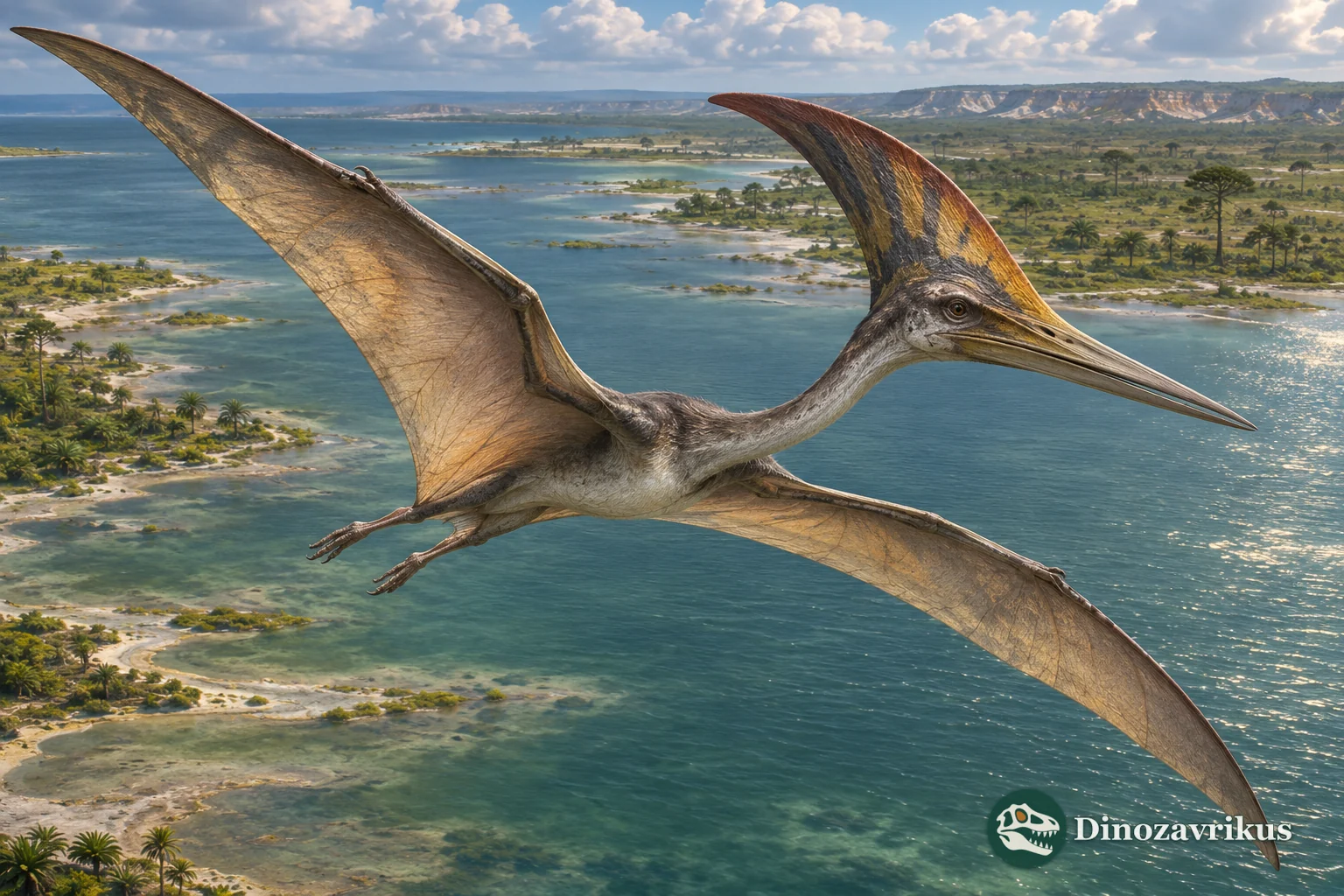
Thalassodromeus sethi was named from an almost complete skull and lower jaw from Brazil's Romualdo Formation. Its great bony crest and sharp-edged toothless jaws are fossil evidence. The wings, colour and lakeside setting in the cover art are reconstructions, since the type specimen does not preserve them.
Quick facts
| Named species | Thalassodromeus sethi, Kellner and Campos, 2002 |
|---|---|
| Holotype | DGM 1476-R, nearly complete skull with mandible |
| Rock unit | Romualdo Formation, Araripe Basin, Brazil |
| Age | Aptian–Albian transition, Early Cretaceous |
| Exact discovery site | Not documented; Santana do Cariri area is possible |
| Directly preserved | Bony crest and toothless jaws with sharp midline keels |
| Wingspan | Not directly measurable from the holotype |
What can the fossils tell us?
DGM 1476-R preserves most of the skull and lower jaw. It documents cranial shape, but contains no complete wing or evidence of the living animal's colour.
Bone supports the tall crest; its soft covering, pigments and function are not preserved. Display, heat exchange and other proposed roles require interpretation.
Narrow sharp midline keels are visible on the jaws. They do not identify specific prey or demonstrate that this pterosaur fed while skimming water.
NMSG SAO 251093 is not part of the holotype. Once called Banguela oberlii, it has also been assigned to Thalassodromeus as a different species, T. oberlii.
A skull from the Araripe Basin
Alexander Kellner and Diogenes de Almeida Campos named Thalassodromeus sethi in 2002 from skull DGM 1476-R and its lower jaw. The genus name reflects an early idea about feeding over water, while the species name refers to the Egyptian god Set, whose crown suggested the crest's outline to the authors. Neither name proves a lifestyle. A 2025 review locates the fossil in the Romualdo Formation; the precise excavation spot was not recorded, though a site around Santana do Cariri has been proposed.
The Romualdo Formation belongs near the Aptian–Albian boundary. Its sediments record coastal and lagoonal settings with marine influence. An age obtained from a fossil fish in the formation supplies geological context, not a direct date for this particular pterosaur skull. The skull's three-dimensional preservation has allowed later preparation and study of details that are lost in many flattened pterosaur fossils.
The crest and the toothless bite
The tall ossified crest rises over the skull and extends far behind it. Further preparation revealed details of the palate and small openings behind it. The toothless upper and lower jaws meet along sharp midline edges. A 2018 revision and a 2025 review use these features, among others, to distinguish Thalassodromeus from Tupuxuara. A large crest by itself does not make two fossils the same species.
No complete wing or body skeleton belongs to the type specimen, so a wingspan cannot be measured directly. Comparisons with other pterosaurs suggested a large animal, but the holotype does not settle wing proportions, growth of the crest in juveniles, sexual differences or living colour. The crest may have served display or other functions; the bone alone cannot choose among them.
A disputed feeding idea and another jaw
The first description proposed that Thalassodromeus could have drawn its lower jaw through the water while flying, like a modern skimmer. Biomechanical modelling published in 2007 challenged whether a pterosaur could sustain the resulting drag. No stomach contents or identified prey have been found with the skull. Alternative feeding ideas remain hypotheses rather than direct observations of diet.
An independent jaw, NMSG SAO 251093, was initially associated with T. sethi and later became the basis of Banguela oberlii. Subsequent revisions have treated it as another species, Thalassodromeus oberlii. It is neither a second jaw of the T. sethi holotype nor a reason to transfer every feature of one specimen to the other. The Banguela profile follows that specimen's separate name history.
Reading the reconstructions
The crest portrait uses the fossil's bony outline but gives it an invented skin covering and colour. The flight scene imagines a possible Romualdo landscape. Because wing bones are absent and skim feeding is contested, neither picture documents this individual's flight style or a feeding event.
Frequently asked questions
What fossil names Thalassodromeus sethi?
The holotype DGM 1476-R is an almost complete skull with a lower jaw, not a complete skeleton.
Where and when did it live?
The skull comes from Brazil's Romualdo Formation near the Aptian–Albian boundary; its exact discovery site is uncertain.
Did it catch fish by skimming the water?
That was proposed in 2002, but later modelling challenged it. No direct evidence of its prey has been found.
Why does Banguela appear in its taxonomy?
A separate jaw was named Banguela oberlii; some subsequent researchers place it in Thalassodromeus as a different species.