

Thomashuxleya was a medium-sized notoungulate from Eocene Patagonia. Its best-known species, T. externa, is represented by an unusually associated skeleton from the Cañadón Vaca Member of Argentina's Sarmiento Formation. The specimen connects a roughly 28-centimetre skull and lower jaw with major parts of the postcranial skeleton, making it possible to test anatomical interpretations against one individual rather than combine unrelated fragments.
The genus belongs to the diverse South American radiation Notoungulata. Its relationships within that group have shifted among analyses, so its name does not by itself settle a family-level classification. The fossils are included in the ancient mammal catalogue; comparisons with Henricosbornia help place early notoungulate anatomy in context without treating the genera as interchangeable.
Quick facts
| Scientific name | Thomashuxleya Simpson, 1945 |
|---|---|
| Type species | T. rostrata Ameghino, 1901 |
| Best-known species | T. externa Simpson, 1945 |
| Group | Notoungulata; precise family placement remains debated |
| Age | Middle Eocene; Vacan subage, about 45 million years ago |
| Locality | Cañadón Vaca Member, Sarmiento Formation, Chubut, Argentina |
| Key specimen | MPEF-PV 8166: associated skull, jaws and much of the skeleton |
| Skull length | About 28 cm in MPEF-PV 8166 |
| Mass estimate | About 84 kg in one model; estimates depend on the method and element |
What does the Thomashuxleya record preserve?
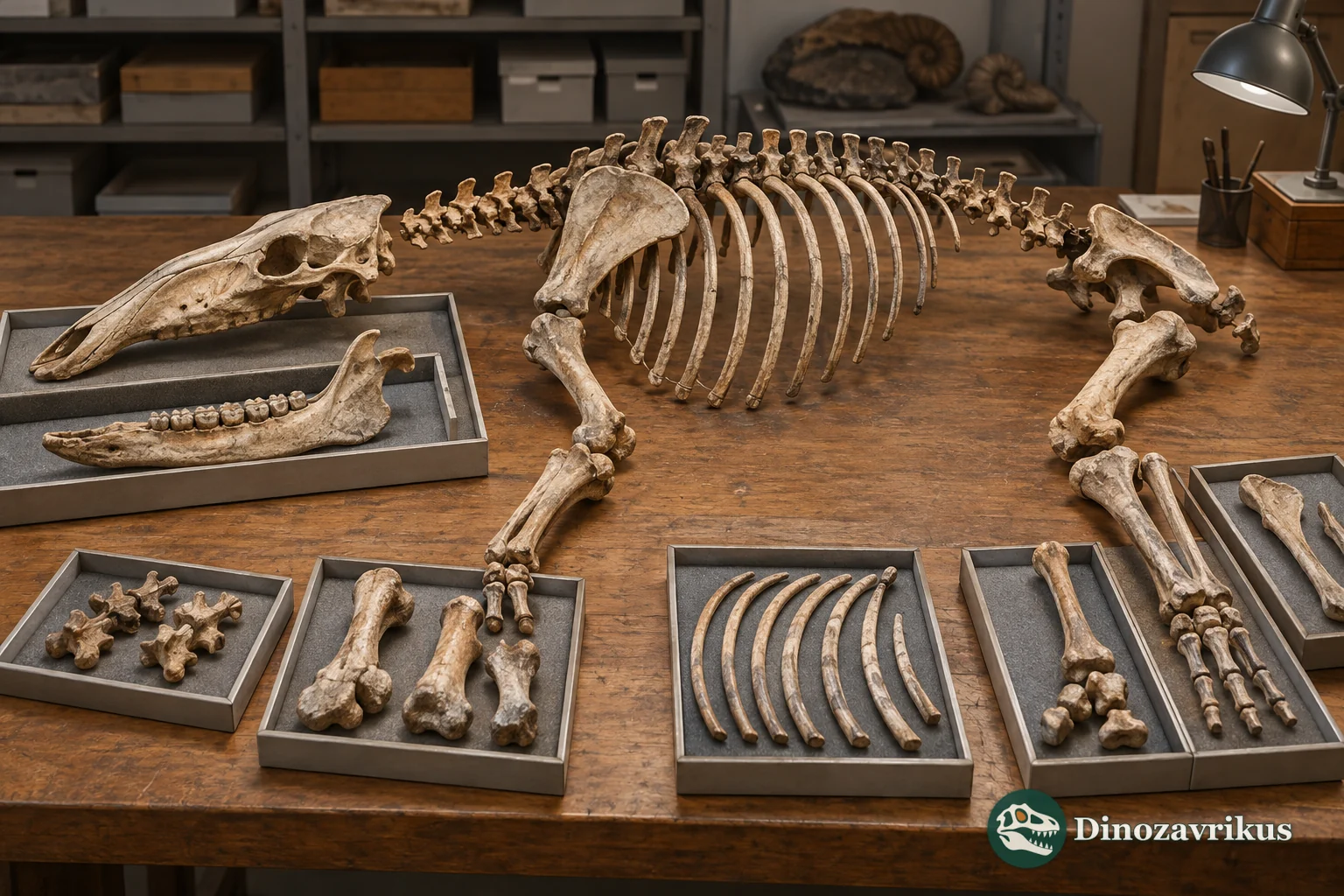
MPEF-PV 8166 preserves an almost complete skull and mandible together with associated shoulder, limb and pelvic elements. This is direct anatomical evidence from one individual, not proof that every species assigned to the genus had identical proportions.
The jaws and cheek teeth document feeding anatomy and allow comparisons among notoungulates. They support a plant-processing interpretation, but no stomach contents or specific meal are known for this specimen.
MPEF-PV 8166 comes from the Cañadón Vaca Member of the Sarmiento Formation. Stratigraphic and biochronological work places the Vacan fauna near 45 million years ago; that is a context-based estimate, not a date measured on the skeleton.
Histological observations indicate a mature skeleton with substantial remodelling, although some epiphyses were not fused. Bone tissue constrains growth history but does not provide an exact age in years or a complete life history.
Names, discovery and the type material
Florentino Ameghino named Thomashuxleya rostrata in 1901. George Gaylord Simpson later established the genus in 1945 and designated T. rostrata as its type species. The name T. externa was applied to material that became central to later anatomical work. The distinction matters: the genus is anchored to its type species, while the most complete skeleton discussed in modern studies belongs to T. externa.
MPEF-PV 8166 is held in the Museo Paleontológico Egidio Feruglio collection in Trelew, Argentina. It was collected from the Cañadón Vaca Member. The associated elements provide a rare opportunity to compare skull, jaw and limb anatomy without assuming that isolated bones from different localities came from one animal.
Age and Patagonian setting
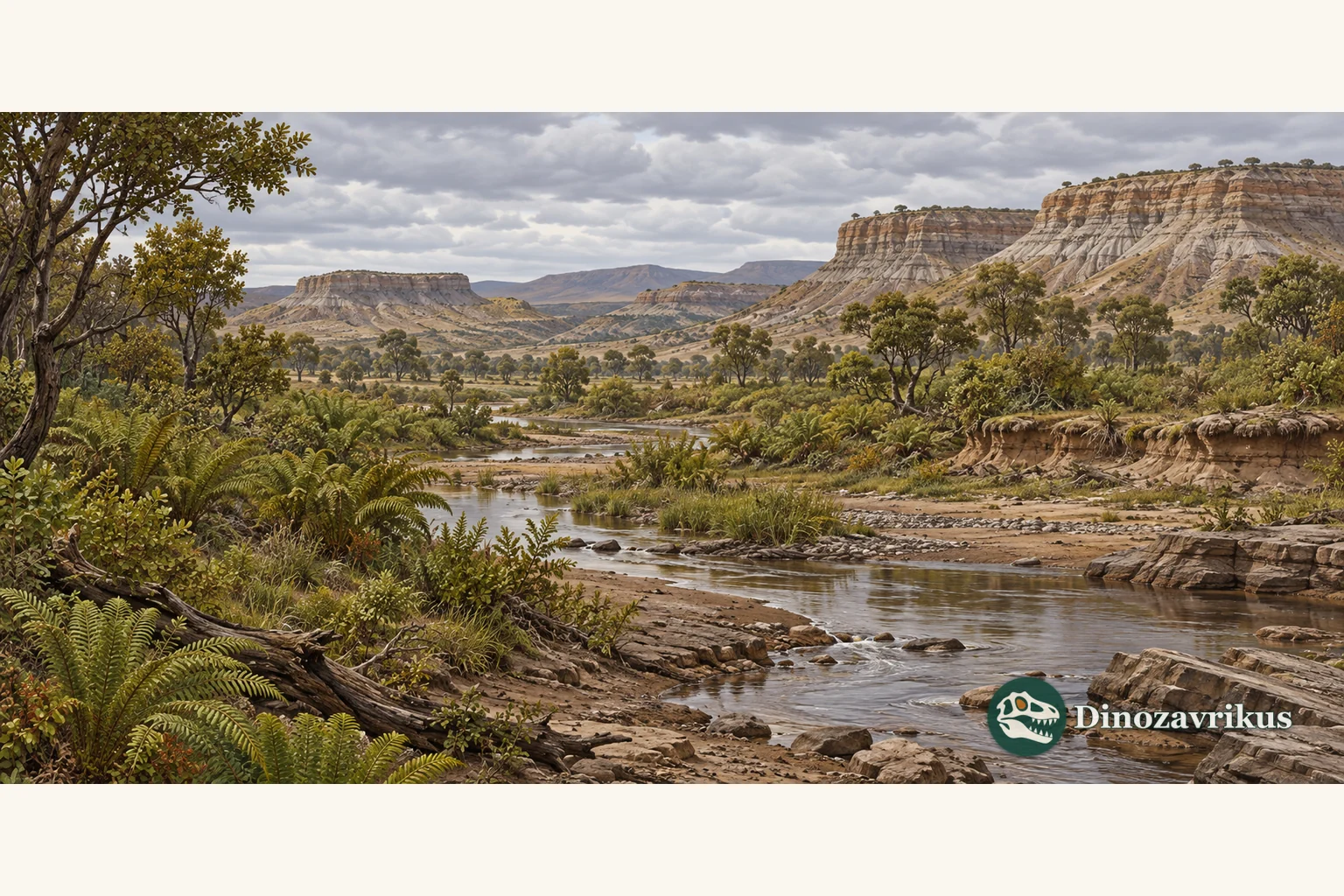
The principal specimen comes from the Cañadón Vaca Member of the Sarmiento Formation in Chubut Province. The member is middle Eocene, and the associated Vacan South American land-mammal subage is commonly placed near 45 million years ago. Published age ranges for the sedimentary unit are broader than a single point value, and a biochronological age should not be mistaken for a radiometric date taken from this fossil.
Patagonia in the middle Eocene supported a diverse mammal fauna. Depositional context and associated fossils help reconstruct the regional environment, but the skeleton alone does not reveal the vegetation immediately around the animal. A woodland or open-habitat scene in artwork is therefore a reasoned setting rather than a preserved view of the locality.
The broader Palaeogene record shows South American mammal communities developing while the continent remained geographically isolated from most other landmasses. That context helps explain the distinctiveness of notoungulates, but does not identify the exact ecological role of Thomashuxleya.
Skull, teeth and body proportions
The skull of MPEF-PV 8166 is about 28 centimetres long. Its proportions, jaw and cheek teeth can be described directly from the specimen. The associated shoulder girdle, pelvis and limb bones add information about the rest of the skeleton that is missing from many notoungulates known only from teeth. No single bone, however, preserves muscle volume, cartilage or the external outline of the living animal.
Dental form supports a herbivorous interpretation typical of notoungulates, but the fossils do not establish a narrow menu such as leaves, fruit or particular ground plants. Wear and tooth shape reflect how food was processed; they do not name every item eaten. There is no reported stomach content tied to this individual.
Mass, growth and what the skeleton cannot tell us
A published estimate places the mass of the individual represented by MPEF-PV 8166 at roughly 84 kilograms. This figure is model-derived, not a scale measurement. Different skeletal elements and allometric equations can produce substantially different values, especially when the chosen comparison group differs in body shape. It is more useful as an approximate scale than as a precise weight.
Bone histology has been used to examine skeletal maturity and growth. Remodelling and an outer circumferential layer point to a mature individual, even though some epiphyses remained unfused. Fusion does not proceed at the same rate in every bone, so an unfused joint surface alone cannot be treated as proof of youth.
Phylogenetic analyses continue to test how Thomashuxleya relates to other early notoungulates. The associated skeleton adds characters that tooth-only taxa cannot provide, yet the result depends on character selection, taxon sampling and the condition of the fossils. Its coat, colour, exact gait, social behaviour and reproductive biology remain outside the direct evidence.
Frequently asked questions
When did Thomashuxleya live?
The best-known material comes from the Vacan fauna of the middle Eocene in Patagonia, commonly placed near 45 million years ago. The age is based on geological and biochronological context.
What is the best-known Thomashuxleya fossil?
MPEF-PV 8166 is an associated specimen of T. externa with an almost complete skull and mandible and substantial parts of the postcranial skeleton.
How large was Thomashuxleya?
The skull of MPEF-PV 8166 is about 28 centimetres long. One model estimates the individual's mass at roughly 84 kilograms, but estimates vary with the element and scaling method.
What did it eat?
Its teeth support a plant-processing interpretation, but no stomach contents identify a particular diet. A more specific menu remains an inference rather than a direct observation.