

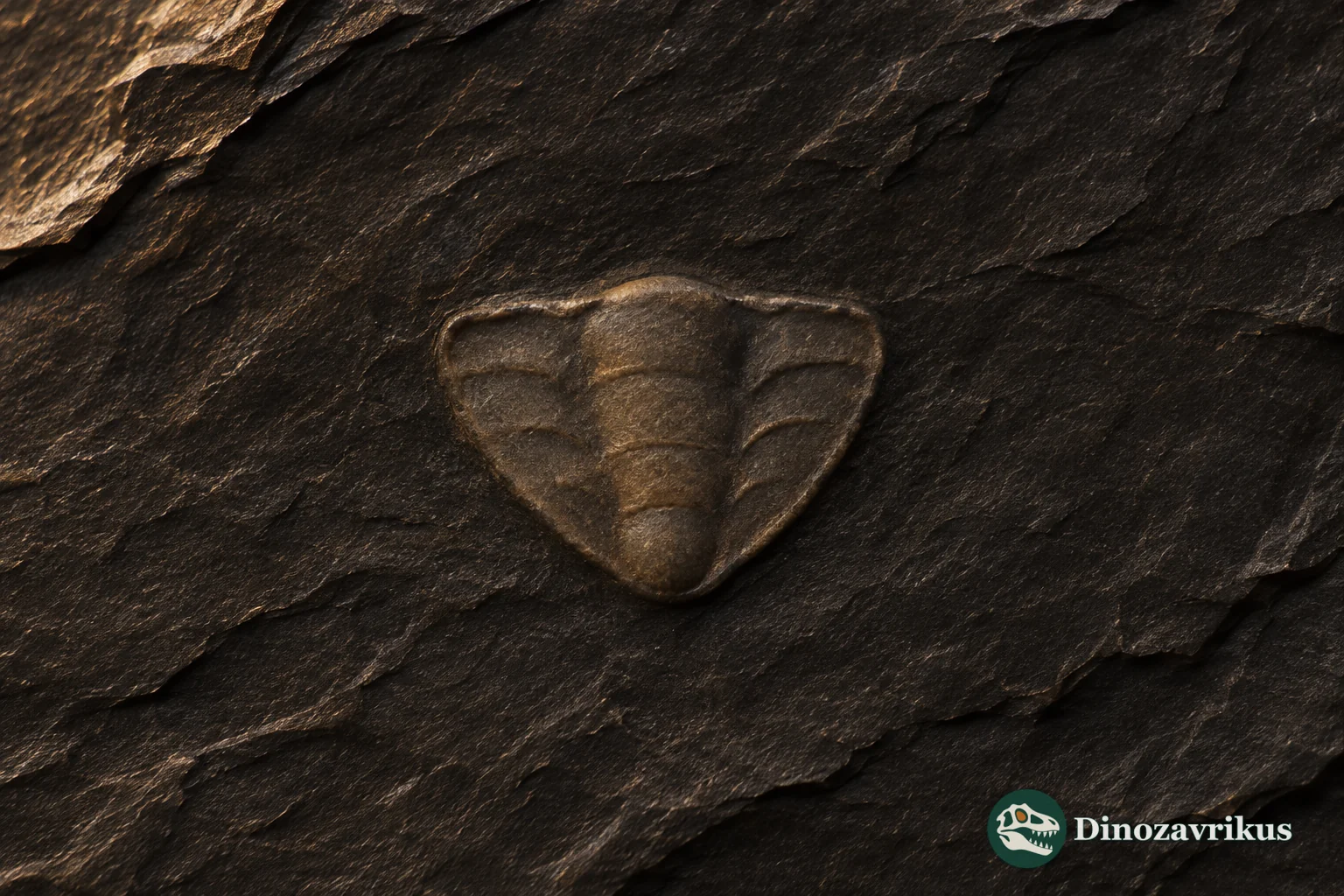
Fossils of Triangulopyge from Britain and Scandinavia passed through several names. The few-millimetre tail shield helped establish the genus. Its triangular outline and smooth margin make it easier to recognise than the closely similar head.
Quick facts
| Group | Trilobites, Olenidae |
|---|---|
| Age | Late Cambrian, Furongian |
| Region | Europe: Britain, Norway, Sweden and Denmark |
| Type species | Triangulopyge humilis |
| Scientific name | Triangulopyge |
| Diet | Unknown |
What can the fossils tell us?
Well-preserved pygidia show a smooth margin, a short segmented axis and shallow furrows on the sides.
Researchers compared separate pygidia of different sizes and inferred that axial rings were added during growth.
The high arch of the shell inspired a pelagic interpretation. Body fossils provide no direct record of swimming or feeding.
From a Malvern fossil to a new genus
John Phillips described Olenus humilis in 1848 from the White Leaved Oak Shale in the Malvern area of England. In 2012, Magne Høyberget and David Bruton made it the type species of Triangulopyge. They selected cranidium Ox A287a from the Phillips collection as the lectotype. Its central head anatomy anchors the species name. The tail features used to distinguish the genus come from other specimens.
Reading the shell from head to tail
The dorsal shell rises steeply across the body. The eyes sit far back on the head, and the rounded ends of the thoracic segments bend down at the sides. An occipital spine behind the central lobe of the head varies in length in T. humilis. Its small triangular pygidium has up to three axial rings and a terminal lobe, with shallow furrows on either side.
A long spine extends from the pygidium of Sphaerophthalmus. The edge of a Triangulopyge pygidium is unarmed. The two head shields can resemble one another, so this difference is especially useful when a tiny tail survives in the same shale.
Evidence from the Scandinavian specimens
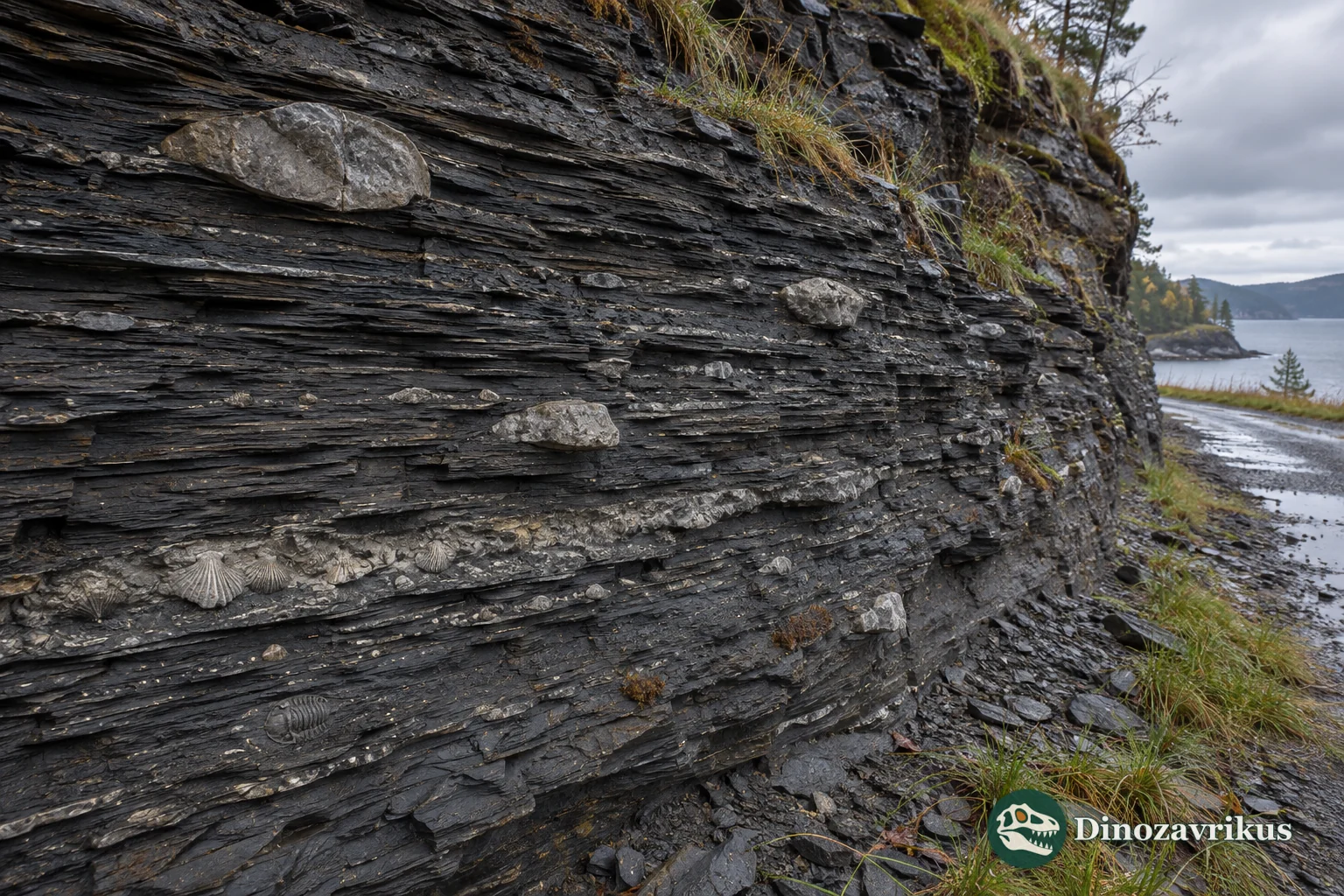
Norwegian specimens of T. humilis occur in the Ctenopyge bisulcata and C. linnarssoni zones. A fossil from Kinnekulle, Sweden, preserves eight articulated segments in front of the tail, without establishing the total segment count. Material from Bornholm in Denmark includes cranidia and pygidia.
Comparing tail shields of different sizes allowed the 2012 authors to infer that the number of axial rings increased during growth. They also suggested that the strongly arched body was compatible with life in the water column. This functional interpretation addresses the animal’s possible habitat and leaves its diet unresolved.
Frequently asked questions
What does the name Triangulopyge refer to?
It refers to the triangular shape of the tail shield, also called a pygidium.
Did Triangulopyge have a tail spine?
The tail shield had a smooth edge. A spine of variable length occurred separately on the back of the head in T. humilis.
Where was the lectotype found?
Cranidium Ox A287a came from the White Leaved Oak Shale in the Malvern area of England.
Did it live in the open water?
A pelagic way of life has been suggested from body shape. The fossils preserve anatomy and cannot reveal how much time the animal spent swimming.