

Tricleidus seeleyi was a Middle Jurassic plesiosaur described from one incomplete skeleton in the Oxford Clay of England. Its skull was comparatively short and broad, its upper teeth were slender and pointed, and the neck was reconstructed at roughly three times the skull length. These observations come from disarticulated bones, so the animal's complete outline and exact proportions remain uncertain.
Quick facts
| Type species | Tricleidus seeleyi |
|---|---|
| Age | Middle Jurassic, Callovian |
| Locality | Peterborough, Cambridgeshire, England |
| Formation | Oxford Clay Formation |
| Type specimen | NHMUK PV R3539, an incomplete disarticulated skeleton |
| Notable anatomy | Short broad skull, pointed teeth and a stout humerus |
| Body length | No secure measurement of a complete skeleton |
Evidence guide
The specimen includes skull bones and a mandible, vertebrae, ribs, shoulder-girdle elements and incomplete paddles. Several cranial bones are crushed or broken; no complete articulated skeleton is available.
The 1910 catalogue lists five premaxillary and fifteen maxillary teeth per side. The teeth are described as long, slender and sharply pointed, with enlarged anterior maxillary teeth. These features do not directly establish diet.
The early catalogue counted about 26 cervicals, including the atlas and axis. The published count comes from incomplete material and should not be treated as a complete preserved series.
Comparative studies discuss Tricleidus with Jurassic cryptoclidids such as Cryptoclidus and Muraenosaurus. Relationships depend on the anatomical characters and incomplete fossils included in each analysis.
From the Leeds collection to a named genus
The type specimen R3539 is associated with the Leeds Collection and the Oxford Clay exposures around Peterborough, Cambridgeshire. Charles William Andrews described Tricleidus seeleyi in 1909; his 1910 catalogue of Oxford Clay marine reptiles provided a fuller account of the anatomy. The specimen is now catalogued by the Natural History Museum, London, as NHMUK PV R3539.
R3539 is not a complete articulated skeleton. It includes separated skull bones and a mandible, cervical and a small number of trunk vertebrae, ribs, shoulder-girdle elements, incomplete front paddles, part of a pelvis and fragments of the hind paddles. Some skull bones are crushed or broken. The specimen provides a collection of anatomical observations, not a finished life-sized blueprint.
The Oxford Clay Formation is Middle Jurassic and Callovian in age. Its marine sediments preserve a rich assemblage of reptiles and other organisms. The age comes from the geological sequence around the fossil, not from a direct measurement of the bones themselves.
A short skull and sharply pointed teeth
Andrews characterised the skull as short and broad compared with those of related plesiosaurs. The 1910 catalogue lists twenty upper teeth on each side: five in the premaxilla and fifteen in the maxilla. The teeth are described as long, slender and sharply pointed, with the front maxillary teeth enlarged. Because the skull bones are separated and incomplete, those counts and proportions should be understood within the limits of the preserved specimen.
Pointed teeth are compatible with grasping prey, but tooth shape alone does not reveal a complete menu. No stomach contents or other direct dietary evidence are known from the type specimen. A specific prey list would go beyond what the fossil records.
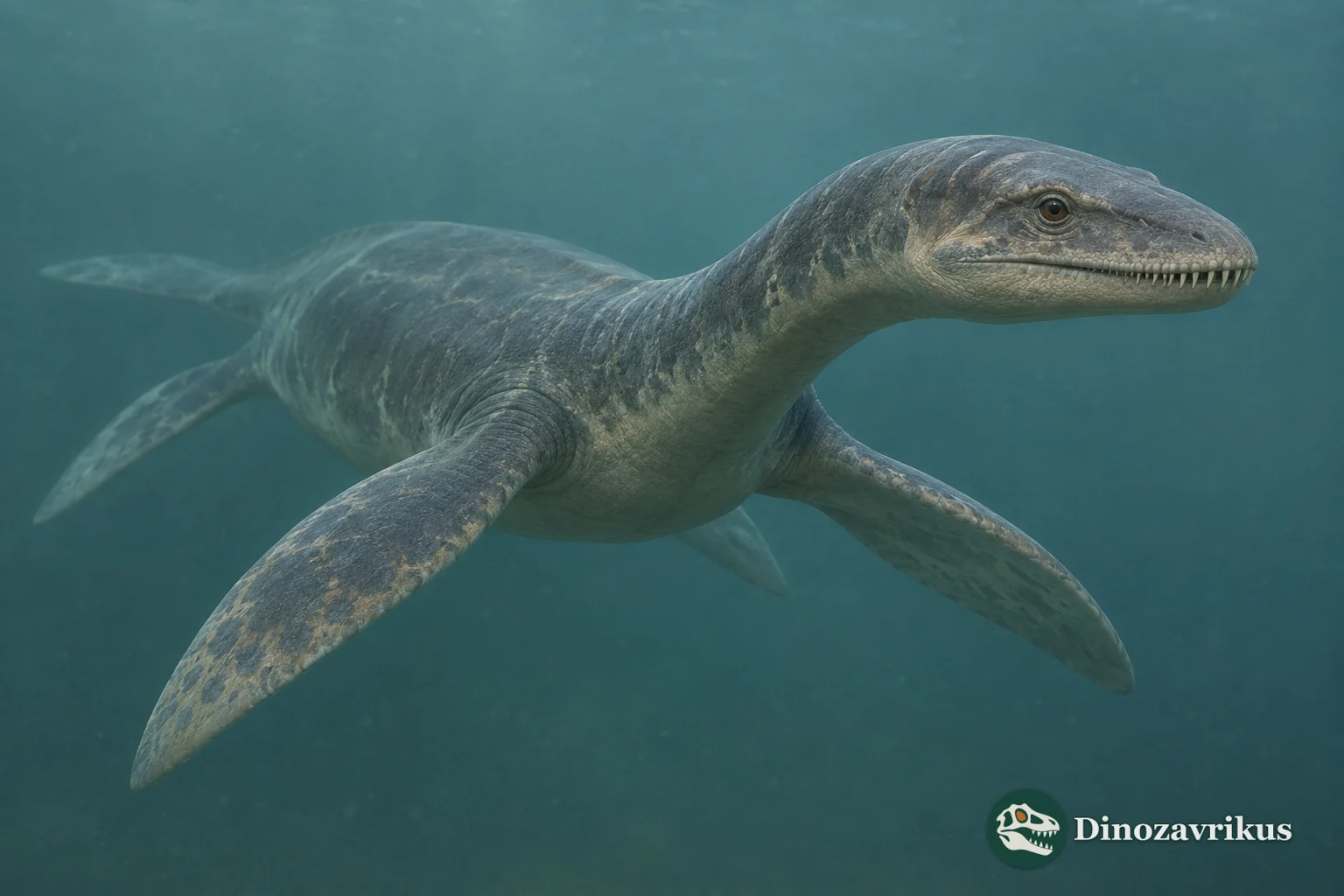
Neck, shoulder girdle and paddles
The early catalogue reconstructed roughly 26 cervical vertebrae, including the atlas and axis. The neck was described as more than three times the skull length, and the vertebral centra were much wider than high with strongly concave joint surfaces. The count and proportion are estimates from incomplete material, not measurements of a fully preserved neck.
The shoulder girdle includes a large interclavicle and well-developed clavicles. Andrews described a stout humerus that was not greatly expanded at its distal end and articulated with several elements of the fore paddle. The femur was more slender than the humerus. These features document bone shape and joint surfaces; they do not record a precise swimming stroke.
Plesiosaurs had four paddle-like limbs, but R3539 preserves the paddles incompletely. The illustration here is a cautious life reconstruction rather than a diagram of the known bones. The profile of the later Jurassic Tatenectes offers another example of how isolated skeletal proportions can shape a reconstruction without fixing its soft-tissue outline.
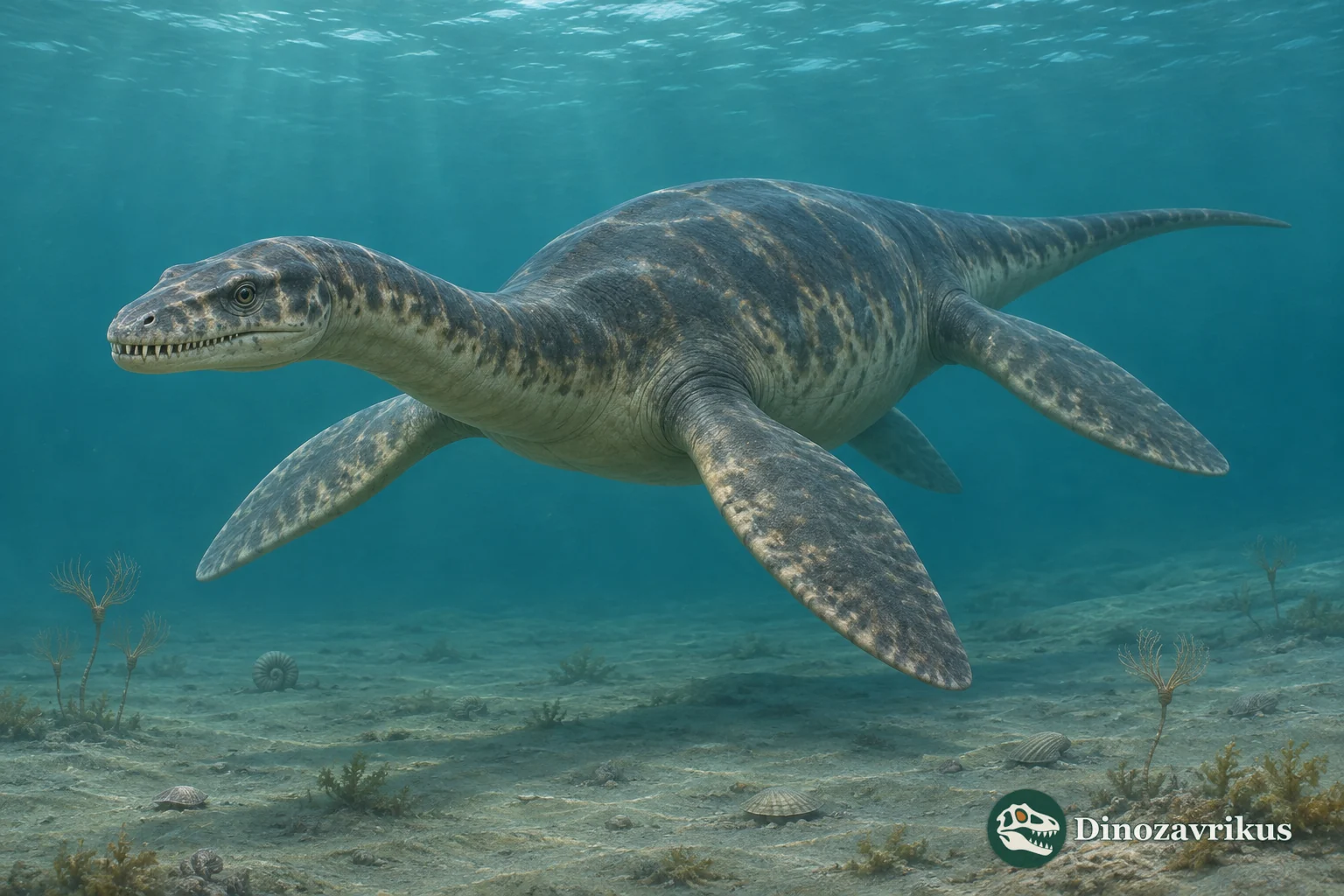
Taxonomic placement and what remains unknown
Tricleidus is usually discussed among cryptoclidid plesiosauroids from the Oxford Clay. Comparative studies consider it alongside Cryptoclidus and Muraenosaurus, but shared proportions do not make those genera synonyms. Phylogenetic placement depends on which characters can be scored from the incomplete fossils and which taxa enter a particular analysis.
The genus is anchored by its type species, Tricleidus seeleyi. Other specimens historically referred to Tricleidus have been reassessed, so they should not be silently merged with NHMUK PV R3539. The type specimen remains the main evidence for the species and the genus diagnosis.
No complete-body measurement, reliable mass estimate, direct evidence of diet, skin colour, growth sequence or reproductive biology can be extracted from R3539. What is established is a marine plesiosaur with a short broad skull, pointed teeth, an estimated neck count and distinctive shoulder and forelimb bones. The broader overview of plesiosaurs and pliosaurs provides context for the group without overstating what one specimen can show.
Frequently asked questions
Where was Tricleidus found?
The type material comes from Oxford Clay exposures around Peterborough in Cambridgeshire, England, and is associated with the Leeds Collection.
Is the Tricleidus skeleton complete?
No. NHMUK PV R3539 is disarticulated and incomplete, with skull bones, vertebrae, ribs, girdle elements and parts of the paddles.
What is distinctive about its teeth?
The 1910 catalogue lists twenty upper tooth positions on each side. The teeth were long, slender and sharply pointed, with enlarged anterior maxillary teeth.
How large was Tricleidus?
A secure total length has not been measured from a complete skeleton. The type specimen is too incomplete to establish a precise body length or mass.