

Trigonictis was an extinct North American mustelid compared with living South American grisons. Researchers assess its relationships through jaws and carnassial teeth, not a preserved coat or observed behavior. Important Pliocene samples come from Hagerman, Idaho, and Rexroad, Kansas; subsequent revisions changed which names were applied to the larger form.
The cover imagines a low-bodied mustelid at a wetland margin. The fur pattern and precise habitat of any individual specimen are not directly known.
Quick facts
| Group | Mustelidae, an extinct grison-like lineage |
|---|---|
| Genus | Trigonictis Hibbard, 1941 |
| Type name | T. kansasensis, later synonymized with T. macrodon |
| Commonly recognized species | Larger T. macrodon and smaller T. cooki / cookii |
| Important sites | Rexroad, Kansas, and Hagerman, Idaho |
| Age | Key Hagerman and Rexroad samples are Pliocene |
| Material | Jaws, teeth and some skeletal elements |
What can the fossils tell us?
The elongated triangular upper P4 and lower m1 with a cutting blade and basined rear portion support comparisons. A tooth cannot reveal coat pattern or prey species.
A 1981 study synonymized T. kansasensis and T. idahoensis with the older T. macrodon. The smaller Hagerman form appears as T. cooki or cookii in different publications.
A 2016 stratigraphic analysis found both species at many levels, with a gap during a cooler interval. A sampling gap is not proof that the animals vanished completely from the region.
A complicated naming history
Edward Cope described the form later called T. macrodon in the nineteenth century under another genus. In 1934 C. Lewis Gazin named a smaller Hagerman mustelid Lutravus cooki after local collector Elmer Cook. Claude Hibbard established Trigonictis in 1941 for Kansas material called T. kansasensis. Clayton Ray, Elaine Anderson and S. David Webb later compared the fossils and placed kansasensis and the Hagerman name idahoensis with the older macrodon. A type species becoming a junior synonym of an older species does not erase the genus name.
The smaller species appears as cooki and cookii in different publications. The historical account retains Gazin's spelling, while specific research is discussed under its own terminology. Synonymy rests on comparisons of jaws and teeth, not on a known ancestor-descendant sequence of individuals.
What the jaws preserve
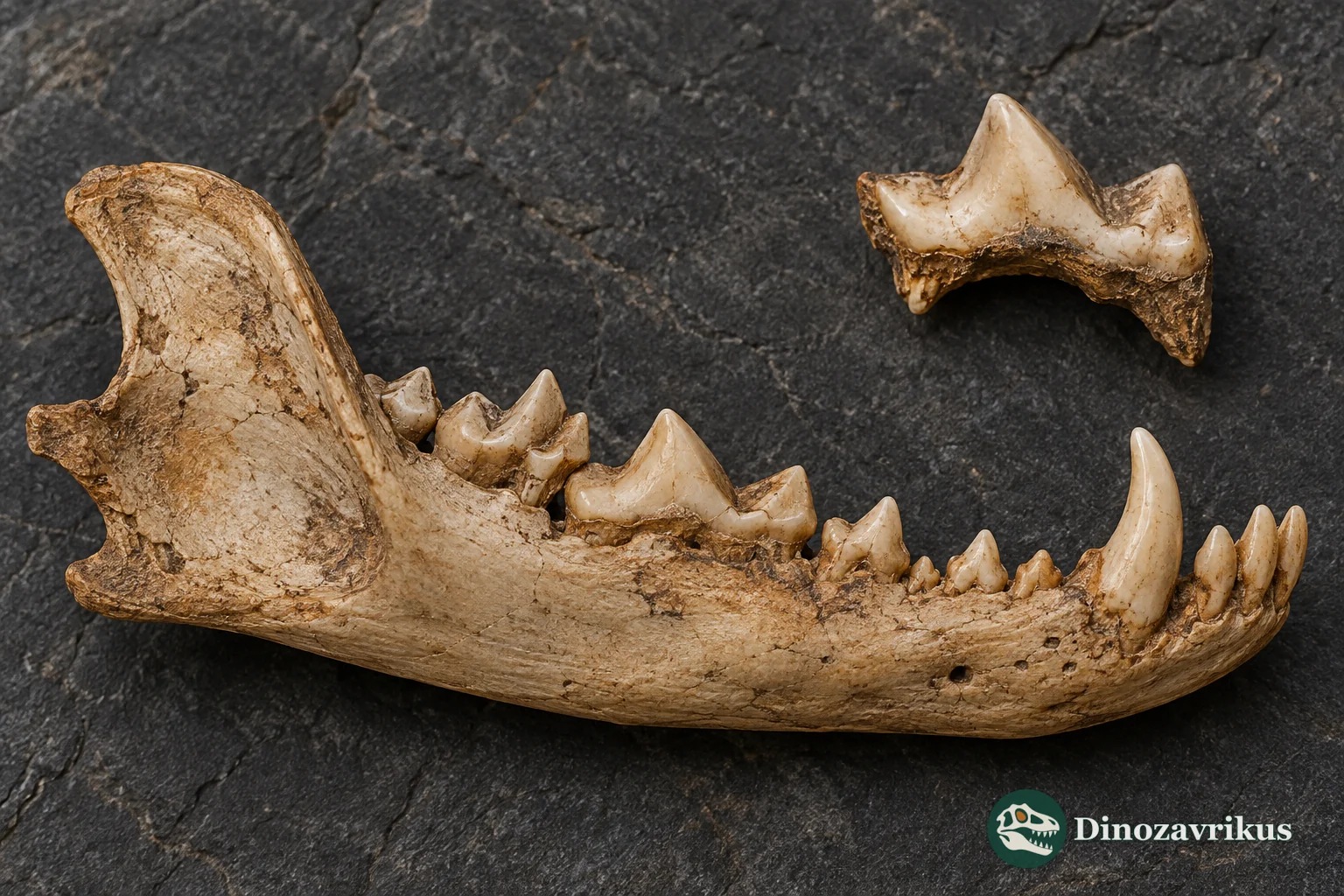
Smithsonian records for T. cooki include material collected by Elmer Cook at Hagerman in June 1930. The collection date is not the date of the species description. Gazin's original description used a lower jaw with premolars and a molar; subsequent finds include more cranial and skeletal elements.
Comparisons describe an elongated triangular upper P4 with a lingual cingulum and a lower m1 bearing a shearing blade and a basined rear portion. These characters help distinguish Trigonictis from other mustelids and compare the smaller and larger species. Cutting teeth support carnivory but do not identify exact prey. The jaw illustration is generic, not a replica of a named type.
A Pliocene sequence at Hagerman
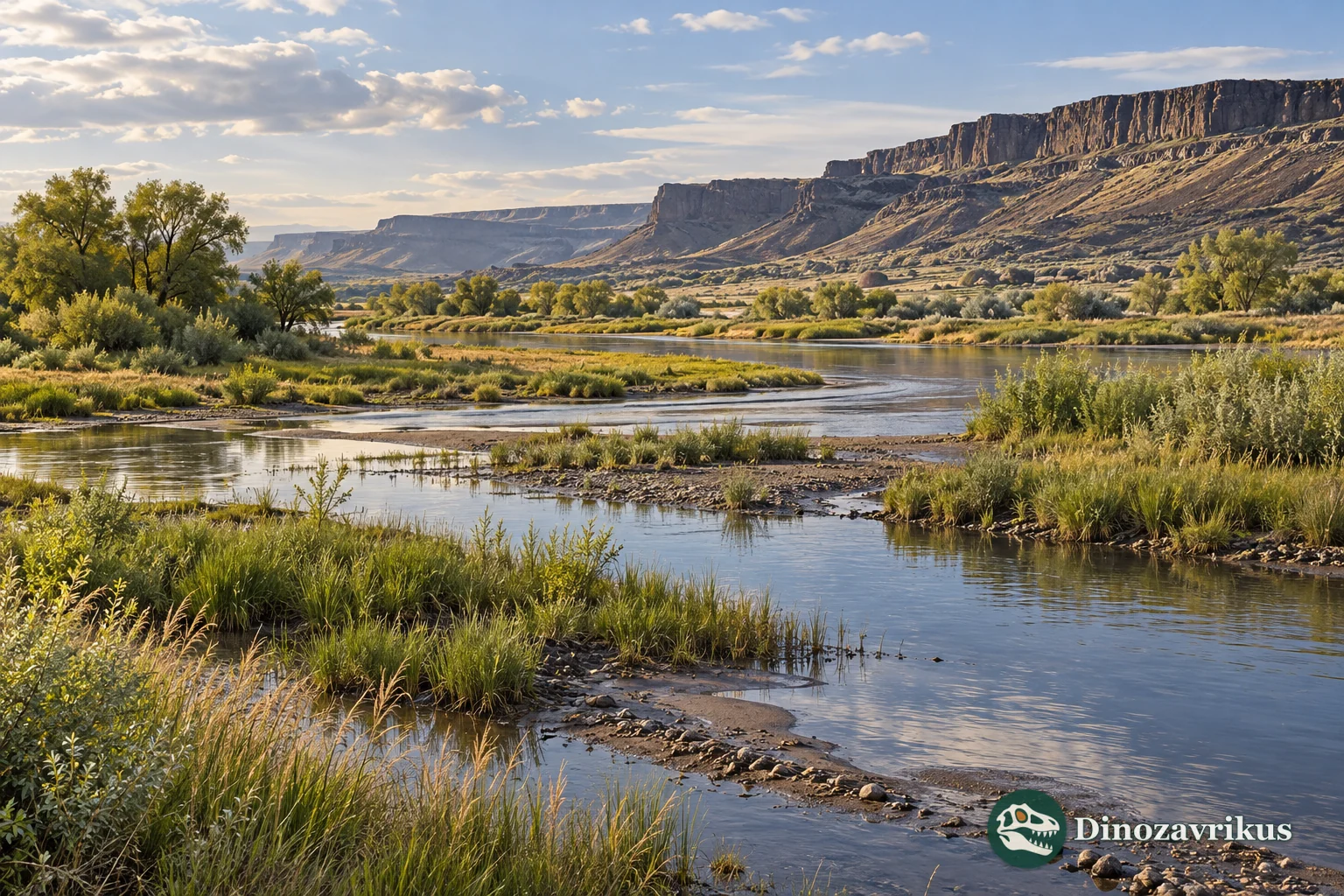
The Glenns Ferry Formation at Hagerman preserves many strata rather than a single instantaneous fauna. Dennis Ruez compared carnivoran occurrences by level and found both Trigonictis species across much of the sequence. A gap in specimens coincided with cooler conditions and less surface water. It records a sampling pattern, not proof of complete local extinction or a single cause.
The landscape illustration depicts a possible floodplain, not a documented fossil horizon. Rexroad and Hagerman differ in location and stratigraphic context. Later records sometimes extend the genus into the early Quaternary, but the Pliocene Hagerman sample must not be redated by association. Protocyon was another American carnivore, but as a canid it was not a close mustelid relative.
Kinship and reconstruction
Grison-like anatomy suggests a relationship with living mustelids, not a documented direct ancestry for each modern grison species. Body length, coat bands, hunting style and preference for wetlands versus woodland require independent evidence. The cover is a plausible artistic silhouette, not a faithful portrait of a Hagerman animal.
Frequently asked questions
Was Trigonictis a living grison?
No. It was an extinct North American mustelid compared with grisons by anatomy, especially teeth.
Why does T. kansasensis appear in older works?
Hibbard made it the genus type in 1941; a 1981 revision placed that larger form under the older species name T. macrodon.
How were the Hagerman forms separated?
Primarily by size and dental characters: the smaller cooki / cookii and larger macrodon. Individual fragments need comparison with series.
Do its fossils identify its prey?
Carnassials indicate cutting ability, but direct evidence has not established a specific prey list.