

Tritoechia is an Ordovician brachiopod genus recognised by a combination of valve shape, fine radial ribs and internal shell features. Some species have hollow costellae, but a ribbed outline by itself is not a diagnosis.
Published material comes from Oklahoma, Tasmania, Central Asia and Peru, among other regions. These collections represent different species and beds. Their shell measurements and age evidence must remain attached to the individual record. The early Palaeozoic marine fossil catalogue also includes Leptellina, another Ordovician brachiopod whose internal architecture differs.
Quick facts
| Scientific name | Tritoechia Ulrich & Cooper, 1936 |
|---|---|
| Type species | Deltatreta typica Schuchert & Cooper, 1932 |
| Group | Brachiopoda, family Tritoechiidae |
| Type area | Kindblade Formation, Arbuckle Mountains, Oklahoma |
| Type species age | Lower Ordovician, Floian |
| Diagnostic evidence | Unequally convex valves, fine ribs, occasional hollow costellae and internal plates |
| Measured sizes | T. lewisi valves to 11.8 mm wide; a T. mollesensis valve to 29.75 mm |
| Main limitation | Family-level relationships have been revised |
What can the fossils tell us?
Ulrich and Cooper established Tritoechia in 1936 for the earlier species Deltatreta typica, reported from the Floian Kindblade Formation in Oklahoma. Age and ribbing alone are not enough to identify a new specimen.
The valves are unequal in convexity and bear many fine radial ribs; some species have hollow costellae. The ventral interarea, dental plates and internal field also matter.
Published Tasmanian T. lewisi valves reach 11.8 mm wide, while a Peruvian T. mollesensis valve reaches 29.75 mm. These are separate species and collections, not one genus-wide size.
Studies have proposed different superfamily relationships for Tritoechiidae. Shell characters inform the debate but do not settle every phylogenetic question.
The type species and the genus name
The species now used as the type was described as Deltatreta typica by Schuchert and Cooper in 1932. In 1936 Ulrich and Cooper established the genus Tritoechia for it. Modern summaries place the type record in the Kindblade Formation of the Arbuckle Mountains, Oklahoma, and in the Floian Stage of the Lower Ordovician.
The type species anchors the name; it does not encompass the full variety of later species. A new fossil should be compared using shell characters, not assigned to the genus only because it is Ordovician or finely ribbed.
Tasmanian collections and named specimens
John Laurie revised Early Ordovician orthide brachiopods from southern Tasmania in 1980. His figures include a series of T. lewisi specimens from the Florentine Valley Formation, including UTGD 97366, 97368, 97371, 97374–97376 and 97380–97385. The new species T. florentinensis was based on holotype UTGD 97410, from the Florentine Road locality near the Gap.
These collection numbers and localities refer to specific figured material. They should not be transferred to the Oklahoma type species or to other Tasmanian species.
Ribs, valves and internal anatomy
The shell is biconvex but the dorsal and ventral valves are not equally deep. The exterior carries many fine ribs that branch or increase between earlier ribs during growth. Some described species have hollow costellae. Their number and position vary, so a well-preserved surface and magnified examination are useful.
The interior of the ventral valve may preserve long, slightly divergent dental plates and a muscle field. The dorsal valve preserves its own cardinal structures. In T. lewisi, Laurie described an oval to semicircular outline and rare hollow costellae. Other species differ in convexity, groove and ornament.
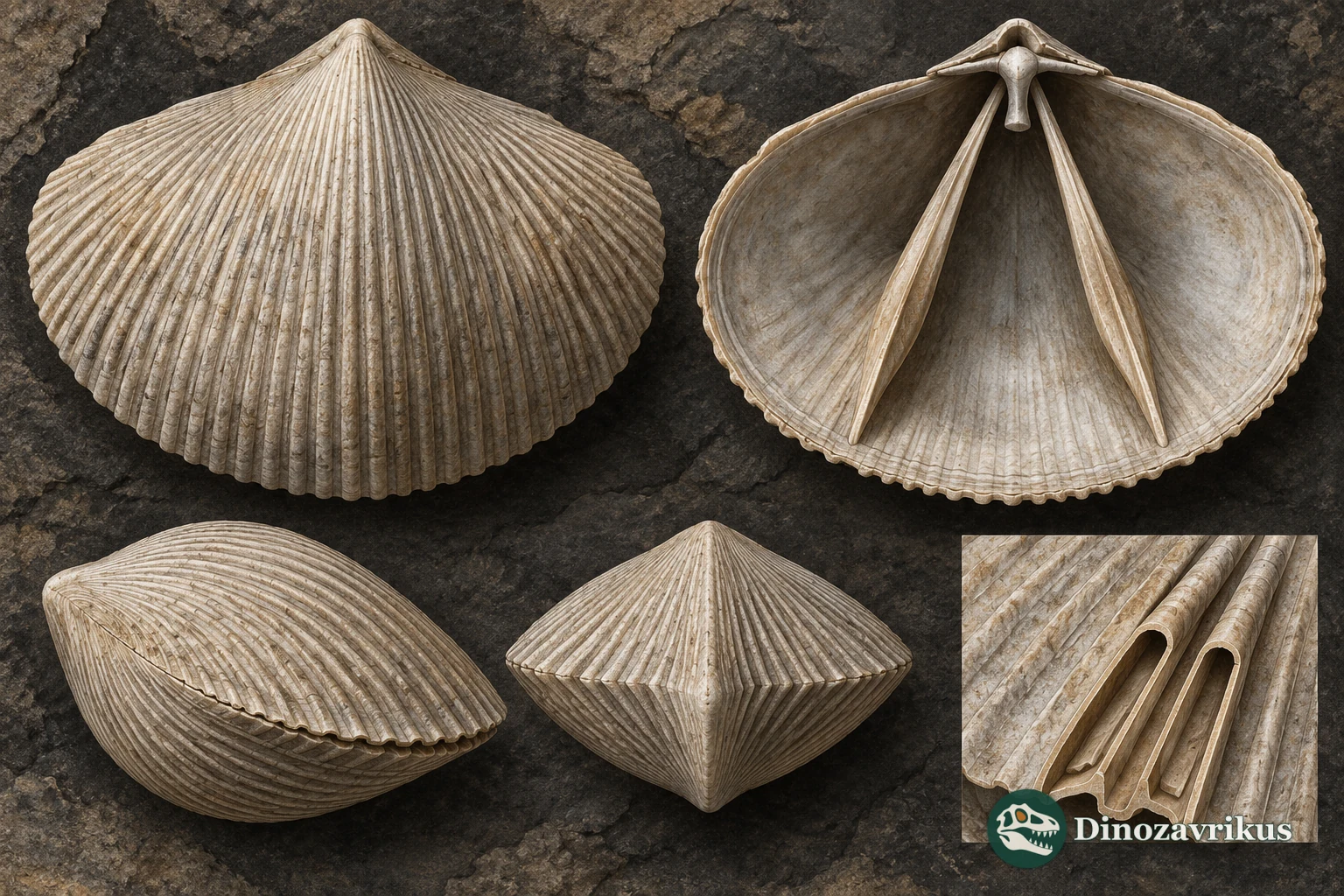
Measurements differ between species
Laurie reported T. lewisi valves up to 11.8 mm wide and 10.4 mm long. A later study of T. mollesensis from Peru described a largest measured valve 29.75 mm wide. The values come from different species and regional collections; they are not competing estimates for one animal.
Internal molds can preserve a measurable valve after the shell itself has been lost. A useful measurement states which valve and specimen were measured. An artistic reconstruction cannot supply a genus-wide length.
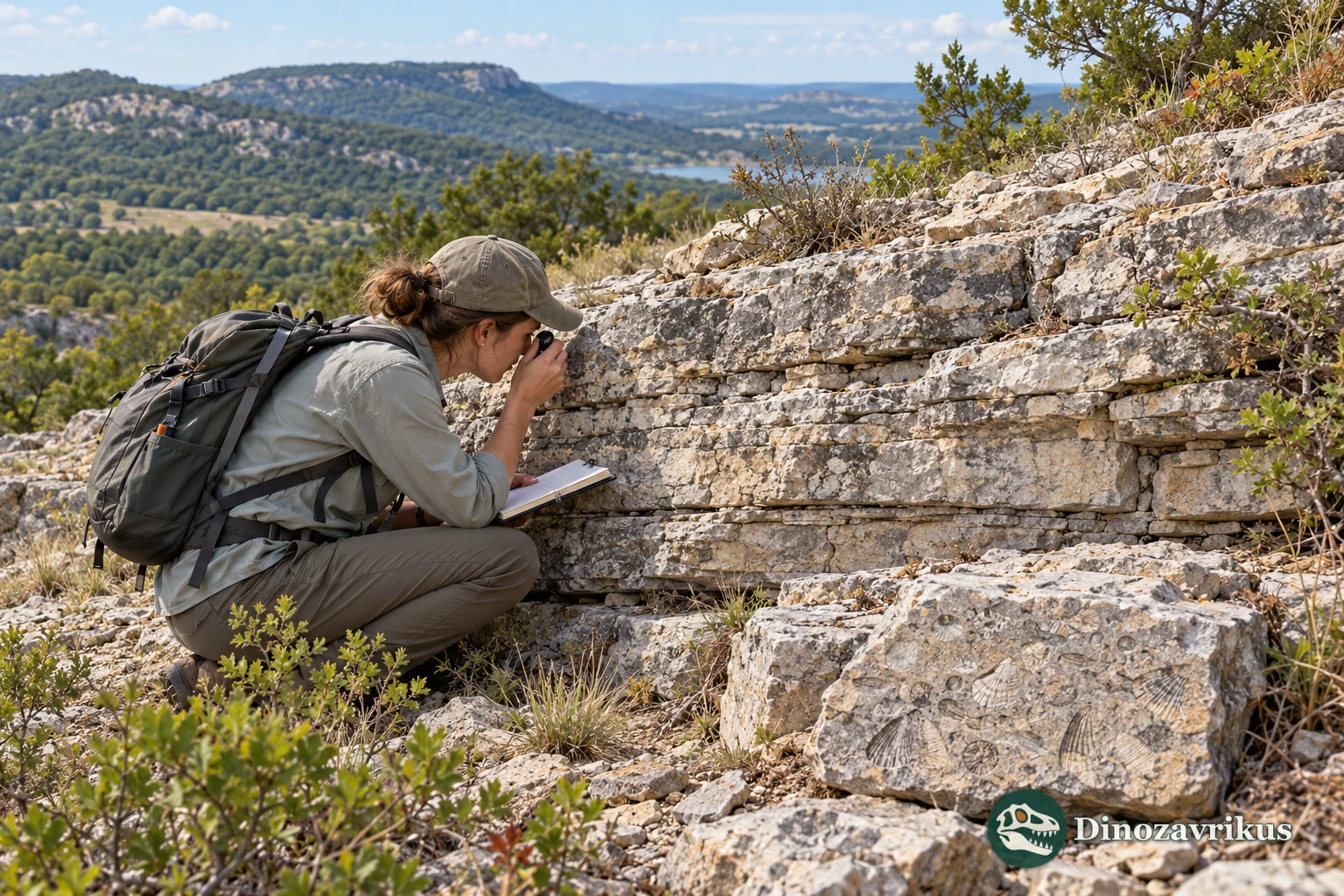
Ordovician age and geography
The type species comes from Lower Ordovician rocks in Oklahoma. Several Tasmanian species occur in Early Ordovician strata. A revision of Tritoechiidae from Kazakhstan and the South Urals covered an interval from the upper Tremadocian to lower Caradocian in the historical zonation used by that study. The Peruvian T. mollesensis is reported from middle Darriwilian beds of the San José Formation.
These reports show a long published span, but the genus-level range depends on which species assignments survive later review. Reassigning a species can change both the known range and map.
Feeding and life on the seafloor
The shell supports a benthic brachiopod interpretation. Living brachiopods capture suspended particles with a lophophore, so suspension feeding is inferred for fossil Tritoechia from group biology. The soft tissue is not preserved in the known specimens.
Shells do not identify a precise diet, daily activity or swimming behaviour. Articulated valves, attachment structures and burial orientation may help reconstruct posture, but evidence for one species should not be applied to the entire genus.
Changing family relationships
Early classifications associated Tritoechia with Polytoechiidae. Later work recognised Tritoechiidae as a separate family and revised its contents. Popov and colleagues in 2001 compared nine species from Kazakhstan and the South Urals and argued for a relationship with billingsellids. Later regional studies have used a different superfamily placement.
The disagreement concerns how shell characters map onto ancestry, not whether the fossils exist. Family and superfamily placement can change as new material and character analyses become available.
Frequently asked questions
What is the type species of Tritoechia?
The type species is Deltatreta typica, described in 1932 and placed in Tritoechia by Ulrich and Cooper in 1936.
How can Tritoechia be recognised?
Researchers compare unequal valve convexity, fine ribs, occasional hollow costellae, the interarea and internal plates. No single exterior feature is sufficient.
How large was Tritoechia?
There is no one genus-wide size. Reported valves include T. lewisi up to 11.8 mm wide and a T. mollesensis valve 29.75 mm wide.
What did Tritoechia eat?
Its exact diet is unknown. Suspension feeding is inferred from brachiopod biology; soft feeding structures and stomach contents are not preserved.