

Leptellina is a genus of marine brachiopods known from fossil shells and their impressions. Its name is tied to the type species Leptellina tennesseensis, described from Ordovician rocks in Tennessee. Later records from other regions broaden the comparison, while also making the genus harder to diagnose from a ribbed outline alone.
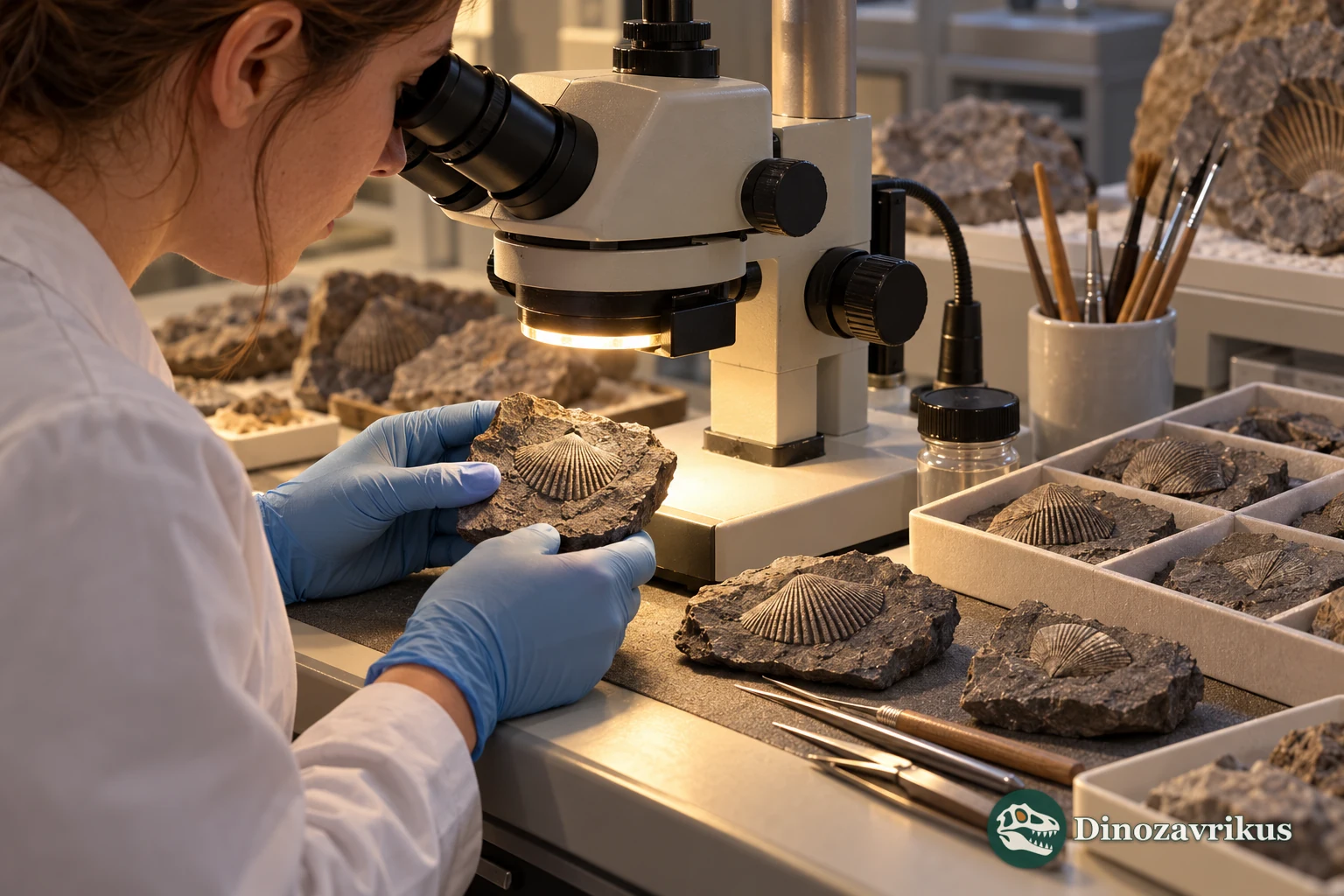
External molds, internal casts and shells with both valves preserve different parts of the evidence. They document shape, ornament and some internal supports. Soft tissues, colour and exact behaviour are absent, so ecological reconstructions must stay cautious. Other brachiopods in the early Palaeozoic marine fossil catalogue, including Tritoechia, provide useful comparisons without implying that the genera are interchangeable.
Quick facts
| Scientific name | Leptellina Ulrich & Cooper, 1936 |
|---|---|
| Type species | Leptellina tennesseensis |
| Type specimen | Holotype USNM 92871, Smithsonian National Museum of Natural History |
| Group | Brachiopoda, Rhynchonelliformea, Strophomenida |
| Age of documented examples | Middle to Late Ordovician; each collection needs its own age assessment |
| Known material | External and internal molds, casts and some complete shells |
| Size | No single genus-wide length or width is established |
| Main limitation | Several species names and generic assignments have been revised |
What can the fossils tell us?
Ulrich and Cooper designated L. tennesseensis as the type species. Holotype USNM 92871 anchors the name, but it does not validate every later fossil once assigned to Leptellina.
Published material is compared by valve outline, convexity, radial ribs and internal cardinal structures. Compression and incomplete preservation can hide diagnostic details.
The type species is associated with Tennessee; L. occidentalis was described from Nevada and L. qianjiangensis from China. These records do not represent one species or one bed.
Fossils preserve shell geometry and some internal supports. Colour, exact diet and lophophore motion are not directly recorded; suspension feeding is inferred from brachiopod biology.
The name and its type specimen
Edward Oscar Ulrich and Gustav Arthur Cooper established Leptellina in 1936 and designated L. tennesseensis as its type species. Cooper later figured holotype USNM 92871, including external and internal views. The specimen is held by the Smithsonian National Museum of Natural History.
The type locality lies near Friendsville, Tennessee. Mid-twentieth-century literature refers to the Arline Formation, while later stratigraphic work places the relevant upper interval in the Lenoir Formation and dates it to the upper Darriwilian. Formation terminology changed between schemes; the locality and bed should be evaluated from the source rather than treated as identical labels.
A holotype fixes the use of a name. It need not be the largest or most complete specimen, and it does not automatically confirm every geographically distant record assigned to the genus.
Records from Nevada and China
Leptellina occidentalis was described from the Antelope Valley Limestone of Nevada. USGS reports cite specimens including USNM 160824a–b and discuss variation in shell outline. Outline alone therefore cannot always separate species, especially when a valve is compressed or incomplete.
Late Ordovician material from Zhejiang, China, is associated with L. qianjiangensis, first named Qianjiangella qianjiangensis. Later authors treated Qianjiangella as a junior synonym of Leptellina after comparing morphology, including external molds and an internal mold. Similar age or geography by itself is not enough to transfer a new specimen to that species.
Shell anatomy and identification
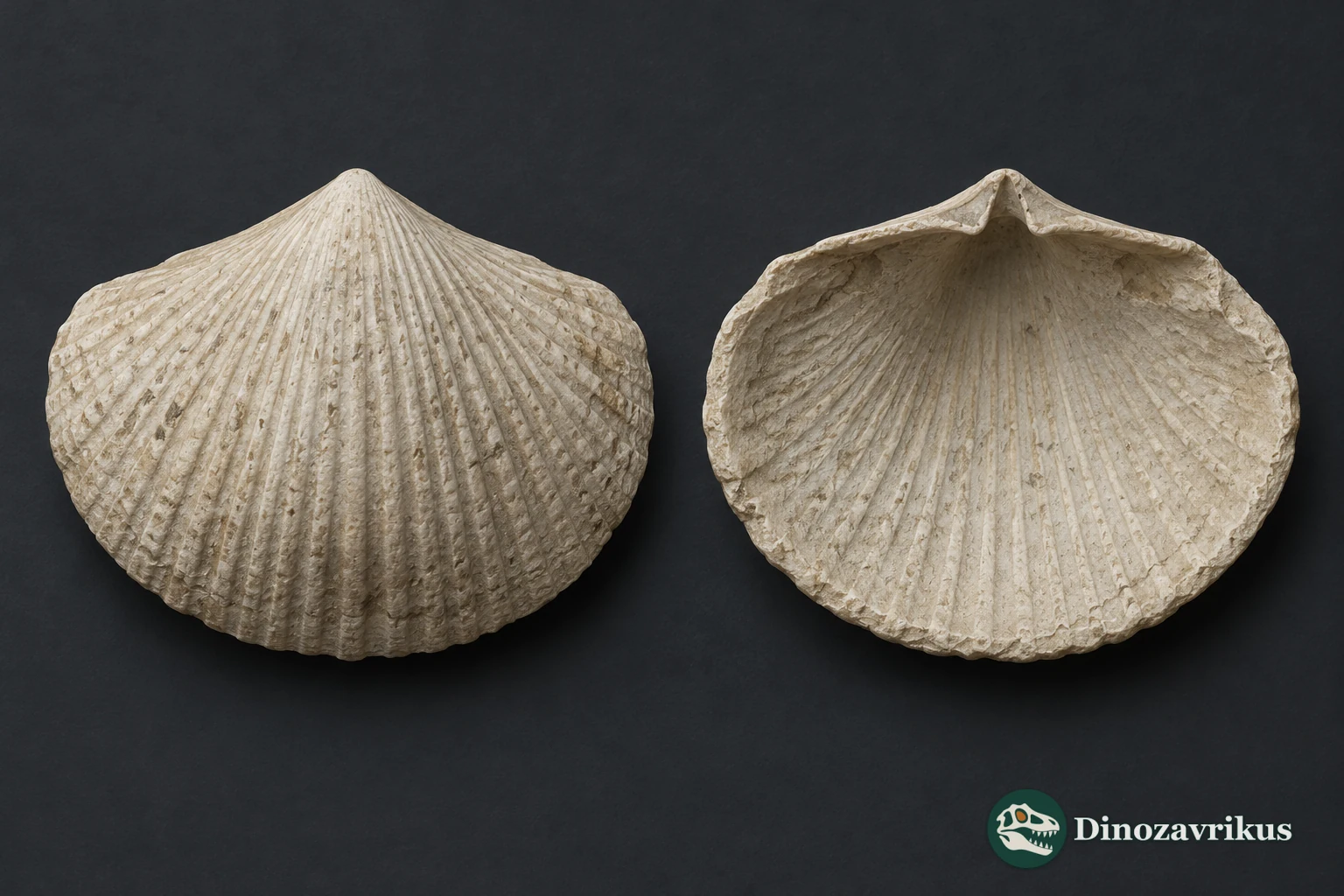
A brachiopod shell has a dorsal and a ventral valve, not left and right halves like a bivalve mollusc. In strophomenides, the valves may differ strongly in convexity. Researchers compare outline, width, curvature, radial ribs and the structures near the hinge.
Internal molds can reveal cardinal structures and muscle fields. An external mold may preserve ribs while concealing the interior. Reliable assignments use multiple characters and compare a specimen with the type species and published revisions. A single shell fragment may not preserve enough information for a confident genus-level identification.
Measurements, age and environment
There is no universal body length for Leptellina. Paleontologists measure particular valves and specify species, orientation and preservation. An incomplete mold cannot be turned into a precise whole-animal estimate, and an illustration is not a measurement.
The type species is associated with Middle Ordovician Tennessee, while L. qianjiangensis is reported from Late Ordovician strata in China. Nevada collections add other occurrences. These carbonate settings record distinct marine basins; they do not establish one uniform habitat for every species in the genus. A formation age is also not the exact date when an individual animal lived.
Feeding and limits of reconstruction
Brachiopods are suspension feeders: a lophophore captures particles from water. For fossil Leptellina, this is an inference from the group's biology, not a direct observation of stomach contents or feeding motion. Ribs do not identify a precise food source.
The valves support a benthic way of life, but they do not always show whether a species stood attached, rested on sediment or shifted position slightly. Without species-specific evidence from attachment structures, articulated shells and burial orientation, a single posture should not be generalized to the whole genus.
Changing names and classification
The synonymy of Qianjiangella qianjiangensis illustrates how comparisons can alter generic boundaries. It does not mean every similar Chinese fossil should be renamed. Researchers still need the external and internal characters that support the revised assignment.
Leptellina is commonly placed in Leptellinidae, but family and subfamily limits have changed across brachiopod classifications. A ribbed shell that resembles Paurorthis is not thereby a close relative; hinge and internal characters matter as well.
Frequently asked questions
What is the type species of Leptellina?
Leptellina tennesseensis, designated by Ulrich and Cooper when they established the genus in 1936.
Where have Leptellina fossils been reported?
Published species include the Tennessee type record, L. occidentalis from Nevada and L. qianjiangensis from China. Each occurrence has its own geological context.
Is Qianjiangella a separate genus?
Later brachiopod revisions treated Qianjiangella as a junior synonym of Leptellina based on shell comparisons.
How large was Leptellina?
There is no single size for the genus. Published measurements refer to particular species and valves, and should not be replaced by an estimate from artwork.