

Tullochelys was named from shells found in Montana. The finds date to the end of the Cretaceous and the beginning of the Paleocene. Broad rounded lobes on the lower shell provide some of the best evidence for its evolutionary relationships.
Quick facts
| Group | Turtles, chelydroid lineage (Chelydroidea) |
|---|---|
| Age | Late Cretaceous (Maastrichtian) and early Paleocene (Danian) |
| Region | North America (Montana, United States) |
| Type species | Tullochelys montana |
| Known fossils | Shells and shell fragments |
| Strata | Hell Creek Formation and Tullock Member of the Fort Union Formation |
| Age of the holotype | Early Paleocene |
| Scientific name | Tullochelys |
| Diet | Exact diet unknown |
What can the fossils tell us?
Material referred to Tullochelys comes from the Hell Creek Formation in Montana, here dated to the Maastrichtian.
The holotype comes from the early Paleocene of Montana. The original description includes shells from the Tullock Member of the Fort Union Formation.
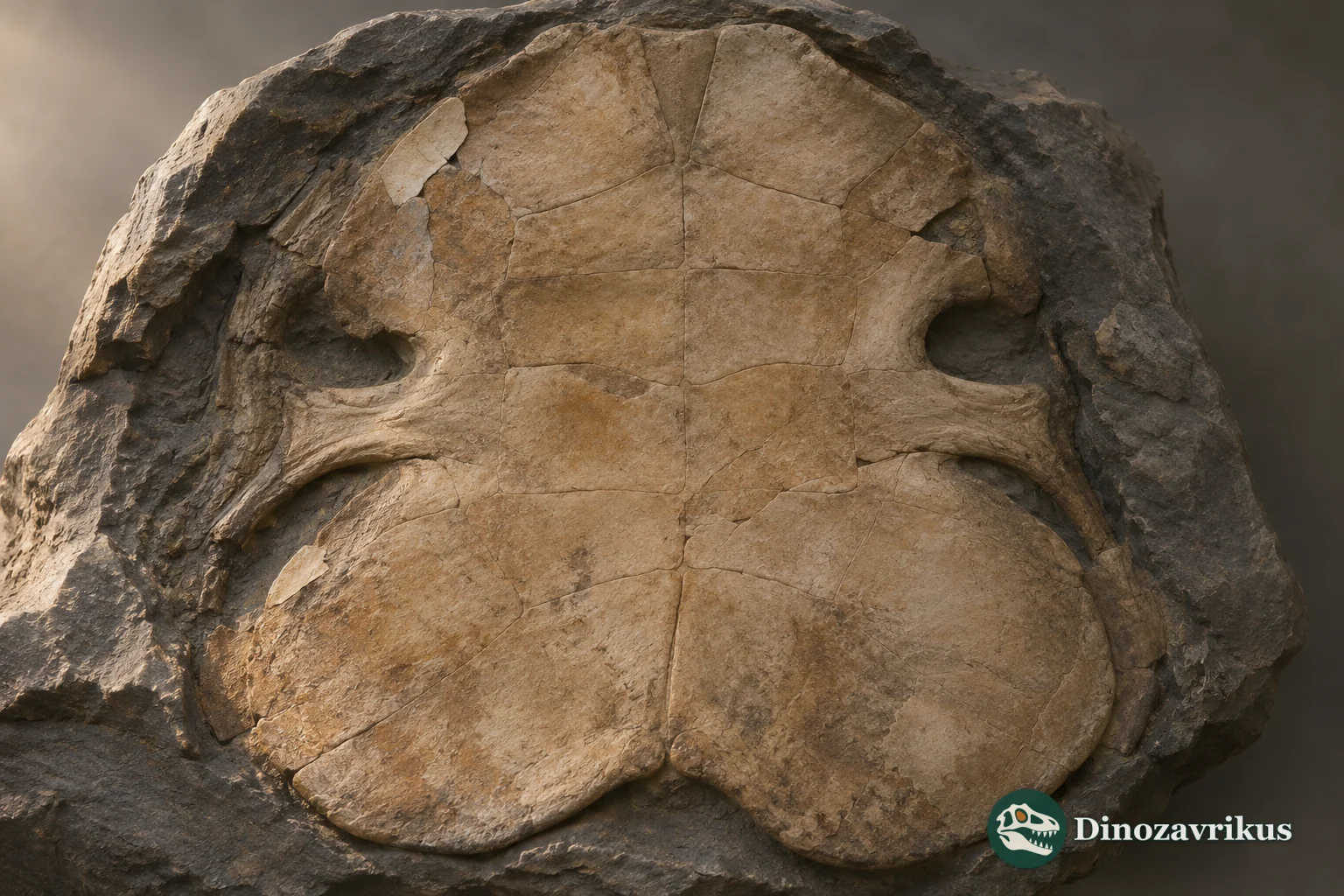
The lower shell has broad lobes at the front and back. Four inframarginal scutes lined each side between the upper and lower parts.
Two fossil-bearing horizons
Howard Hutchison named the genus in 2013. Its holotype comes from the early Paleocene of Montana, from a period known in North American mammal biostratigraphy as the Puercan. Finds from the Tullock Member and the Hell Creek Formation record the genus across the Cretaceous–Paleogene boundary.
The species appeared as Tullochelys montanus in the original description. Later studies use Tullochelys montana for the same fossil species.
What the lower shell preserves
The plastron had broad lobes with rounded margins. A relatively wide bridge connected the upper and lower shell on either side. Boundaries impressed in the bone show four inframarginal scutes on each side.
The width of the bridge is one feature used to compare Tullochelys with other fossil turtles. The larger early Paleocene Tavachelydra stevensoni has three inframarginals and thinner bones at the front of the plastron. Differences like these can be scored even when the shell is incomplete.
Where the genus fits among turtles
Hutchison originally put Tullochelys on the snapping-turtle lineage. Walter Joyce and Jason Bourque later placed it on the branch leading to mud and musk turtles. In a 2025 analysis, Tullochelys fell on the stem of the wider group that includes both lineages, while Emarginachelys remained on the kinosternoid branch.
The fossils establish the anatomy of the shell. The head and precise diet of Tullochelys remain uncertain.
Frequently asked questions
Where was Tullochelys found?
In Montana, in the Hell Creek Formation and the Tullock Member of the Fort Union Formation.
How old is the type specimen?
It comes from early Paleocene deposits of Puercan age in Montana.
What shape was the lower shell?
Its front and rear lobes were broad and rounded. A broad bridge connected the lower and upper parts at the sides.
How is Tullochelys classified?
Studies have placed it near snapping turtles or mud and musk turtles. A 2025 analysis recovered it on the stem of their combined group.