

Tyrrellbatrachus was a Late Cretaceous frog from what is now Alberta, Canada. All seven known bones are fragments of the maxilla, one of the bones of the upper jaw. Their shape distinguishes the species and shows that this bone was toothless.
Quick facts
| Group | Frogs, Anura |
|---|---|
| Age | Late Cretaceous, Campanian |
| Region | North America: Alberta, Canada |
| Type species | Tyrrellbatrachus brinkmani |
| Scientific name | Tyrrellbatrachus |
| Diet | Unknown |
What can the fossils tell us?
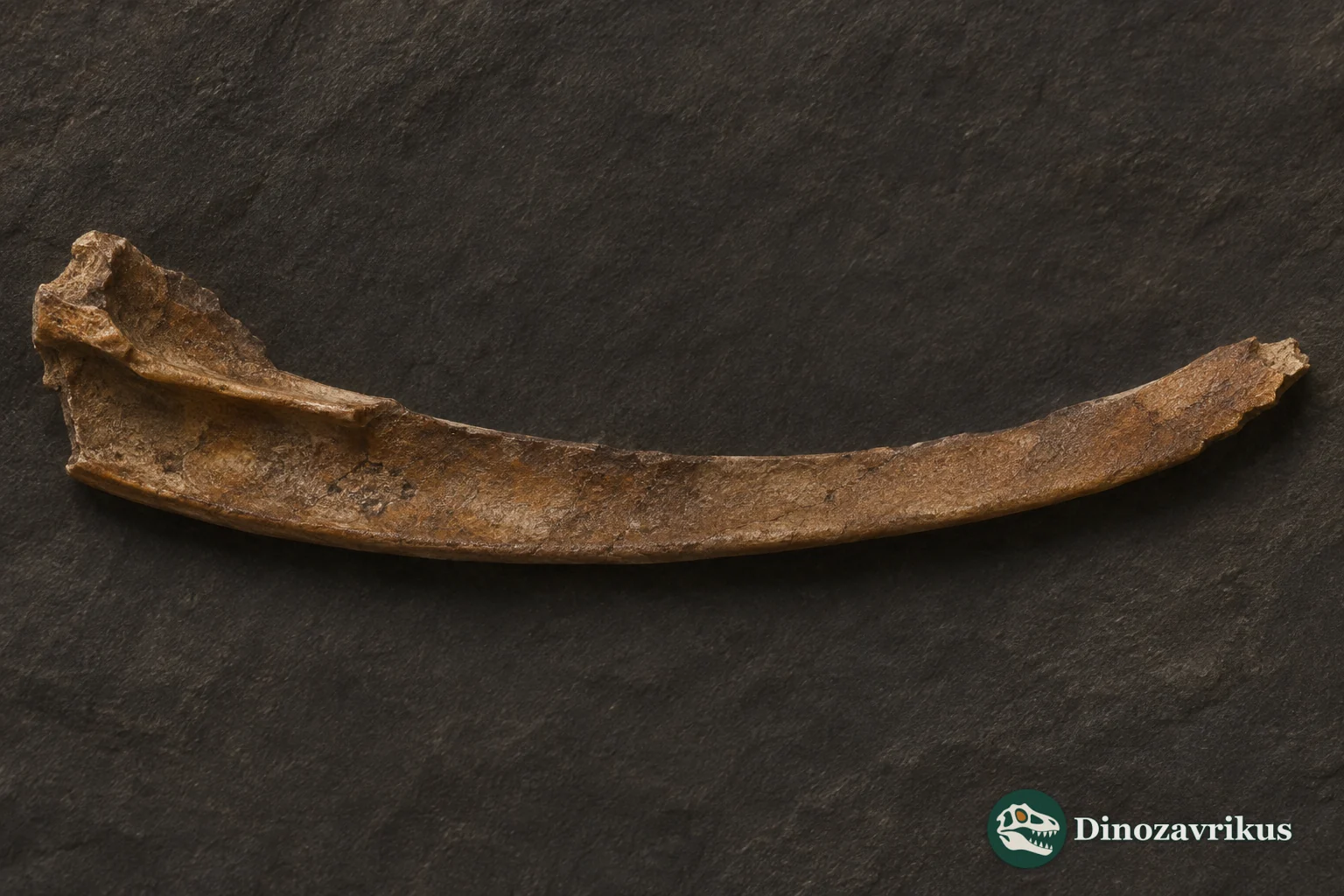
TMP 1985.066.0035, the holotype, is part of a right maxilla. Each of the other known specimens is also a fragment of a maxilla.
The preserved dental crest was toothless. The shape of the process on the inner face also helps distinguish the species.
The bones identify the animal as a frog. A more precise placement would require additional parts of the skeleton.
The Alberta finds
Donald Brinkman collected the first specimens in the mid-1980s. James Gardner described Tyrrellbatrachus brinkmani in 2015. The genus name honours the Royal Tyrrell Museum of Palaeontology, and the species name honours Brinkman. TMP 1985.066.0035 is a fragment of a right maxilla.
Reading a toothless jaw
The fragments preserve parts of the maxilla below and behind the eye. A low dental crest is present and carries no teeth or traces of tooth attachment. A prominent triangular process projects from the inner surface. Some of the larger fragments have a roughened outer surface.
Theatonius, from younger North American deposits, also had a toothless maxilla. Its distinctive outer ornament and the shape of its inner surface differ from those of Tyrrellbatrachus. A toothless edge alone offers little evidence of close kinship.
Late Cretaceous deposits
All seven finds came from the basal Dinosaur Park Formation and date to the Campanian. The rocks establish an age and a place of burial. Other parts of the skeleton have yet to be securely associated with the maxillae, leaving body size and diet unresolved.
Frequently asked questions
Where in Canada was Tyrrellbatrachus found?
The known specimens came from the lower Dinosaur Park Formation in Alberta.
How many specimens are known?
The description includes seven incomplete maxillae, including the holotype.
Was the whole mouth toothless?
The maxilla was toothless. The other bones of the mouth have yet to be identified.
How did it differ from Theatonius?
Both had toothless maxillae, but the outer texture and the shape of the inner surface differ.