

Ugandax is an extinct African member of Bovini, the tribe that includes cattle and buffalo. It has been discussed as a relative of the African buffalo lineage, but its exact position is unsettled. Researchers compare partial skulls, horn cores and teeth from Uganda and Ethiopia. The animal pictured above is a life restoration: preserved bone does not reveal its coat, horn sheath or social behavior.
The most informative Ethiopian species is U. coryndonae. Its fossils allow a closer look at early buffalo-like anatomy than the name alone suggests.
Quick facts
| Genus | Ugandax Cooke and Coryndon, 1970 |
|---|---|
| Type species | U. gautieri |
| Group | Bovidae, tribe Bovini |
| Key species | U. coryndonae from Ethiopia |
| Evidence | Partial skulls, horn cores, jaws and teeth |
| Securely studied age | Pliocene deposits of East Africa |
What can the fossils tell us?
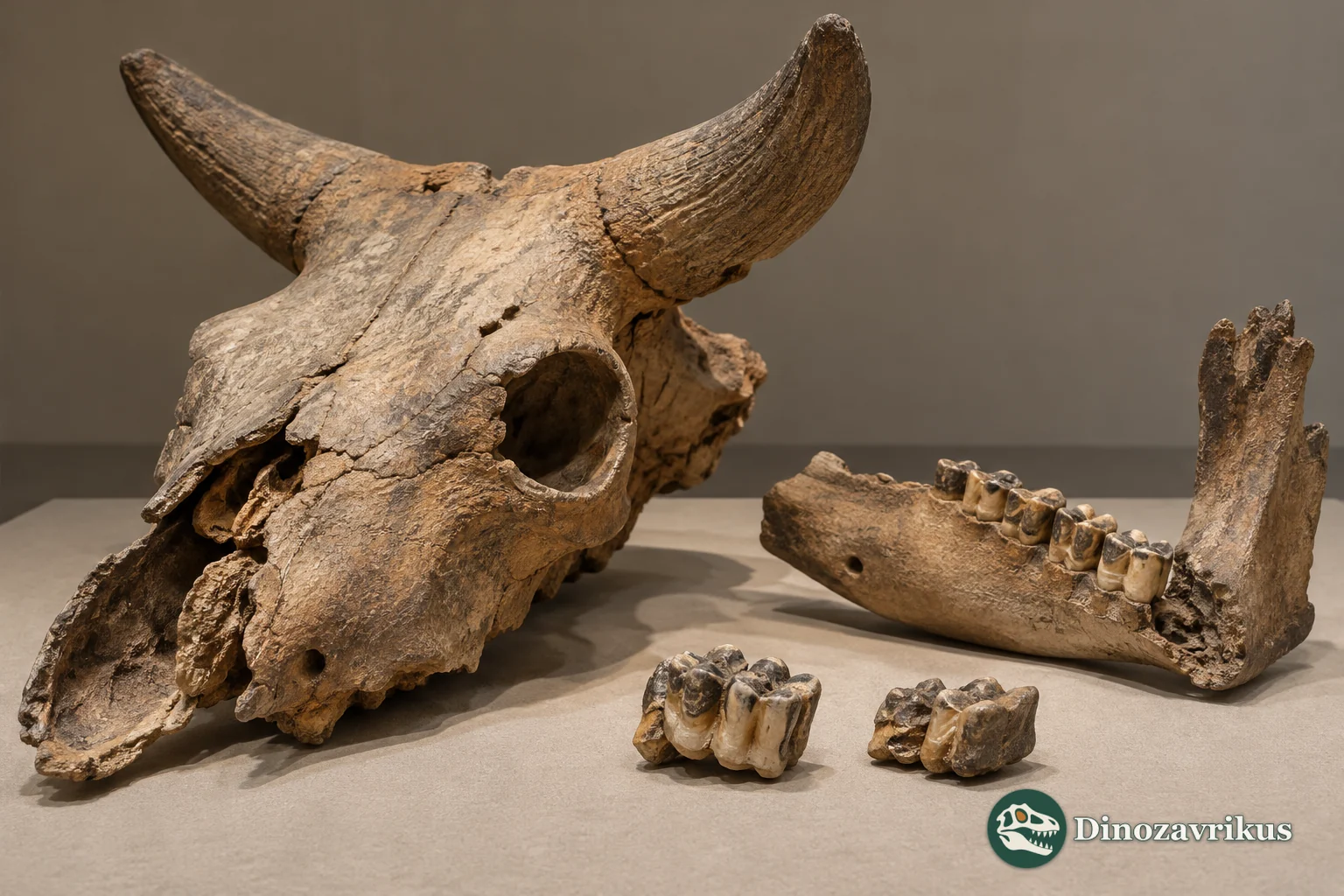
Partial crania of U. coryndonae preserve paired horn cores. Their cross-sections, keels and inclination are observable; the missing keratin sheath and full external horn silhouette are not.
Woranso-Mille includes a posterior cranium, jaw, teeth and ankle bones. These are separate fossils, not one complete skeleton, and comparison with Hadar supports rather than proves every assignment.
Hadar, Woranso-Mille and Ledi-Geraru represent different Pliocene deposits. The age of one cranium should not be assigned to every piece labelled Ugandax.
Uganda, Hadar and later Ethiopian finds
H. B. S. Cooke and Shirley Coryndon introduced the genus in 1970 for Ugandan material, naming U. gautieri as the type species. Alan Gentry later described U. coryndonae from the Hadar Formation in Ethiopia. Generic limits have remained debated because early African bovins share combinations of horn and skull traits.
At Woranso-Mille, researchers described a rear skull with one complete horn core, a mandible, several isolated teeth and two ankle bones attributed to U. coryndonae. These pieces come from a regional sample, not one articulated skeleton. A partial cranium with both horn cores, LD 285-3, was also identified at Ledi-Geraru. Afrohyrax is another African fossil mammal whose story rests on a different set of preserved bones.
What a horn core can and cannot show
The LD 285-3 horn cores rise above the posterior orbits. Their bases are nearly triangular in section, become rounder farther out, and carry a prominent anterior keel extending onto the frontal. The skull was compared with Hadar material using several measurable features, including the divergence of the cores. These observations describe bone rather than the missing outer horn sheath.
Gentry moved some fossils formerly called Simatherium into Ugandax. Other workers have cautioned that keels and section shape can be ancestral traits shared by several bovins. The much later Pelorovis illustrates another African buffalo-like form; great horn size alone does not identify either genus. A direct line of descent from Ugandax to living Syncerus has not been demonstrated.

Dates and an African landscape
Hadar, Woranso-Mille and Ledi-Geraru establish a substantial Pliocene record for U. coryndonae. The Ledi-Geraru material discussed in a 2017 specimen study comes from strata around 2.8–2.6 million years old. That is an age for those deposits, not a blanket date for all Ugandax fossils. Earlier material labelled Ugandax cf. gautieri also needs its own stratigraphic and anatomical assessment.
Bovid teeth support herbivory, but these finds do not identify an exact menu, body mass, herd structure or predator response. The Afar artwork offers a plausible setting, not a photograph of a dig. The Pliocene-to-Quaternary transition makes local dates important; a workbook label saying Pleistocene cannot replace them.
Frequently asked questions
Where was Ugandax first named?
Cooke and Coryndon established it in 1970 for Ugandan material, with U. gautieri as the type species.
What supports the Ethiopian U. coryndonae?
Partial crania and horn cores, with jaws and teeth from related localities, allow comparison of several anatomical traits.
Was Ugandax the direct ancestor of modern African buffalo?
It is a possible relative of that lineage, but a direct ancestor-descendant relationship has not been established.
Are all Ugandax fossils Pleistocene?
No. Well-studied Ethiopian specimens come from Pliocene deposits, and each other record needs its own age assessment.