

Ungaromys names a group of very small extinct voles known chiefly from isolated molars in Late Pliocene and Early Pleistocene European deposits. Researchers distinguish forms by the pattern of the chewing surface, enamel thickness and crown characters. These fossils rarely reconstruct a whole body: fur and behavior were not preserved. The cover is a plausible vole-like interpretation.
A large series from Schernfeld, Germany, is especially useful because it shows how the same tooth position varies with wear and growth. A single isolated molar can look unlike a less worn tooth of its own species.
Quick facts
| Group | Arvicolinae, voles |
|---|---|
| Type species | U. nanus, named by Kormos |
| Time | Late Pliocene and Early Pleistocene records in Europe |
| Range | Central and western Europe, with more easterly reports |
| Key material | Mostly isolated molars |
| Studied species | U. dehmi from Schernfeld, Germany |
| Limit | Fur color and full body dimensions are not preserved |
What can the fossils tell us?
Small teeth with relatively broad enamel bands and often confluent dentine fields distinguish Ungaromys in comparisons. A single similarity does not prove direct ancestry.
Carls and Rabeder described hundreds of U. dehmi molars from a fissure fill. The holotype is left lower first molar Sf 7/1; the tooth count is not an individual count.
The wear surface and crown characters of U. dehmi and U. nanus help compare localities, but do not independently date each isolated tooth.
The Schernfeld species and its type
Norbert Carls and Gernot Rabeder described U. dehmi from a fissure fill at Schernfeld near Eichstätt, Germany. The name honors palaeontologist Richard Dehm. Its holotype is the left lower first molar Sf 7/1, held in the Bavarian State Collection in Munich. The authors assigned the reddish sands and loams to the earliest Pleistocene; that is a deposit age, not a direct date on the tooth.
Their study listed 160 first lower molars among a larger set of isolated teeth. This is a count of elements, not 160 demonstrable animals. The series lets researchers test changes in chewing patterns and size that might otherwise be mistaken for species differences.
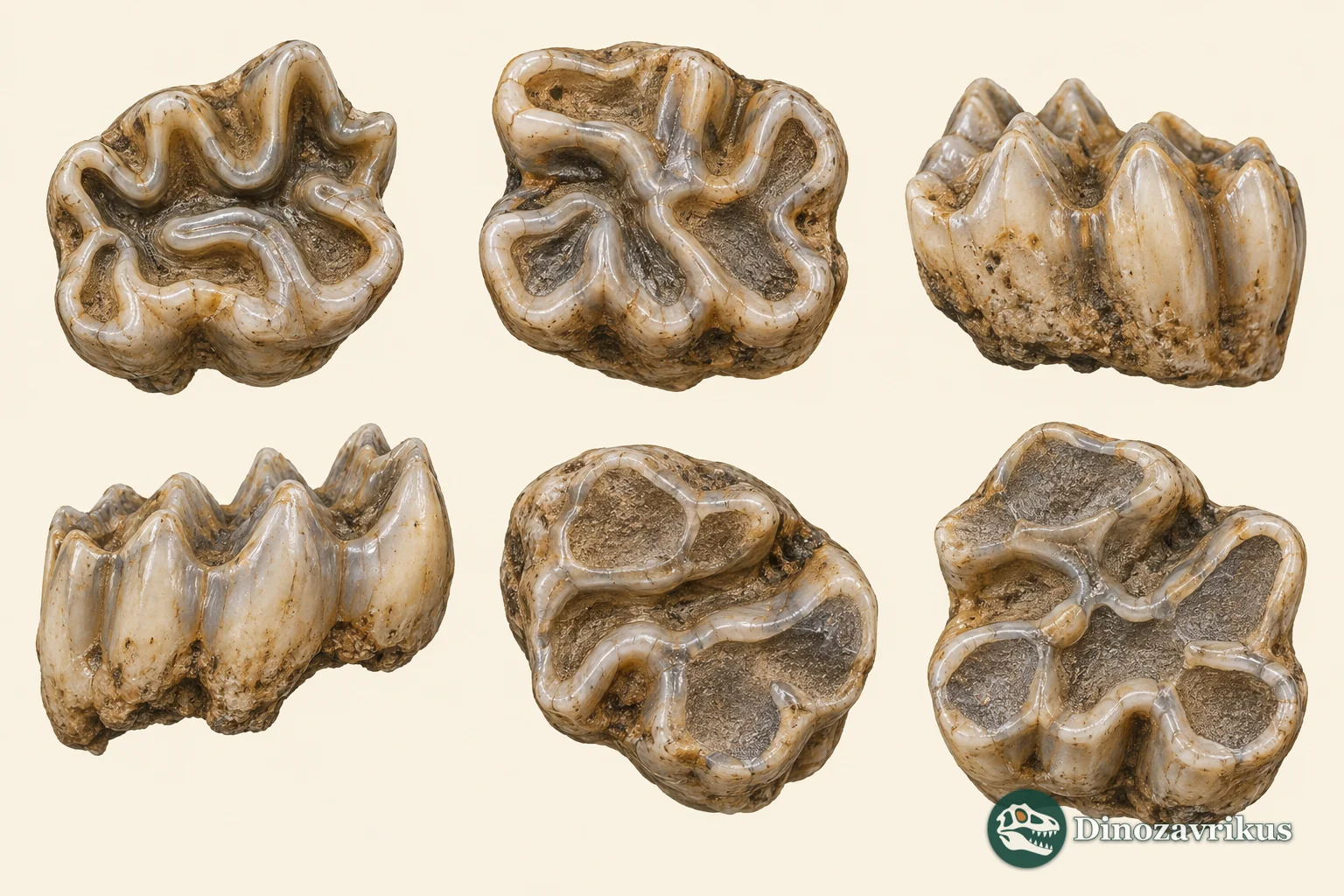
How molar enamel is read
Carls and Rabeder emphasized the small dimensions, comparatively broad enamel band, often confluent dentine fields and relatively primitive enamel-free line in Ungaromys. Some young U. dehmi teeth still show a small enamel islet. It may disappear as the crown wears down. Tooth wear therefore matters when comparing the visible loops of separate fossils.
They compared the Schernfeld sample with U. nanus from Deutsch-Altenburg, Austria. In their analysis the latter showed more derived crown characters. This supports a hypothesis about character change through time, not a documented parent-to-offspring chain. The North American Atopomys provides another example of how fossil vole relationships depend on combinations of dental traits.
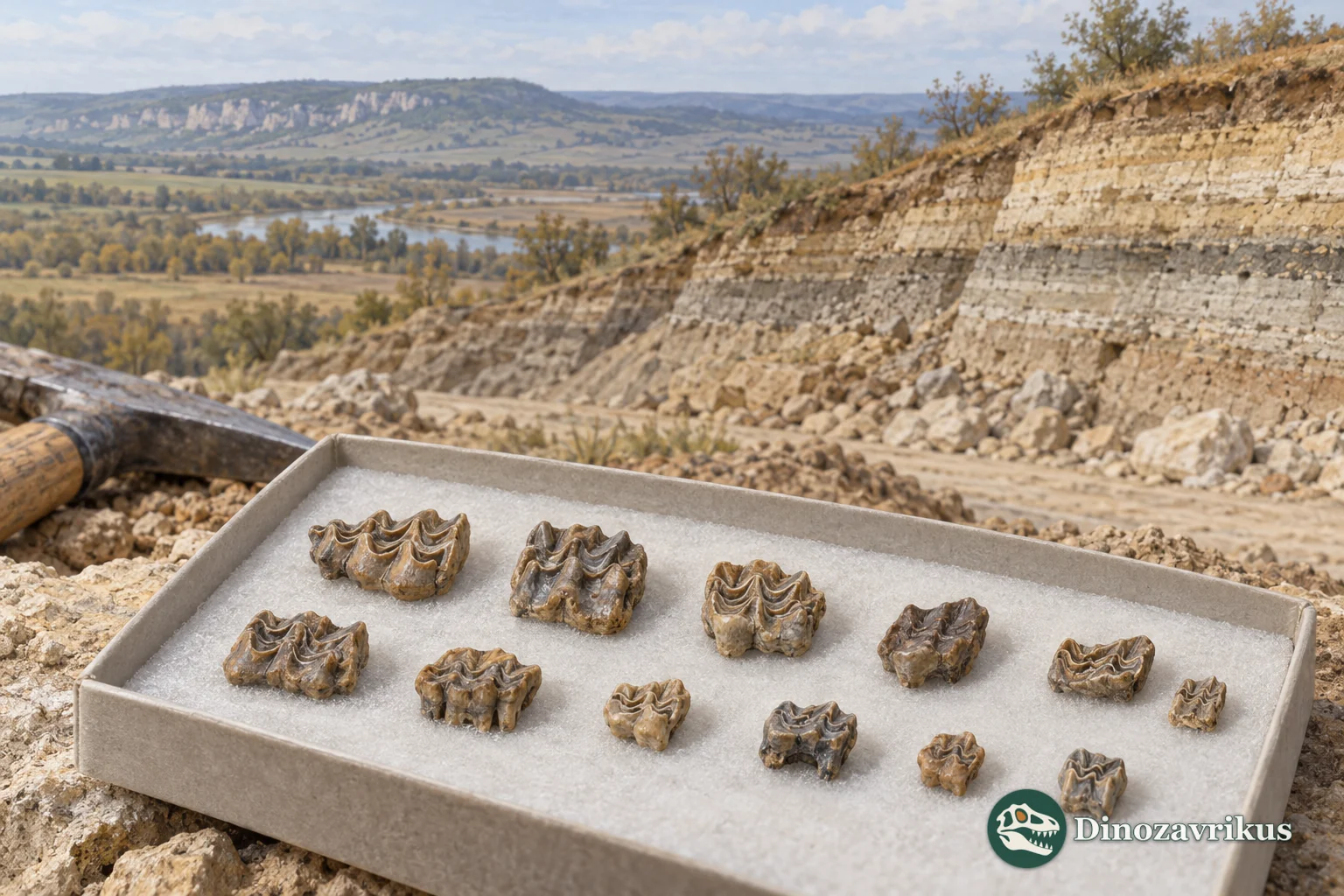
Other faunas and the setting of preservation
U. nanus was also reported from the early Pleistocene Żabia Cave locality near Podlesice in Poland. Its association with other small mammals helped constrain the faunal age. Reports from further European sites do not make every sample coeval or equally secure in identification.
Tiny molars can accumulate in caves and fissures, but their burial location does not prove that the vole lived inside a cave. The illustration shows a conceptual collecting and comparison scene, not a known Schernfeld lot or excavation. Part of the genus' record belongs to the Quaternary; an older Pliocene component must be considered separately.
What teeth cannot establish
Molar anatomy supports placement among voles and species comparisons, but cannot specify the coat color, litter size or exact diet of a local population. Body proportions in the cover follow living relatives and remain an artistic choice. The fossil record also does not justify assigning a precise body mass to every named species from one isolated tooth.
Frequently asked questions
Is Ungaromys known from complete skeletons?
The studied material consists mainly of isolated molars; the Schernfeld series is a tooth sample, not a complete skeleton.
What is the type of U. dehmi?
A left lower first molar, Sf 7/1, from Schernfeld and held in Munich.
Why does tooth wear matter?
Wear changes visible enamel loops and dentine fields, so teeth from one species at different ages can look different.
Can molars show its fur color?
No. The molars preserve no fur or pigment. The cover's color is an artistic choice.