

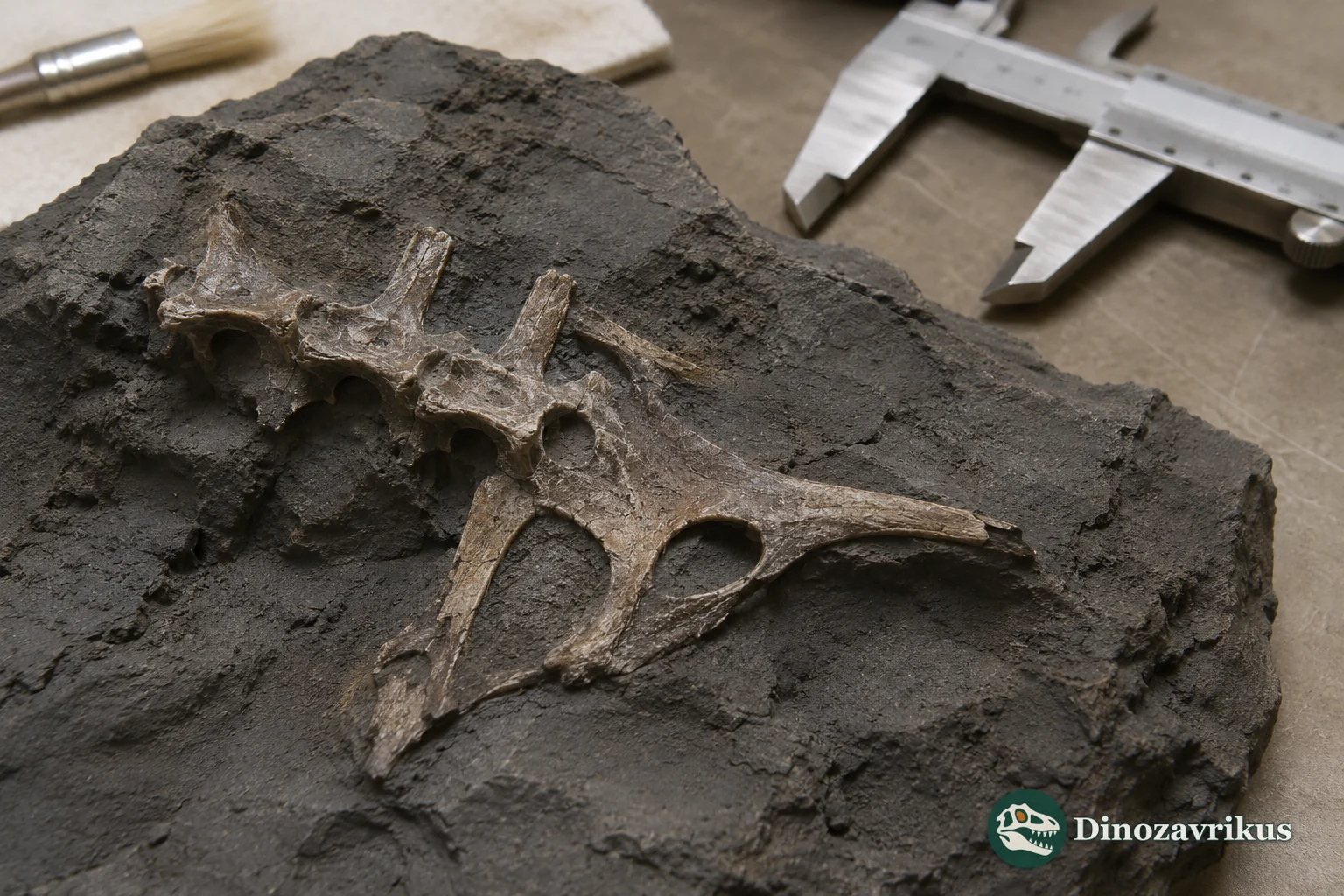
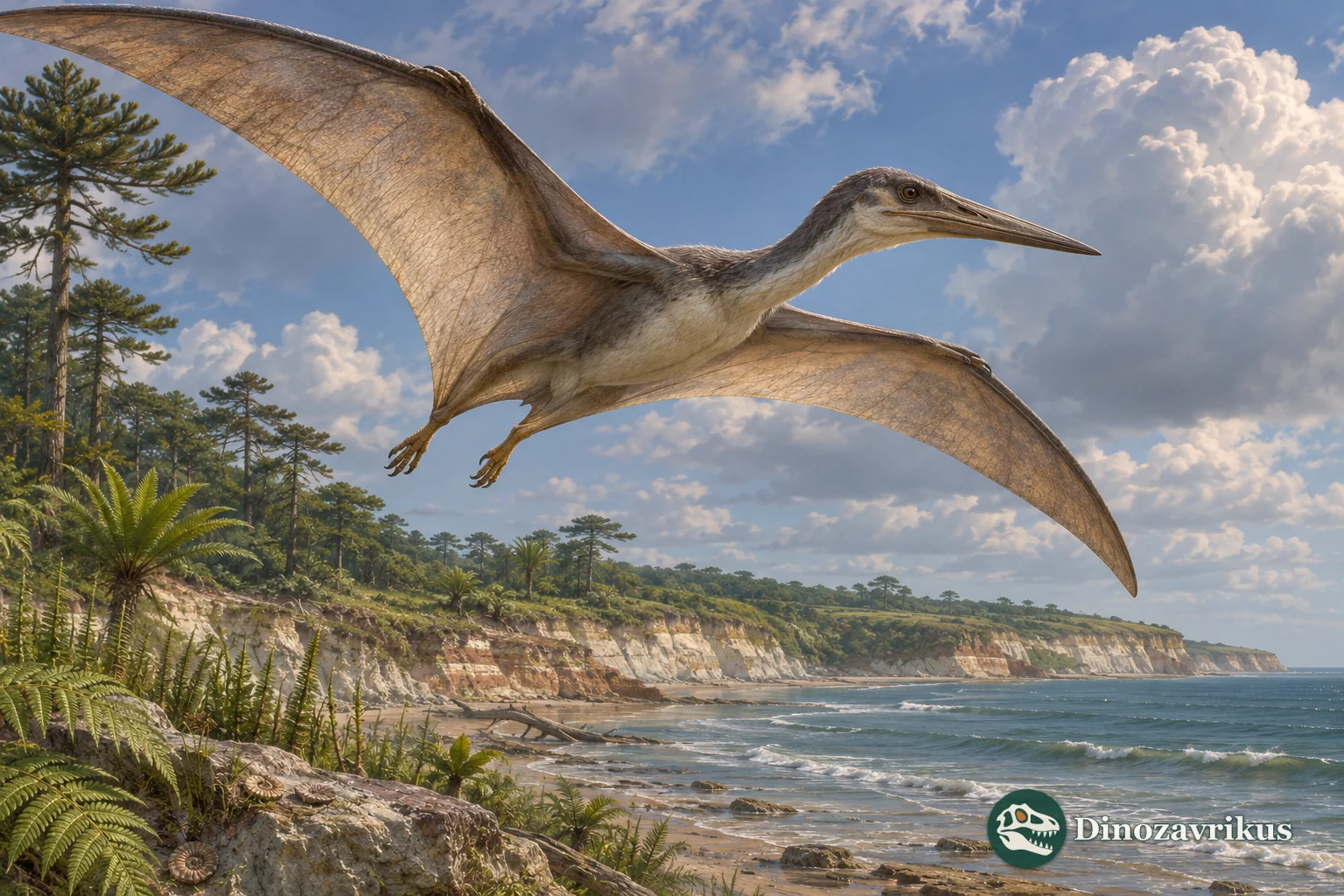
Vectidraco daisymorrisae was described from a small partial pelvis and vertebrae found on the Isle of Wight. The fossil shows pelvic anatomy and signs of near skeletal maturity. No skull, teeth or wing bones are known, so the animal pictured here is an artistic interpretation rather than a reconstruction of a complete specimen.
Quick facts
| Named species | Vectidraco daisymorrisae, Naish, Simpson and Dyke, 2013 |
|---|---|
| Holotype | NHMUK PV R36621, partial pelvis and associated vertebrae |
| Discoverer | Daisy Morris, with her family, Isle of Wight |
| Rock unit | Chale Clay Member, Atherfield Clay Formation |
| Age | Early Aptian, Early Cretaceous |
| Preserved pelvis | About 40 mm long, incomplete anteriorly |
| Estimated wingspan | About 75 cm from comparison, not preserved wings |
What can the fossils tell us?
NHMUK PV R36621 includes the left pelvic region, part of the right ischium and associated vertebrae. Distinctive iliac depressions and processes are preserved; skull and wings are absent.
The surrounding sediment matches the Chale Clay Member of the marine Atherfield Clay Formation, early Aptian. The nearby Vectis Formation is excluded by matrix and locality.
Fusion among pelvic and vertebral elements led the authors to regard the small specimen as mature or nearly mature, not simply a juvenile of a large species.
The authors compared the 40 mm preserved pelvis with another small azhdarchoid. Variable pterosaur proportions make the resulting span approximate.
Daisy Morris's find
The Morris family spotted tiny bones weathering from a clay block at the foot of cliffs west of Atherfield Point. Daisy first noticed the fossil; her family collected the remaining exposed pieces and a sediment sample. Later searches found no additional material, and coastal erosion has since removed the exact spot. The specimen was donated to London's Natural History Museum and catalogued as NHMUK PV R36621.
Darren Naish, Martin Simpson and Gareth Dyke named Vectidraco daisymorrisae in 2013. The species honours Daisy Morris. The genus name combines an old name for the Isle of Wight with a word for dragon. The holotype is most of the left pelvic side, an incomplete right ischium, three sacral vertebrae and a dorsal vertebra, rather than a whole skeleton.
Why Atherfield Clay matters
The bones were found in fallen material, but their matrix matches silty clay in the Chale Clay Member of the Atherfield Clay Formation. This is an early Aptian marine unit; the authors cite the Deshayesites forbesi ammonite zone and D. fittoni subzone. The original bed was reconstructed from the sediment and local geology, not observed with the bones still in place.
The nearby Vectis Formation yielded other pterosaurs, including Istiodactylus, and the name Vectidraco can obscure the difference. The 2013 authors explicitly rejected a Vectis origin for this specimen because its matrix and find site indicate Atherfield Clay.
A small, almost mature pelvis
The preserved pelvis is about 40 mm long and 27 mm high, with the missing front estimated to have added 20–30 mm. A triangular depression near the hip socket and the shape of the rear iliac process help distinguish the taxon. The bone also shows internal pneumatic texture. Fusion of pelvic and vertebral elements led the authors to infer an animal at or near skeletal maturity rather than a young individual of a much larger form.
The published approximate wingspan of 75 cm and nose-to-tail length of 35 cm came from comparison with a reconstruction of another small azhdarchoid. Neither dimension was measured from a preserved Vectidraco wing or skull. The original analysis placed it among azhdarchoids, but closer placement is hard to test because many pterosaur phylogenetic studies include few pelvic characters. Europejara offers a comparison with another Early Cretaceous European azhdarchoid, not a warrant for identical head shape.
What cannot be seen
Without a skull or teeth, diet, beak form and any crest are unknown. The toothless, possibly crested animal in the original paper was an explicitly speculative reconstruction. Our flight scene similarly imagines wings and colour from general pterosaur comparisons. The fossil does not reveal nesting, sex differences or the cause of this individual's death.
Frequently asked questions
Who discovered Vectidraco?
Daisy Morris first noticed the fossil, and her family collected the weathered bones and surrounding clay on the Isle of Wight.
Which formation yielded the fossil?
Its matrix indicates the Atherfield Clay Formation, probably the early Aptian Chale Clay Member; the neighbouring Vectis Formation was ruled out.
Was the small animal an adult?
Fused pelvic and vertebral bones suggest maturity or near maturity, although its exact age in years cannot be determined.
Is the 75 cm wingspan a measurement?
No. It is a rough estimate from comparison with another pterosaur because no Vectidraco wing bones were found.