

Volocephalina was a Cambrian trilobite genus from the Great Basin. In the type species, ridges run almost continuously from the eye lobes to the front of the central lobe of the head. In two other species, the axial furrow interrupts that connection.
Quick facts
| Group | Trilobites |
|---|---|
| Age | Middle Cambrian, Wuliuan |
| Region | North America (United States, Nevada and California) |
| Diet | Unknown |
| Type species | Volocephalina connexa |
| Genus named by | Allison Palmer, 1979 |
What can the fossils tell us?
Palmer measured the central part of the head along its axis. The fossils do not reveal total body length.
In V. contracta the axial furrow interrupts it. Cheek width provides a second way to distinguish the species.
USNM 493117 is the holotype cranidium of V. variosa. The frontal area, cheek width and shell surface vary within the collection.
Two species from the Carrara Formation
Allison Palmer named the genus in a 1979 study of the Carrara Formation with Robert Halley. Cranidia of the type species, Volocephalina connexa, came from Nevada and the Titanothere Canyon section of California. The front edge is almost straight. The glabella, the raised central lobe of the head shield, tapers slightly towards the front.
V. contracta has a shorter frontal area and narrower fixed cheeks. An isolated free cheek also preserves a short, flattened genal spine. The original description recorded no securely assigned tail shields, so the head provides the most useful parts for comparison.
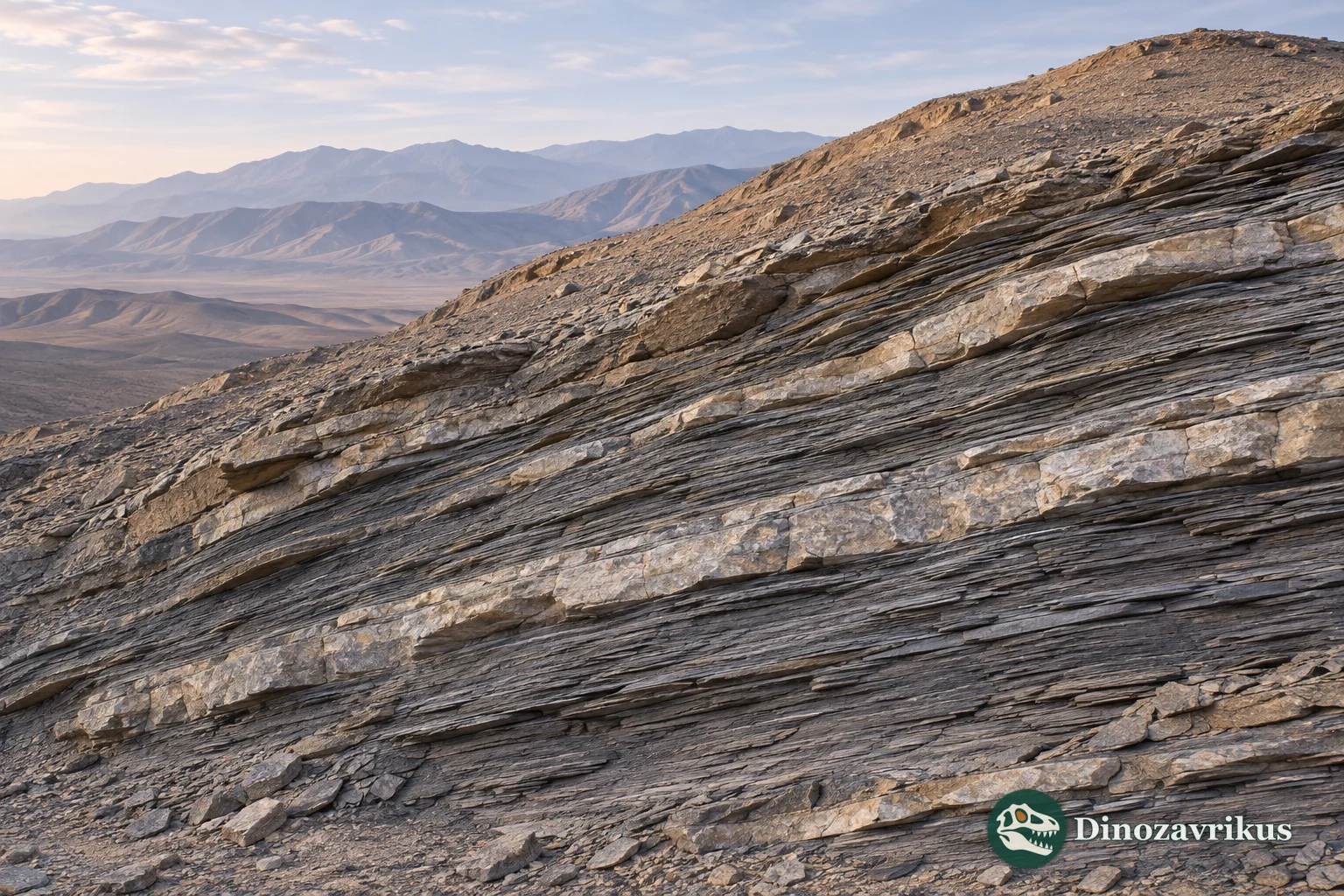
Variation in the Pioche Shale
Julie Eddy and Linda McCollum named V. variosa from southeastern Nevada in 1998. The density and coarseness of shell granules varied even within one sample. They attributed some variation to preservation and used the proportions of the head and the course of the eye ridge to distinguish the species.
In the Pioche Shale, V. variosa occurs in the lower Albertellina aspinosa Subbiozone. V. connexa occurs higher in the Albertella Biozone, alongside Plagiura in some collections. The authors suggested that the earlier species might be ancestral. The order of the beds establishes sequence, while the proposed relationship depends on anatomical comparisons.
Frequently asked questions
Which species defines Volocephalina?
V. connexa, described from Carrara Formation cranidia in Nevada and California.
What part of the fossil was measured?
Palmer measured the central part of the head shield. The largest cranidia in his original material reached about four millimetres.
How do the eye ridges distinguish V. connexa and V. contracta?
In V. connexa, the ridge almost merges with the glabella. The axial furrow interrupts it in V. contracta.
Which species occurs in the lower Albertella Biozone of the Pioche Shale?
V. variosa. Its holotype is catalogued as USNM 493117.