

Vulpavus was an early carnivoraform from Eocene North America. Its record includes teeth, parts of skulls and several postcranial skeletons, giving researchers more to work with than an isolated jaw. In particular, the limb bones support an animal capable of climbing. They do not tell us exactly how much of its life was spent in trees.
The genus belongs in the ancient mammal catalogue as a fossil relative near the origin of modern carnivorans, not as a proven ancient fox. The name, colour choices in artwork and a comparison with living climbers must not be mistaken for direct ancestry.
Quick facts
| Scientific name | Vulpavus Marsh, 1871 |
|---|---|
| Type species | V. palustris Marsh, 1871 |
| Group | Early Carnivoraformes, near the origin of crown carnivorans |
| Age | Early Eocene for studied skeletons; some named forms are Middle Eocene |
| Range | Western North America, especially Wyoming basins |
| Evidence | Teeth, cranial elements and postcranial skeletons |
| Mass estimate | About 3.5–7.5 kg for studied specimens, from limb cross sections |
| Locomotion | Well suited to climbing; full-time arboreality remains inferred |
What can the fossils tell us?
Marsh named the type species V. palustris in 1871. An old specimen once referred to it was later separated as Neovulpavus washakius. Taxonomy must be checked against the preserved teeth and the bed.
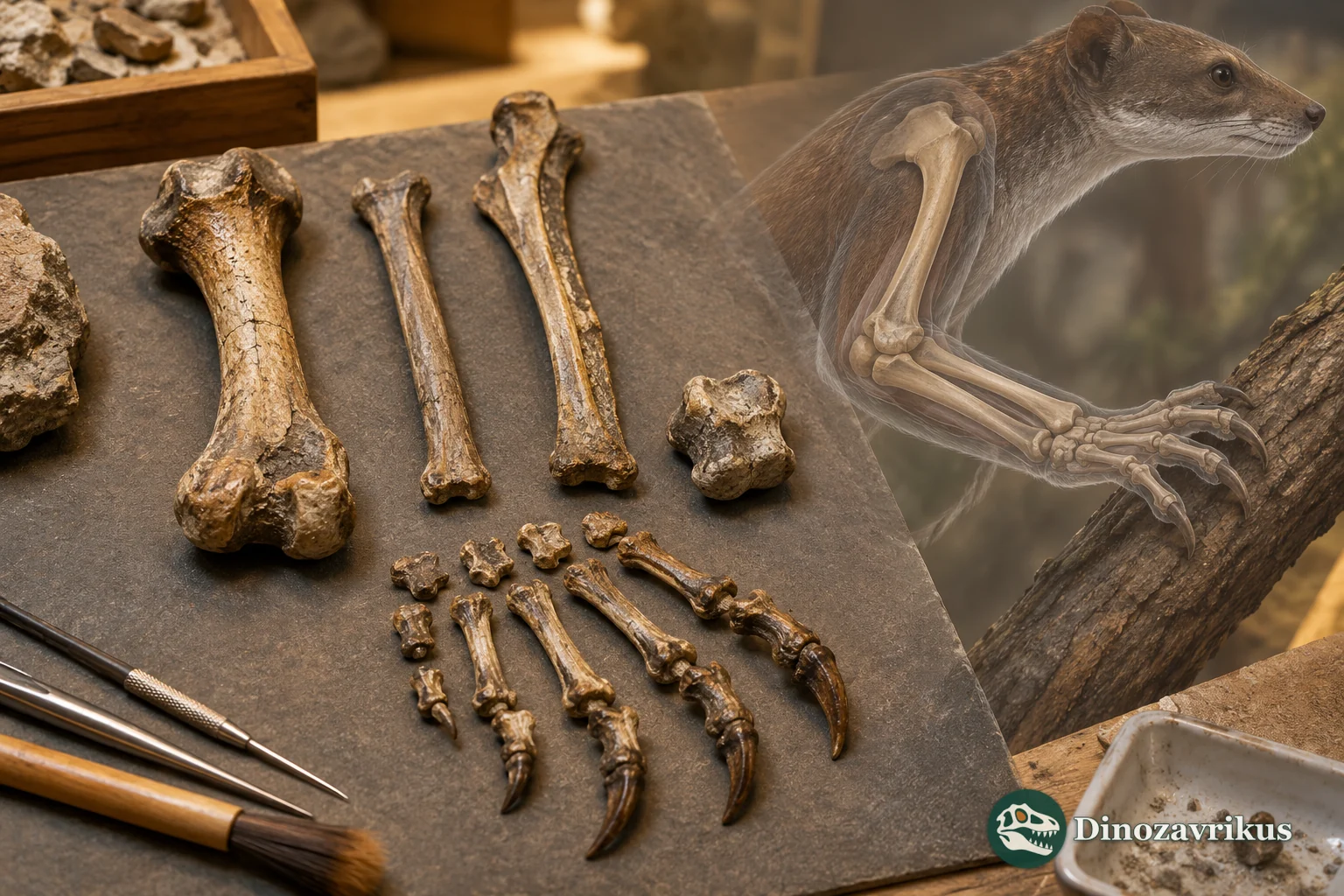
Comparisons of shoulder, forearm and foot bones with living mammals support a climbing adaptation in studied Vulpavus material. Possible arboreality is a functional inference, not an observed habit.
Roughly 3.5–7.5 kg was estimated from cross-sectional geometry of studied humeri and femora. It is not a measured weight for every Vulpavus species or individual.
Phylogenetic analyses place Vulpavus species among early carnivoraforms, but positions vary. The fossils do not establish a direct ancestor of living foxes.
Marsh's name and the danger of an old label
Othniel Charles Marsh introduced Vulpavus in 1871. Its type species is V. palustris from the Green River Basin region of Wyoming. Later workers assigned several similar Eocene carnivoraforms to the genus, often using teeth. The historically broad “miacid” grouping did not resolve their relationships into a single simple line leading to foxes and cats.
AMNH FM 2305 illustrates the need to inspect the specimen behind an old identification. It was first described as V. palustris, then separated as Neovulpavus washakius. A modern restudy found some parts damaged and questioned the confidence of details in an early drawing. That does not erase Vulpavus. It means information from an old Vulpavus label cannot automatically be transferred to the type species or to every animal called a “miacid.”
What the limb bones actually reveal
Ronald Heinrich and Kenneth Rose compared postcranial material referred to Vulpavus with the contemporary carnivoraform Didymictis and a range of living mammals. Shoulder, forearm, hip, hindlimb and foot elements were available, but some Vulpavus referrals remained tentative, including comparisons with V. australis or V. canavus. The evidence is not one flawless complete skeleton of the type species V. palustris.
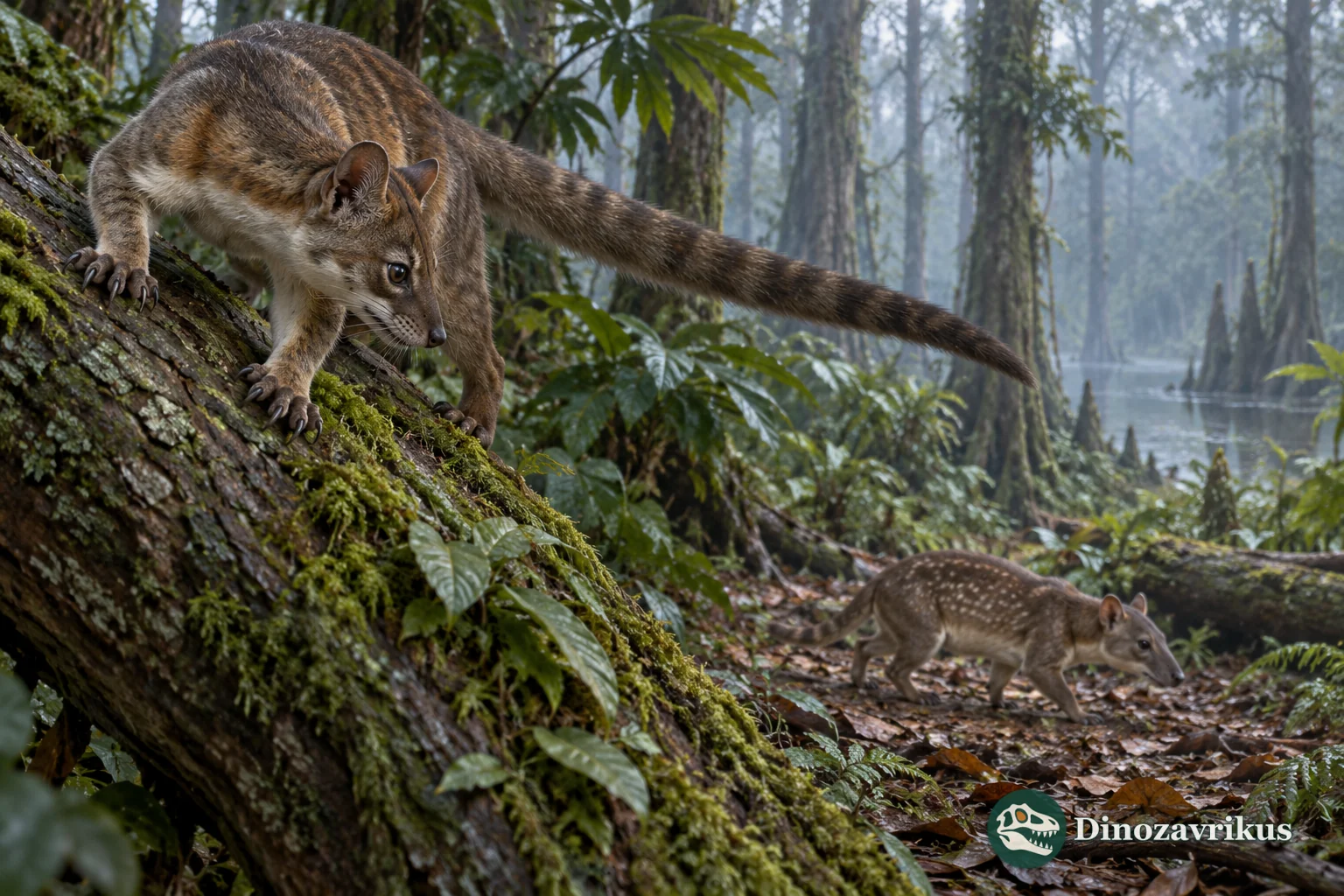
The joint surfaces and proportions suggest Vulpavus was much better adapted to climbing than Didymictis, which the authors reconstructed as mainly terrestrial. A living coati helped illustrate a functional possibility, not a close family relationship or identical behaviour. The study argued that Vulpavus may have lived in trees. Fossils do not record the number of hours an individual spent on branches or show the precise gait used in the cover scene.
Body mass, teeth and unknown behaviour
Heinrich and Rose estimated body mass from the cross-sectional geometry of humeri and femora. Their studied early Eocene Vulpavus and Didymictis material yielded estimates in roughly the 3.5–7.5 kg range. These are model outputs for particular bones, not scales used on a living animal and not a fixed mass for every species, age or sex.
Its dentition places it among early carnivoraforms, but the material discussed here does not establish an exact prey list or the proportion of insects, vertebrates and carrion consumed. An illustration of a stalk or leap would be a guess, not a fossil result. Coat colour, tail markings and external ear shape likewise remain artistic choices.
Eocene western North America and uncertain kinship
Fossils assigned to Vulpavus come from Eocene deposits of western North America. A single numerical age cannot be assigned to all species and specimens: each fossil is dated through its geological layer. The early Eocene was a period of diversification among small carnivorous and omnivorous mammals, long before the appearance of living foxes.
Phylogenetic analyses place at least some Vulpavus species among early carnivoraforms, but the precise position of individual species can shift with the character sample and analysis. The wider Palaeogene Period provides the geological setting. The much older Late Cretaceous Didelphodon belonged to another mammal lineage and should not share an Eocene forest scene with Vulpavus. The fossils support a capable climber, not a fully documented daily life or a straight line to any living carnivore.
Frequently asked questions
Was Vulpavus an ancient fox?
No. It was an early carnivoraform. Foxes belong to a much later branch of living canids, and the similar-sounding name is not proof of direct ancestry.
Why do researchers think it climbed?
Shoulder, forearm and foot bones were compared with those of living mammals. Their combined anatomy supports climbing, but not a measured amount of time in trees.
Did it weigh exactly seven kilograms?
No. Roughly 3.5–7.5 kg is a calculated range for studied early Eocene specimens based on long-bone geometry, not a universal weight.
Are all old fossils labelled Vulpavus securely identified?
No. Some have been reassigned after restudy, including AMNH FM 2305. The actual teeth, preservation and layer must be checked.