

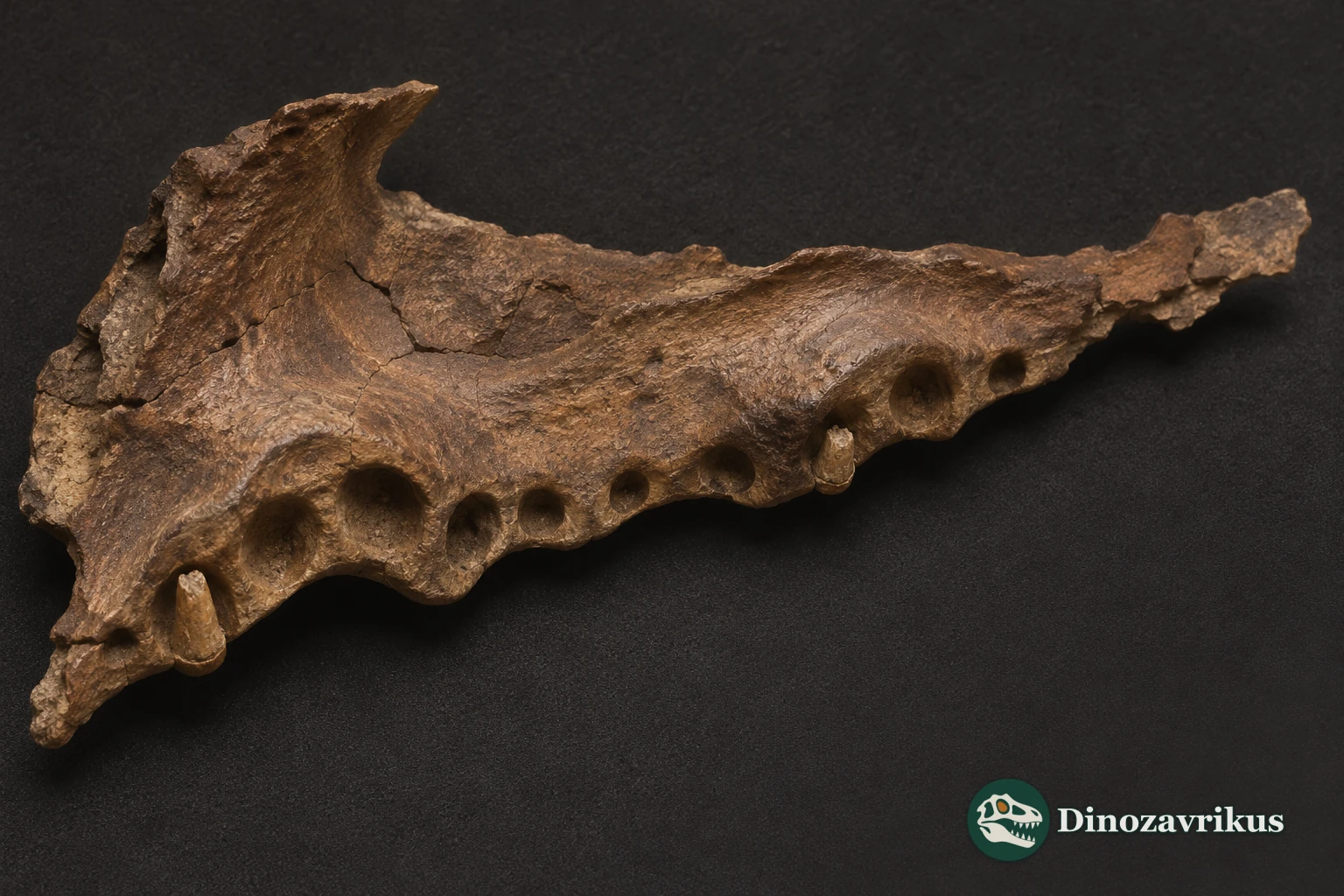
Wahasuchus egyptensis comes from Campanian rocks near the Dakhla Oasis in Egypt’s Western Desert. Two runs of enlarged sockets give its upper jaw a distinctive outline. That feature helps identify the species, although much of the palate needed to resolve its relationships is missing.
Quick facts
| Species | Wahasuchus egyptensis |
|---|---|
| Age | Campanian, Late Cretaceous |
| Locality | Dakhla Oasis, Western Desert, Egypt |
| Formation | Quseir Formation |
| Holotype | MUVP 1, partial cranial and jaw bones |
| Affinities | Possible non-eusuchian neosuchian |
What can the fossils tell us?
The maxilla preserves a wavy outline with two sets of larger sockets. Socket size indicates where larger teeth sat without revealing what those teeth routinely caught.
Several cranial features are consistent with Neosuchia. More complete palatal bones would help distinguish between possible relationships within the group.
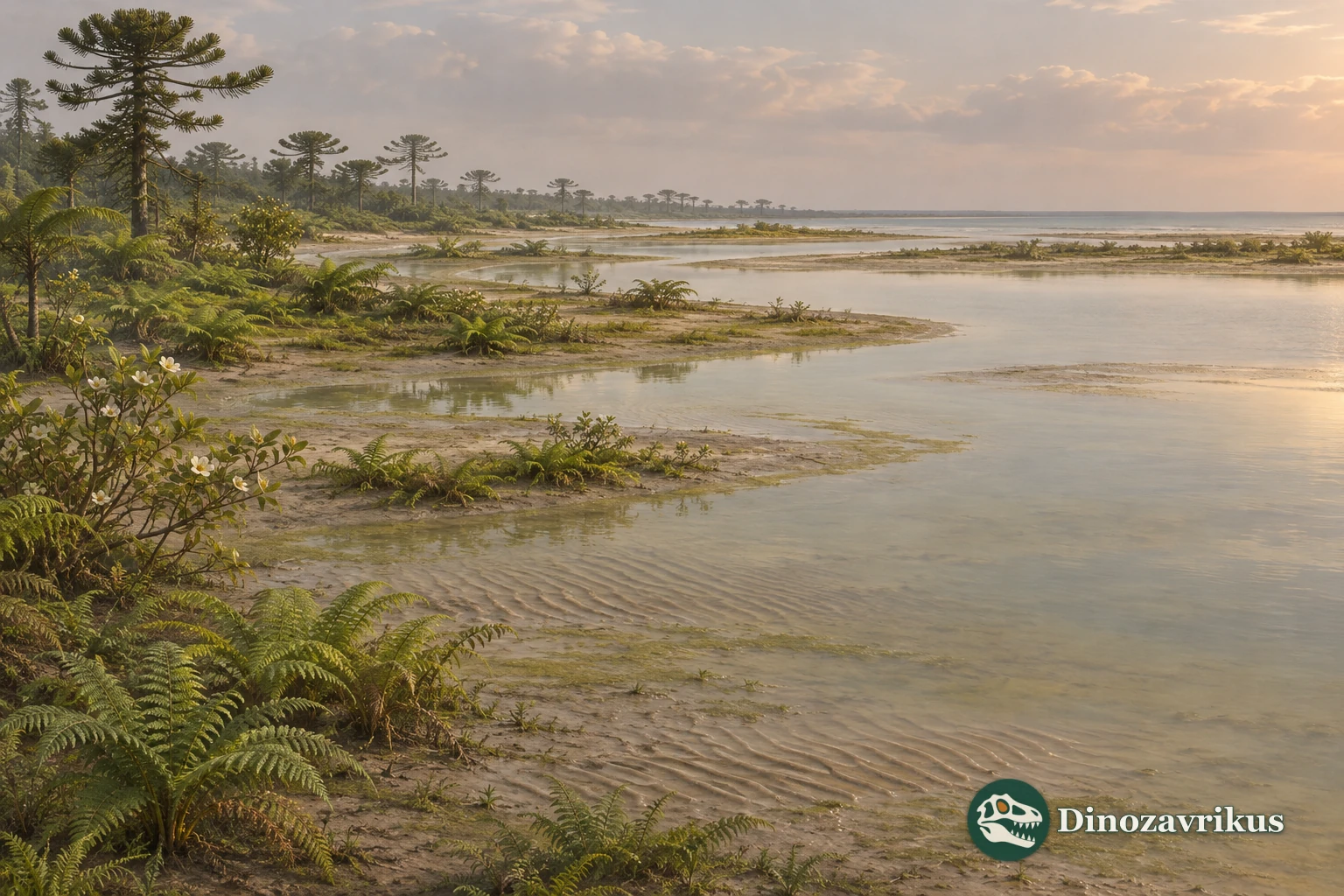
Sediments near Dakhla accumulated in continental and marginal marine settings. Skull anatomy suggests some use of water, while the burial environment provides a separate line of evidence.
A skull assembled from several finds
Sara Saber and colleagues described Wahasuchus in 2018. The type specimen, MUVP 1, includes part of the left lower jaw, a jugal and several bones from the skull roof and rear of the head. It is housed at the Mansoura University Vertebrate Palaeontology Center.
The reconstruction of the head also uses other finds, including an incomplete maxilla, MUVP 12, and part of a premaxilla, MUVP 13. The generic name begins with the Arabic word for oasis, referring to Dakhla. The species name refers to Egypt.
The outline of the upper jaw
The preserved bones suggest a broad, low snout with a robust, somewhat domed upper surface. Its upper jaw has a pair of waves along the tooth row where sockets become larger. At the front of the lower jaw the two sides met in a short, broad joint that included the splenial bone on the inner side.
The flattened jaws of Laganosuchus belonged to a different crocodyliform from older African deposits. Its elongated lower jaw provides a comparison for the compact jaw junction and strongly undulating upper tooth row of Wahasuchus.
A tentative place among neosuchians
The back of the ear recess was enclosed by bone, a feature consistent with neosuchian affinities. Two referred trunk vertebrae have centra concave at both ends. The original authors tentatively placed the animal outside Eusuchia within Neosuchia, but the incompletely known palate keeps its precise position open.
The deposits include continental and marginal marine sediments. The broad snout and high position of the nostrils led the authors to suggest a semiaquatic habit. There are no preserved meals among the known remains to identify its prey.
Frequently asked questions
Where was Wahasuchus discovered?
The fossils come from the Quseir Formation near the Dakhla Oasis in the Western Desert of Egypt.
What makes its upper jaw distinctive?
The tooth row has two waves of enlarged sockets, reflected in the strongly undulating edge of the maxilla.
Was it part of the modern crocodilian group?
Its original description tentatively placed it among neosuchians outside Eusuchia. More complete fossils are needed to refine that placement.
What does the name Wahasuchus refer to?
Waha is Arabic for oasis. The name refers to Dakhla, where the specimens were discovered.