

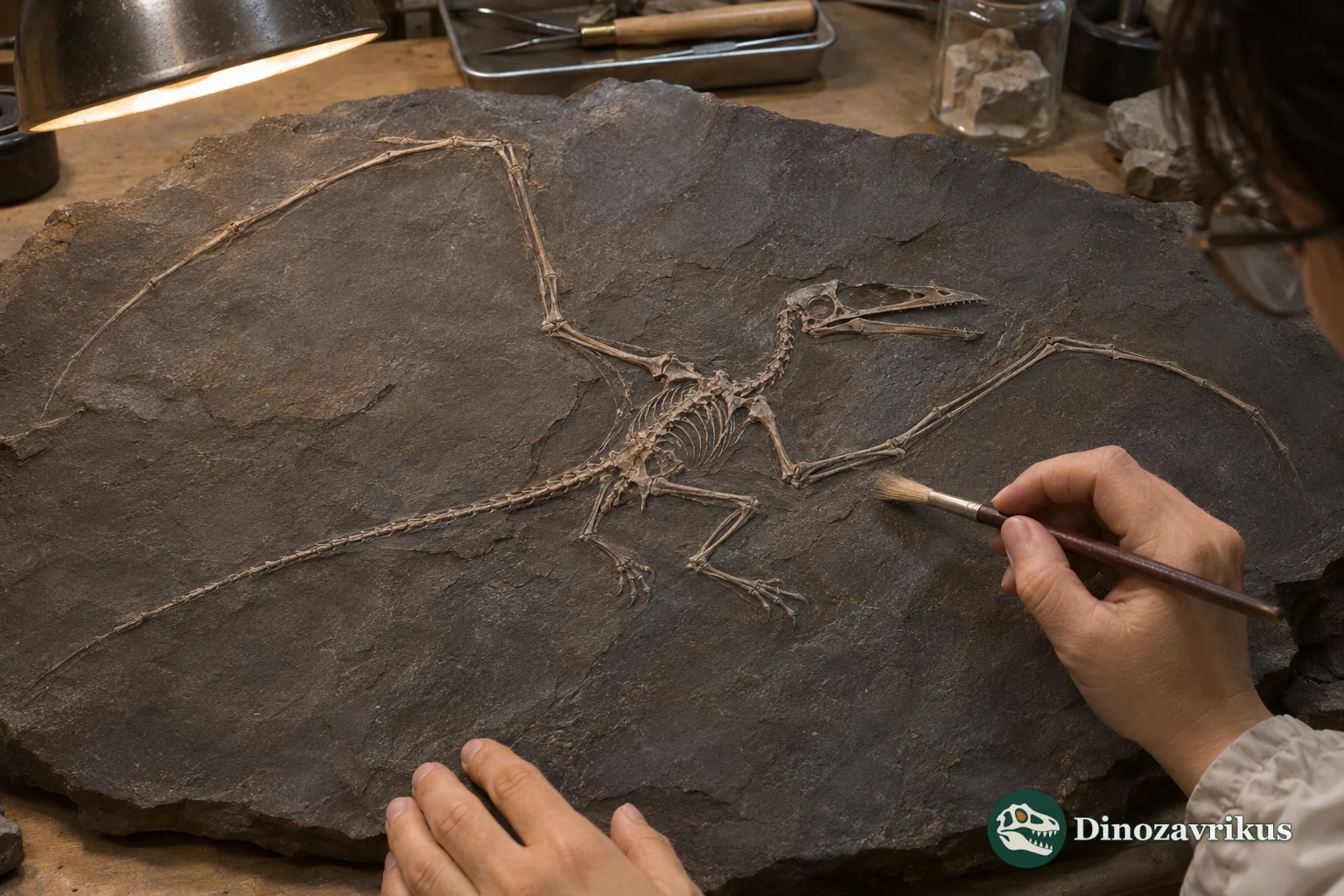
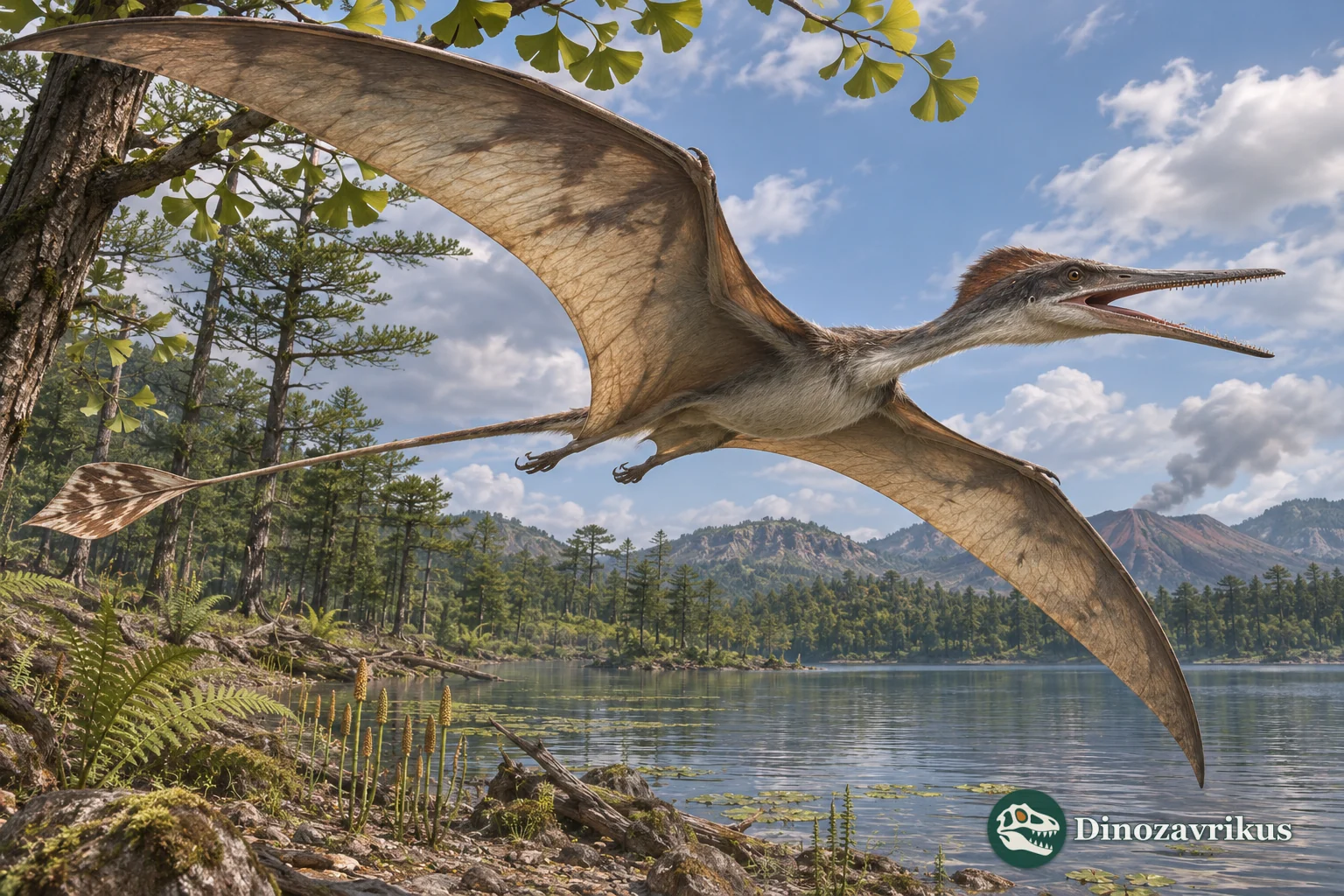
Wukongopterus lii is represented by an almost complete skeleton from Liaoning, China. Its long tail, elongated neck and wing bones made it important for studying how pterosaur features evolved in different combinations. The skull roof is missing, while the living animal on the cover is an artistic reconstruction.
Quick facts
| Named species | Wukongopterus lii, Wang and colleagues, 2009 |
|---|---|
| Holotype | IVPP V15113, nearly complete articulated skeleton |
| Repository | Institute of Vertebrate Paleontology and Paleoanthropology, Beijing |
| Locality | Linglongta, Jianchang County, Liaoning, China |
| Age | Jurassic deposits; the exact local rock correlation was debated |
| Group | Wukongopteridae |
| Estimated wingspan | About 730 mm in the original description |
| Key combination | Long tail with elongated front skull and neck |
What can the fossils tell us?
IVPP V15113 includes linked trunk, tail, limb and wing bones. The skull roof and rear are absent, so a high crest cannot be established from this holotype alone.
Approximately 730 mm was calculated in the original paper. Membrane shape and colour in an illustration are reconstructed, although wing fibres were reported on the slab.
The vertebrae show a long tail. Shared and differing features among wukongopterids indicate relationships, not a demonstrated ancestor-descendant chain.
The authors discussed alternatives for assigning the Linglongta beds. A single skeleton does not independently date its layer to an exact geological stage.
The Linglongta skeleton
Xiaolin Wang and colleagues named Wukongopterus lii from IVPP V15113 in western Liaoning. The fossil was preserved on a slab near Linglongta. Jaws, much of the vertebral column, the tail, limbs and wing elements remain associated. The roof and back of the skull are absent, a vital limit when restoring the head.
The genus refers to Sun Wukong, a literary figure, and the species honours fossil preparator Li Yutong. These names explain the history of the description; they offer no evidence about the animal's behaviour or appearance.
What the bones actually show
Wukongopterus combines a long tail with head and neck features that occur in other combinations across pterosaurs. The front teeth projected forward, shorter teeth followed farther back, and the second phalanx of the fifth toe bent strongly. These are anatomical observations, not a record of a particular prey or hunting method.
The 2009 paper estimated a wingspan of about 730 mm. It is a useful scale based on preserved bones and inferred wing configuration, rather than a measure of mass, flight speed or exact membrane outline. The authors reported fibres of wing soft tissue, but these do not establish the animal's original colour. A longitudinal fracture in one tibia was also described; its cause and survival time cannot be securely reconstructed.
Rock age and relationships
The original geological discussion was cautious about which local unit contained the Linglongta fossil. Later studies commonly discuss these pterosaurs in a Jurassic context. Assigning this particular slab to a precise stage still depends on correlating local sedimentary units.
Douzhanopterus and Kunpengopterus help compare other pterosaurs with related features. Resemblance does not make any named genus a direct ancestor of the others. A separate skull, IVPP V17959, was later compared with Wukongopterus; its proposed attribution and crest evidence should be considered separately from the incomplete skull of the holotype.
The limits of the reconstruction
No stomach contents identify a particular prey for the holotype. Teeth document jaw anatomy but cannot define a complete diet. Sex, growth changes and the season of death remain unknown. The scenes on this page visualize a plausible flying animal while keeping bones, geological context and artistic choices distinct.
Frequently asked questions
What fossil defines Wukongopterus?
Holotype IVPP V15113 is a nearly complete skeleton. Its skull roof and rear portion are missing.
How large was its wingspan?
The original description estimated about 730 mm from its bones; this is not a direct observation of the living animal.
Why is the geological age qualified?
The original paper discussed uncertainty in correlating the local Linglongta strata, so a precise stage for this slab should not be asserted.
Was it an ancestor of later pterosaurs?
A direct ancestral line has not been demonstrated. Its combination of features informs comparisons among pterosaur groups.