

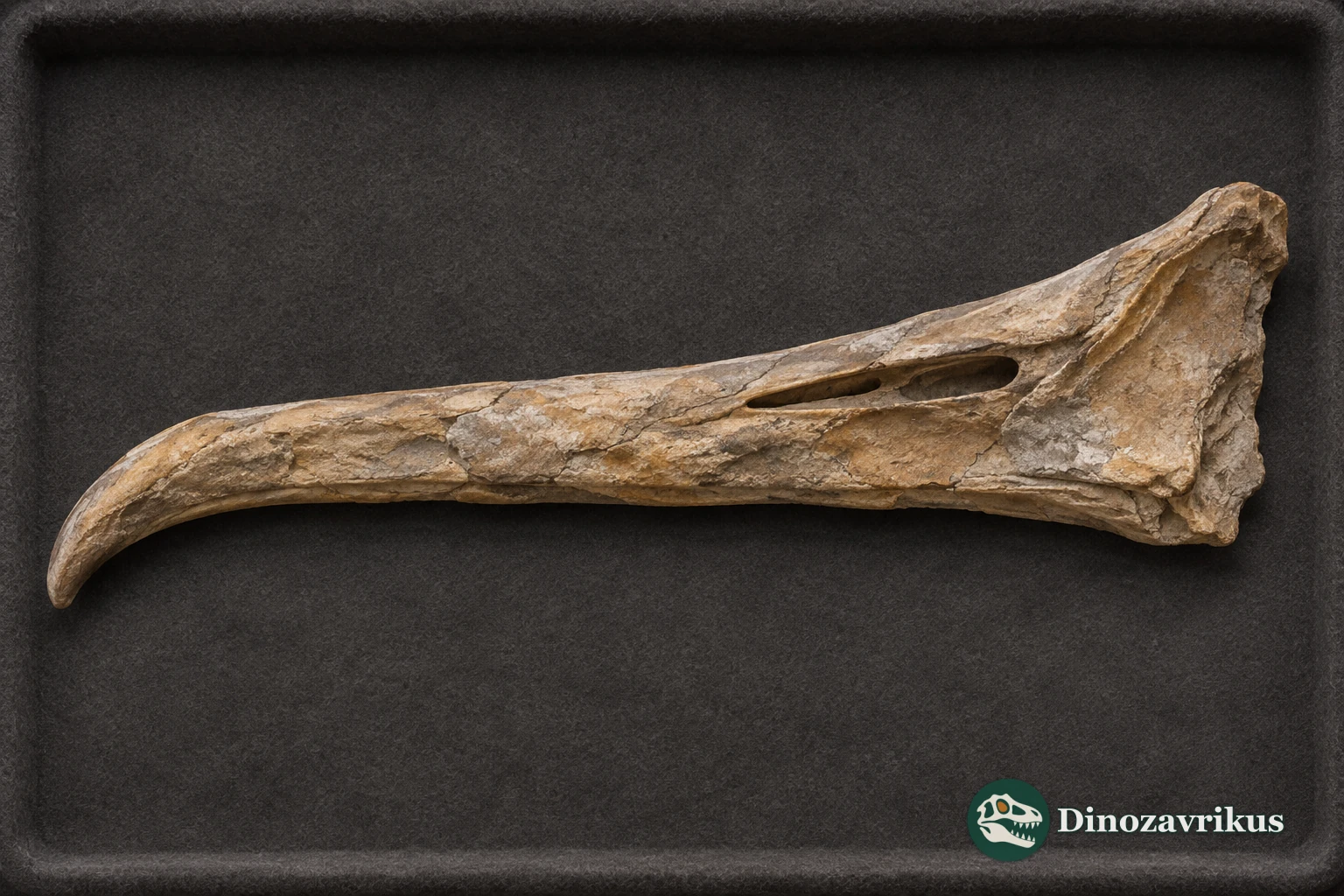
Xenerodiops mycter is known from the bony core of an upper bill from the early Oligocene of Egypt. The tip is strong, expanded and turned sharply down. The first authors named a separate family based on its unusual anatomy. A later study proposed an affinity with herons, although the fossils leave room for competing interpretations.
Quick facts
| Type species | Xenerodiops mycter |
|---|---|
| Age | Early Oligocene |
| Locality | Fayum, Egypt |
| Formation | Jebel Qatrani Formation |
| Holotype | DPC 3088 |
| Type material | Nearly complete bony upper bill |
What can the fossils tell us?
The chord from the tip to the rear flange of the premaxilla measures 86.2 mm. This is a measurement of the fossil bone and does not include the sheath in life.
DPC 2350 lacks the lower end. The original authors referred it on size and its heron-like anatomy. It was not associated with the bill.
The first authors proposed a separate family. Later work compared the humerus with that of a boat-billed heron and proposed placing the fossil within Ardeidae.
Two fossils from Fayum
Elwyn Simons collected DPC 3088 at Quarry M. The fossil came from the upper succession of the early Oligocene Jebel Qatrani Formation. The left side retained its outline better than the right. David Rasmussen, Storrs Olson and Simons named the species in 1987.
John Fleagle recovered the left humerus DPC 2350 from Quarry I. Its complete length was estimated at about 120 mm. The comparisons suggested a bird in the size range of a large heron, provided that the wing bone belongs to Xenerodiops.
A possible grasping bill
The bony bill is more rounded in cross section than in a typical heron. Its stout, downturned tip led the authors to suggest that it grasped prey. They compared it with both herons and wood storks, which snap at prey in water. No preserved prey or stomach contents establish its diet.
In 2003 Jiří Mlíkovský drew comparisons with night herons and with the Miocene Zeltornis from Libya. The Libyan species is represented by a coracoid, a bone not yet known for Xenerodiops. The ages of the two records also differ. Another fossil heron, Proardeola, offers an example of an identification based mainly on a different isolated bone, the tarsometatarsus.
Frequently asked questions
Where was Xenerodiops found?
In two quarries in the Jebel Qatrani Formation of the Fayum region, Egypt.
How long is the preserved bill?
The authors measured 86.2 mm between the tip and a rear flange of the premaxilla.
Was it a heron?
The first authors named a separate family. Later work proposed that it could be a relative of night herons, but the material is limited.
What did it eat?
The diet is unknown. The researchers suggested that the strong, curved tip could grasp prey.