

Xenotosuchus africanus was a large-headed temnospondyl from the Triassic Karoo Basin of South Africa. Its name changed as researchers compared incomplete fossils; a nearly complete skull in 2002 supported a new genus, and a still larger specimen later revealed growth-related changes in skull shape.
The fossils belong in the ancient amphibian catalogue. They provide a detailed history of the head, but no postcranial skeleton securely assigned to this species is known, so the total body length remains uncertain.
Quick facts
| Scientific name | Xenotosuchus africanus |
|---|---|
| Group | Capitosauroid temnospondyl |
| Age | Early to Middle Triassic; Cynognathus Assemblage Zone |
| Range | Karoo Basin, South Africa |
| Lectotype | SAM-PK-2360, posterior skull from Vaalbank |
| Largest skull | CGP/1/135; estimated midline length about 500 mm |
| Postcranial fossils | No trunk or limb bones securely referred to the species |
What can the fossils tell us?
SAM-PK-2360 is a posterior skull from Vaalbank. A nearly complete skull, UCMP 41286, enabled Morales and Shishkin to diagnose a distinct genus in 2002. The named material remains cranial rather than a full skeleton.
Damiani estimated CGP/1/135 at about 500 mm along the midline, compared with estimated lengths around 285–300 mm for smaller specimens. Snout proportion rose from about 55% to about 68% of skull length, while width remained near 79%. These are specimen estimates and a growth interpretation, not body-length measurements.
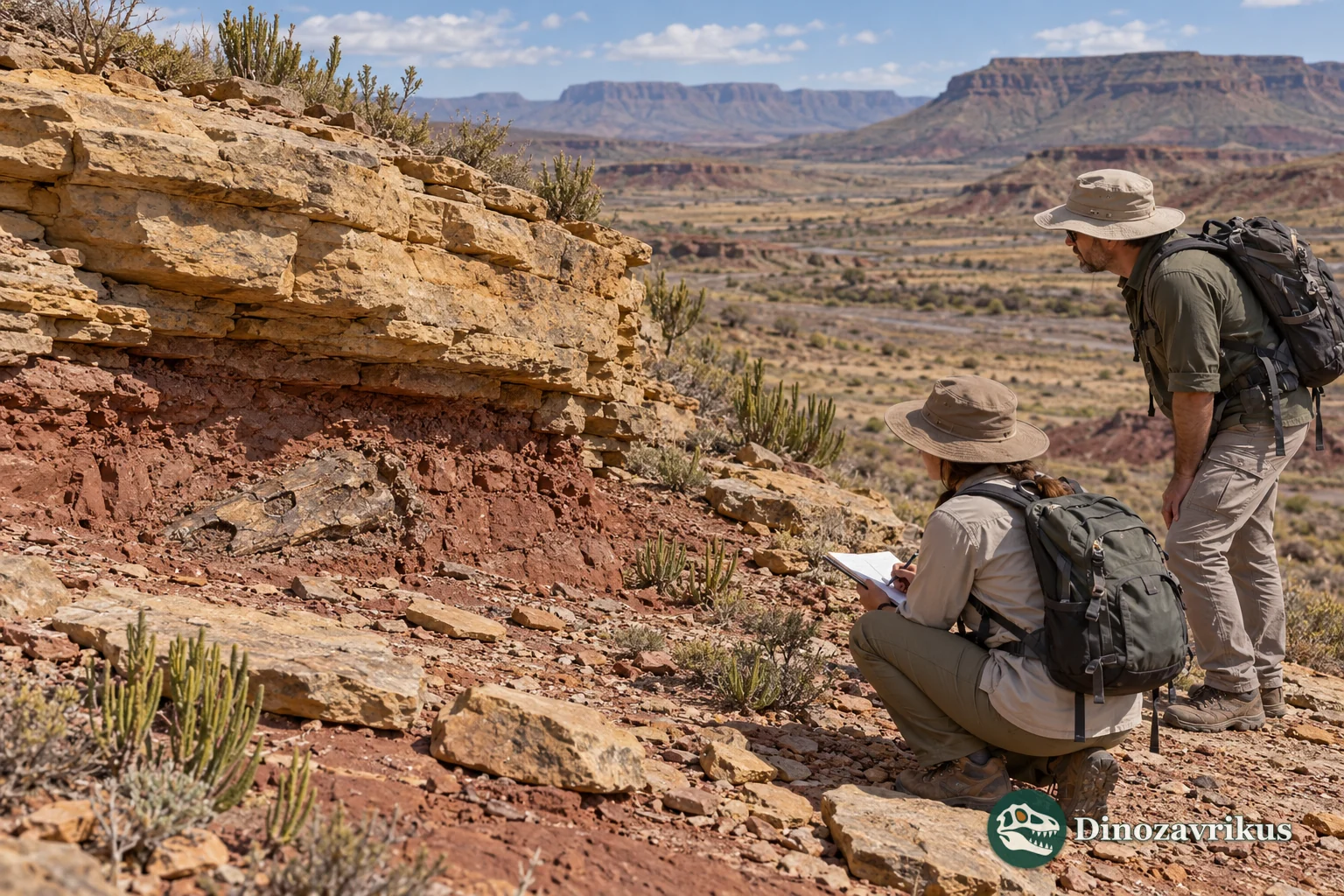
Specimens were collected at several farms in the Beaufort Group of the Karoo Basin. Some are correlated with subzone B and the Anisian based on associated fauna and stratigraphy; the bones themselves were not directly dated.
The 2008 review found no postcranial remains that could confidently be assigned to X. africanus. The skull supports a large aquatic predator, but body mass, soft-tissue colour, individual prey and a complete silhouette remain uncertain.
From Capitosaurus to Xenotosuchus
Robert Broom introduced the name africanus from South African Triassic material in 1909. Later authors placed the species in different capitosauroid genera, including Parotosuchus and Wellesaurus. These combinations reflect the difficulty of comparing incomplete skulls in a group with many shared cranial features.
In 2002, Morales and Shishkin re-evaluated the species and described the nearly complete skull UCMP 41286. Comparison with the name-bearing type showed a distinctive combination of features, and the authors established Xenotosuchus. Older references to Parotosuchus africanus therefore concern the same species under an earlier genus assignment.
The lectotype SAM-PK-2360 is a posterior skull from Vaalbank, with part of the left lower jaw also discussed. It does not preserve the whole head. UCMP 41286 supplied more anatomy, but still lacked some regions. In 2008 Ross Damiani described CGP/1/135, a larger skull collected in a small mudstone pocket within channel sandstone at Prospect farm.
Several localities in the Karoo Basin
Referred specimens come from Vaalbank, Winaarsbaaken, Matabele, Koudekraal, Nooitgedacht and Prospect in parts of the Eastern Cape and Free State. These are separate collection localities, not one mass burial. They are associated with the Cynognathus Assemblage Zone of the Beaufort Group. Some material is correlated with subzone B and probably the Anisian, an Early to Middle Triassic interval.
The age is biostratigraphic. At Prospect, the fossil-bearing succession is also associated with the cynodont Diademodon and dicynodont Kannemeyeria, which help correlate rock layers. The skull was not directly dated, and specimens from different farms need not come from the same exact horizon.
What the half-metre skull tells us
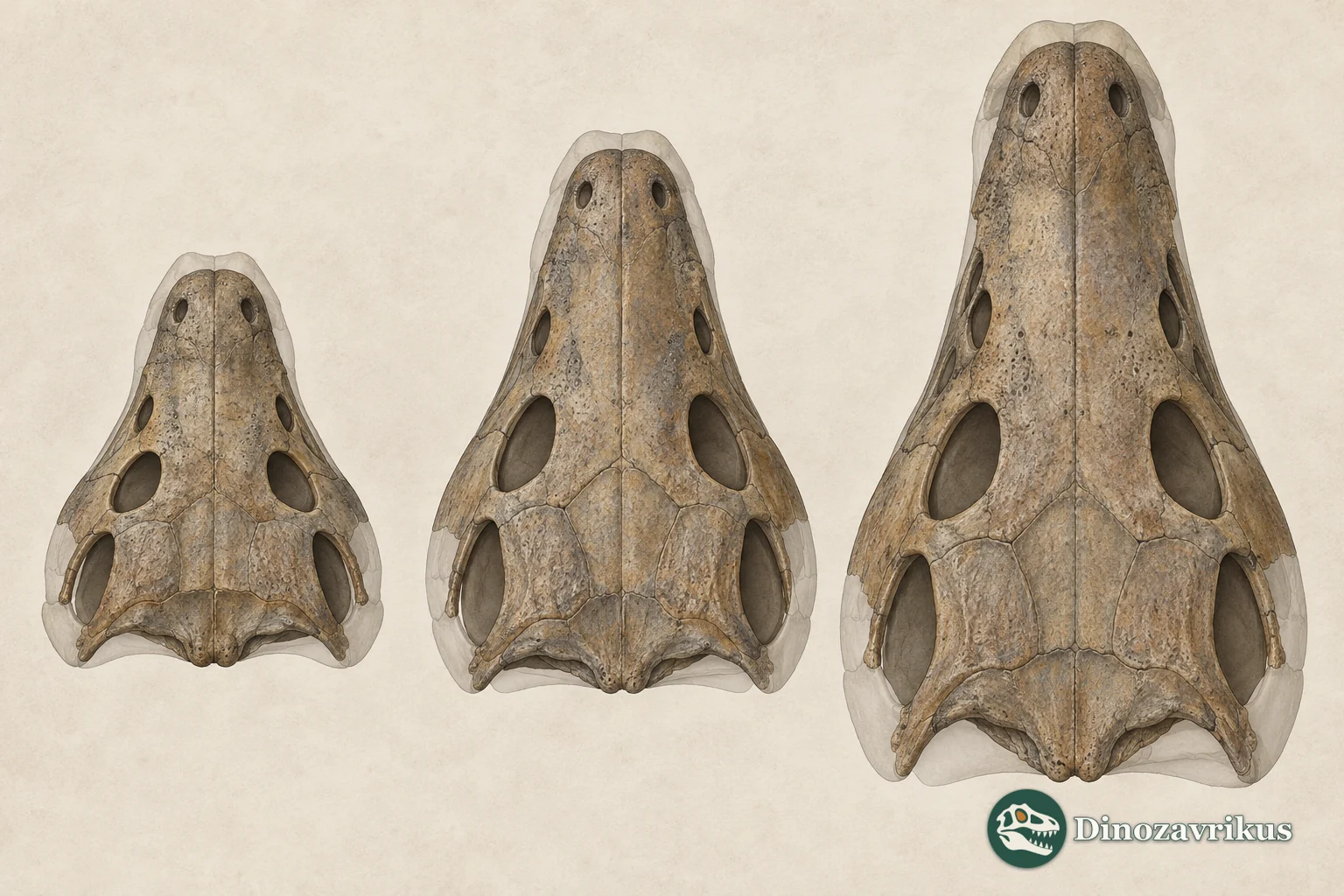
CGP/1/135 preserves about two-thirds of a large skull, with missing regions completed in plaster. Damiani estimated its midline length at about 500 mm. Earlier specimens were estimated at roughly 285–300 mm, also in some cases from incomplete margins. These values describe skulls, not total animal length.
In the smaller UCMP 41286, the snout made up about 55% of skull length; in the presumed adult CGP/1/135 it made up about 68%. Skull width across the quadratojugals remained near 79% of skull length. The comparison suggests that the snout lengthened proportionally as the animal grew.
The larger specimen was interpreted as a mature adult using several features, including bone ornament, ossification, orbit proportions and skull shape. Size alone was not treated as a reliable age test. Sexual dimorphism was considered as an alternative explanation for the size difference, but Damiani regarded it as less likely because clear evidence of such dimorphism was not known in temnospondyls.
Growth can change a taxonomic character
Morales and Shishkin listed diagnostic features based on UCMP 41286 and comparison with the type. Damiani’s larger specimen showed that several of these characters vary across the growth series. A curved lacrimal flexure in a smaller skull, for example, becomes closer to the Z-shaped condition in the larger specimen. Proportions of the postfrontals, frontals and palate also change.
A feature that appears to separate two fossils may therefore record a juvenile or subadult stage rather than a different species. That does not make the genus unrecognisable; it means diagnosis should use multiple characters and account for age. With a small sample, individual variation remains difficult to separate from growth.
Predation and the limits of the fossil record
The broad, flattened skull and numerous teeth are consistent with a large aquatic predator. No stomach contents, securely associated prey, bite marks or coprolites are reported for Xenotosuchus in the principal skull study. A specific prey species or hunting tactic would go beyond the evidence.
Damiani noted that no postcranial bones could then be confidently referred to X. africanus. The skull supports a substantial amphibian, but it does not directly measure body length or mass. The body in the cover is a conservative comparison with related capitosauroids; colour, soft tissues and exact posture are artistic choices.
Xenotosuchus is listed in the ancient amphibian catalogue and lived during the Triassic Period. It can be compared with another South African Triassic amphibian, Kestrosaurus, as part of the regional record, without assuming the two had the same anatomy or precise age.
Frequently asked questions
Why was Xenotosuchus once called Parotosuchus africanus?
The species moved among genera as incomplete skulls were re-evaluated. A near-complete skull allowed Morales and Shishkin to establish Xenotosuchus in 2002.
How long was its skull?
The midline length of CGP/1/135 was estimated at about 500 mm. Smaller specimens were estimated around 285–300 mm; these measurements are for skulls, not bodies.
Is a complete skeleton known?
No postcranial remains have been confidently assigned to X. africanus in the 2008 review. The known record is dominated by skulls.
What did the growth series show?
The snout formed a larger share of skull length in the larger specimen. The study interpreted this as likely growth-related, while noting the small sample and alternative explanations.