

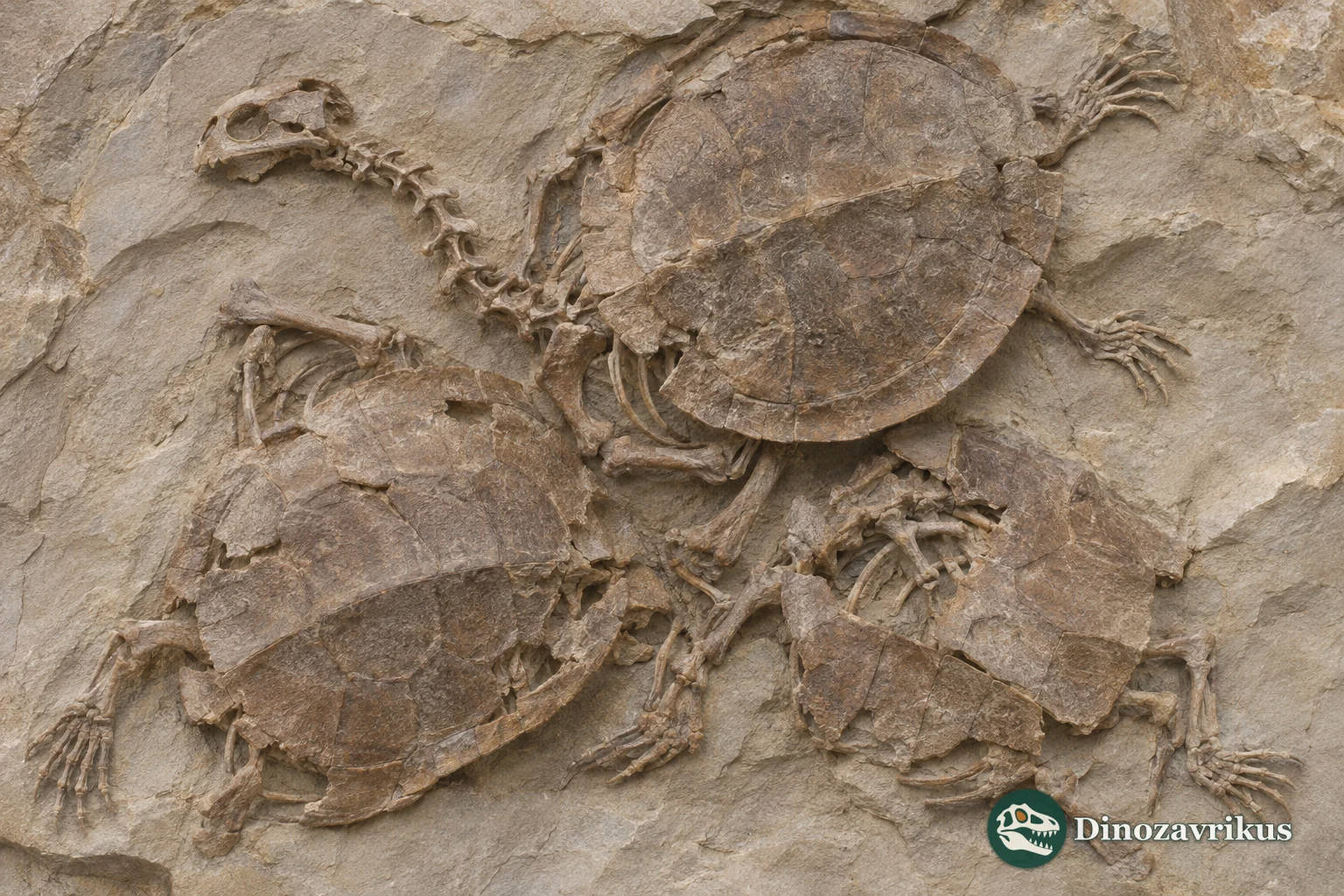
Xinjiangchelys was a Jurassic turtle from Asia. The genus was erected for an incomplete specimen from the Junggar Basin. Three turtles from the Turpan Basin were preserved close together. Two retain parts of the skull, making it possible to study anatomy that shells alone cannot reveal.
Quick facts
| Group | Turtles, family Xinjiangchelyidae |
|---|---|
| Age | Jurassic |
| Region | Asia: Xinjiang, China |
| Type species | Xinjiangchelys junggarensis |
| Material | Shells, partial skeletons and skulls |
| Scientific name | Xinjiangchelys |
| Diet | No direct evidence |
What can the fossils tell us?
The Turpan specimens preserve complementary parts of the skeleton. Their position together in the rock leaves their social behaviour unknown.
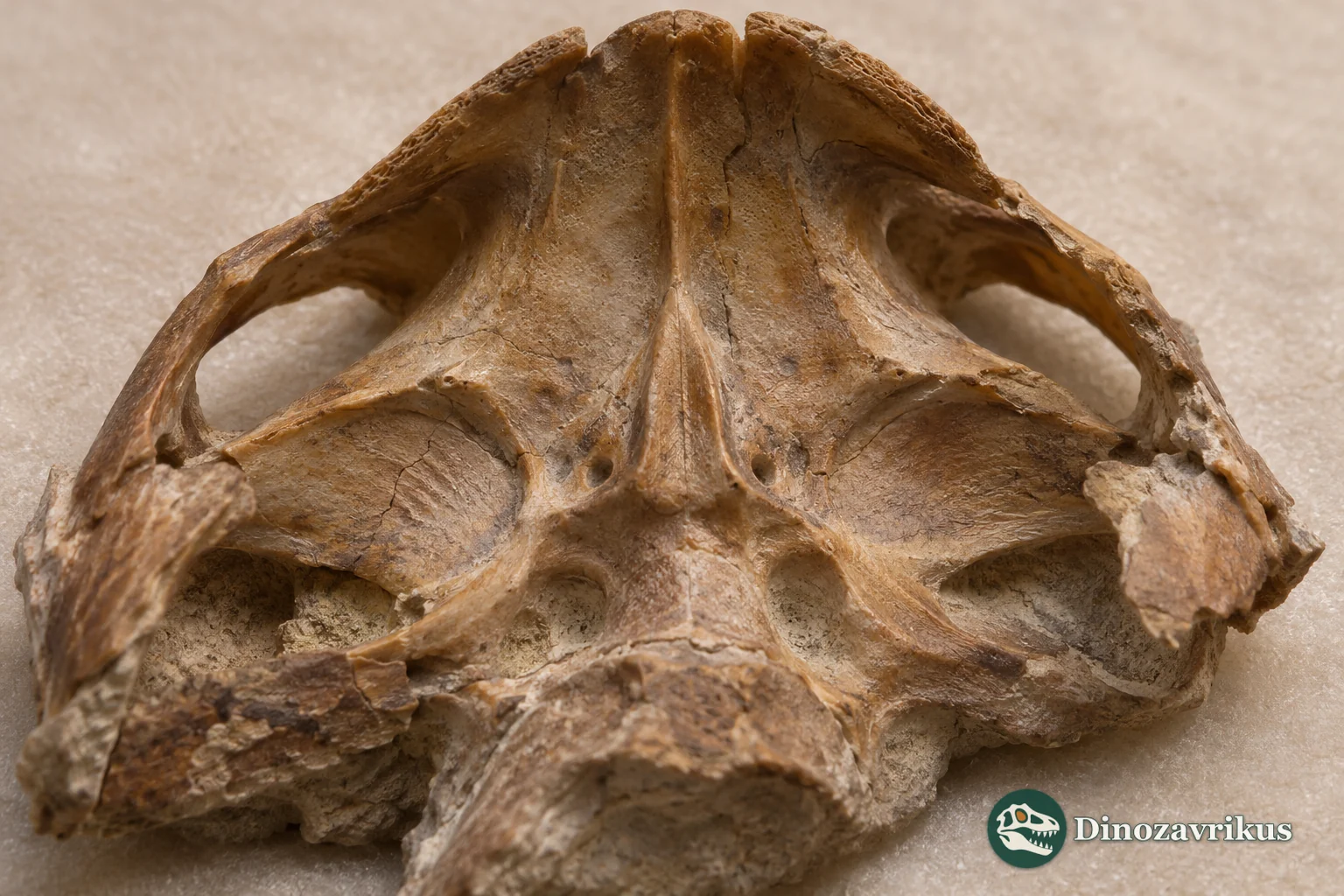
Openings and a groove on the underside of the skull of X. wusu indicate where arteries ran. The soft vessels themselves are gone.
Specimen IVPP V18100 preserves several rim bones in contact and dates to the Oxfordian. The Turpan site requires its own stratigraphic evidence.
Fossils from two basins
The type species, X. junggarensis, was described in 1986 from the Jiangjunmiao area of the Junggar Basin. A later find from the upper Shishugou Formation, IVPP V18100, preserves its first three left peripheral bones in articulation.
In 2013 Márton Rabi and colleagues named X. wusu for material from the Turpan Basin. The holotype PMOL-SGP A0100-1 exposes the top of the skull and a series of neck vertebrae. Specimen A0100-3 exposes the base of the skull alongside the lower jaw and hyoid bones. The third preserves parts of the shell and limbs.
What the skulls revealed
At the base of the skull, a bony process formed part of the connection with the palate. Openings and a groove exposed on the underside record the path of part of the internal carotid system. In some later turtles, bone encloses comparable passages.
The shell offers another set of traits. The midline sulcus on the plastron of X. wusu is straight, while in some close relatives it curves. A series of shells helped researchers study growth in the Late Cretaceous Mongolemys. The Turpan specimens are particularly valuable because they associate shell traits with skulls.
Dating the finds
The upper Shishugou specimen dates to the Oxfordian in the Late Jurassic. The Turpan locality was tentatively assigned to the Qigu Formation. The exact age of the fossil bed there depends on local correlations, so each find retains its own stratigraphic context.
Frequently asked questions
Where was the type species found?
It was found in the Junggar Basin of Xinjiang. The species X. wusu was described from the separate Turpan Basin.
What did the Turpan fossils preserve?
Three partial skeletons preserve parts of the shell, limbs and neck. Two provide views of the skull from different sides.
Why are the skulls important?
They record the shape of bony joints and the positions of arterial passages, features that cannot be read from a shell.
What did Xinjiangchelys eat?
Direct evidence of diet is unavailable. The jaws allow anatomical comparisons with related turtles.