

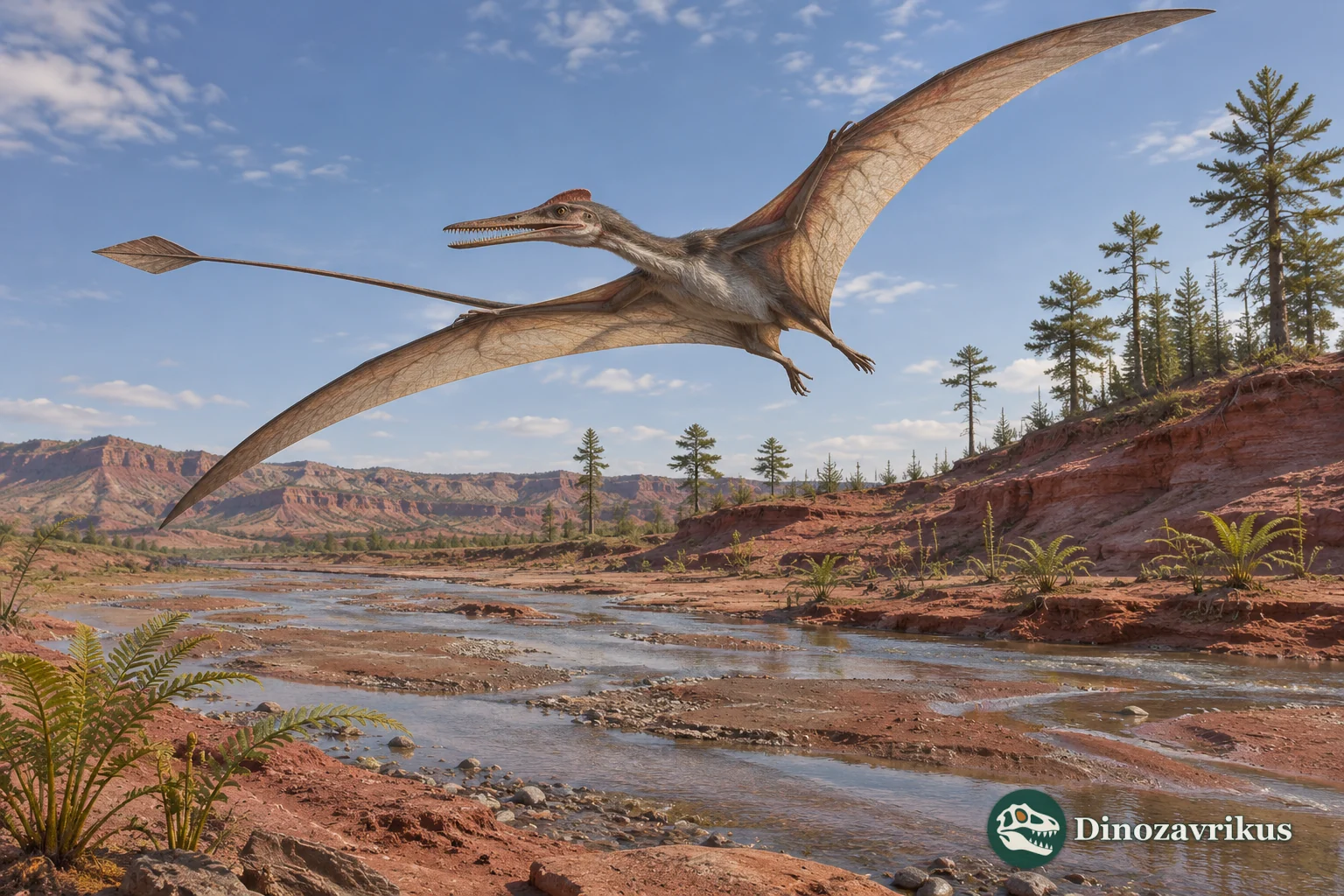
Yelaphomte praderioi is known from a 15.4 mm fragment of upper snout found in Late Triassic rocks in San Juan Province, Argentina. It preserves teeth, part of a bony crest and internal air spaces. No wing, body or tail of this species was found with it. The complete animal on the cover is an artistic reconstruction.
Quick facts
| Named species | Yelaphomte praderioi, Martínez and colleagues, 2022 |
|---|---|
| Holotype | PVSJ 914, fragment of the upper rostrum |
| Repository | Instituto y Museo de Ciencias Naturales, San Juan |
| Locality | Quebrada del Puma, Caucete Department, Argentina |
| Rock unit | Quebrada del Barro Formation |
| Age | Late Norian to Rhaetian, Late Triassic |
| Preserved length | 15.4 mm of snout, not total skull length |
| Wingspan | Unknown; no wing bones belong to the holotype |
What can the fossils tell us?
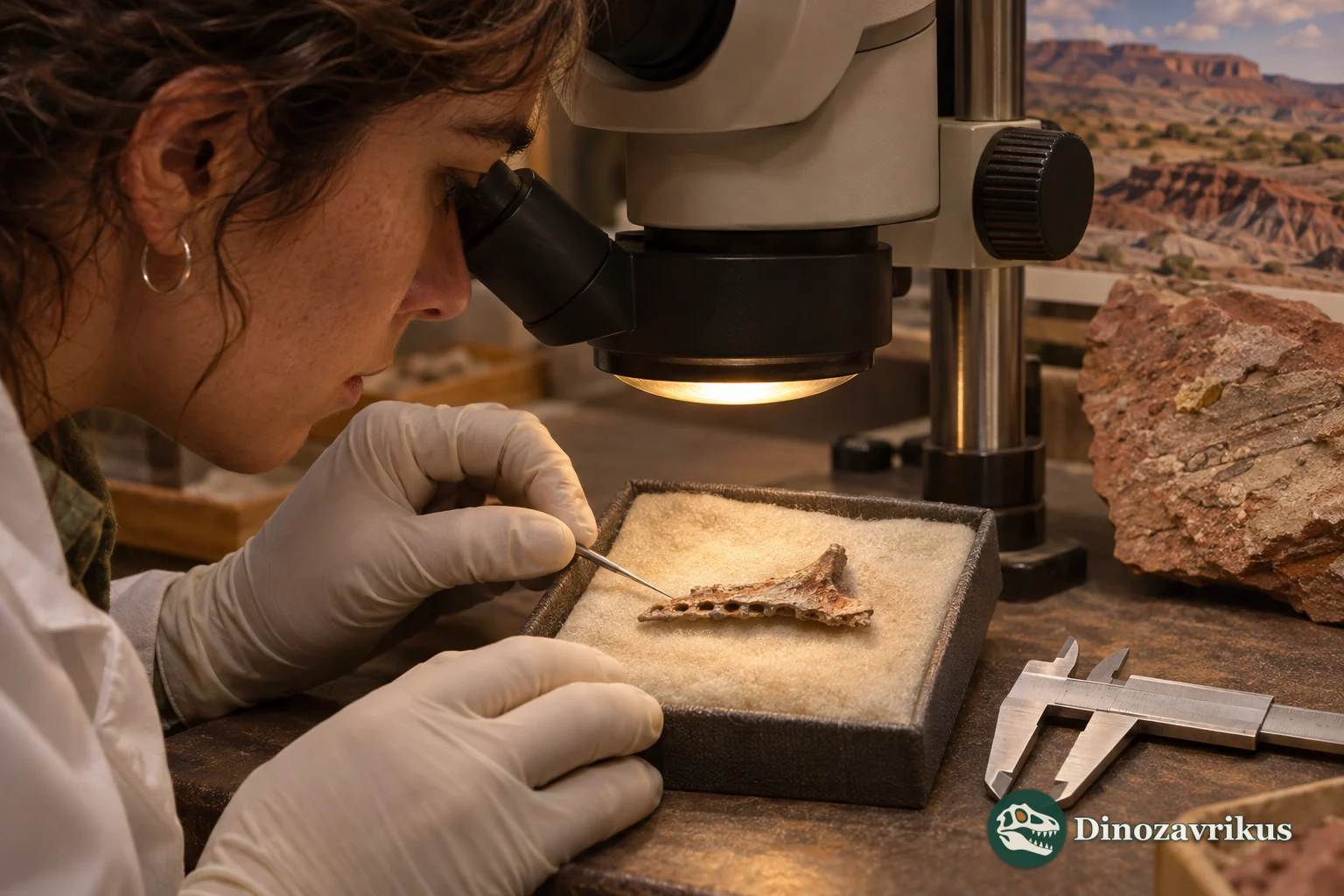
PVSJ 914 preserves 15.4 mm of upper snout. Its front tip, rear skull and lower jaw are missing.
A thin bony crest bears spaced radial grooves. Broken margins prevent a reliable restoration of its full height or shape.
Computed tomography revealed internal trabeculae and pneumatic cavities. It did not measure lung size or flight performance.
The Quebrada del Barro Formation is dated broadly to the late Norian-Rhaetian interval. The exact age of the individual remains unknown.
A find at Quebrada del Puma
Ángel Praderio found PVSJ 914 in Caucete Department. Ricardo Martínez, Brian Andres, Cecilia Apaldetti and Ignacio Cerda named Yelaphomte praderioi from this fossil in 2022. The species honours the finder. The genus combines words from Allentiac, a language of the Huarpe people of San Juan, meaning a beast of the air. The name describes the authors' interpretation rather than a measurement of the animal.
The fragment came from reddish muddy sandstone roughly 60 m below the top of the Quebrada del Barro Formation. Its rock unit is assigned to the late Norian-Rhaetian interval. The 2022 paper treated the finds as the first unequivocal Triassic pterosaur records from the Southern Hemisphere, extending the known geographical record at that time.
Teeth and a broken crest
The fossil includes parts of the premaxillae, maxillae and palatine bones. At least six pairs of slightly forward-leaning teeth were described. The anterior part of the preserved maxilla has no teeth, but the extreme snout tip is missing. Neither an entirely toothless nor a fully toothed beak should be inferred from that limited section.
A thin midline bony plate rises from the preserved bone. Its sides have widely spaced radial grooves that help distinguish the species. The front, rear and top edges are broken. Its preserved height of 3.7 mm therefore cannot stand in for the original height. CT scans showed internal partitions and air spaces, but they do not yield a body mass, lung volume or flight speed.
A neighbour with different bones
The same study described Pachagnathus from a different, mainly lower-jaw specimen in the area. Limited overlap makes comparison demanding, yet the authors identified differences in tooth sockets and tooth direction and named two species. Co-occurrence does not demonstrate that the two fossils were one animal or sexes of one species.
A phylogenetic analysis placed Yelaphomte among raeticodactylids. Austriadactylus offers a more complete early pterosaur comparison for skull and crest anatomy. Relationship does not supply the missing Argentine wings or a measured size.
What cannot be recovered
Neither body length nor wingspan can be measured from this holotype. Teeth do not identify a particular prey without direct feeding evidence. Sex, growth, behaviour and original colour are unknown. Illustrations show a plausible Triassic pterosaur while distinguishing the actual fragment from comparison-based anatomy.
Frequently asked questions
What is the Yelaphomte holotype?
PVSJ 914 is 15.4 mm of preserved upper snout, not a complete skull or skeleton.
Did its crest survive?
Part of a thin grooved crest survives, but broken margins prevent reconstruction of its full height and outline.
How were its internal cavities studied?
The researchers used CT imaging to examine the trabeculae and air spaces inside the snout bone.
Do we know its wingspan or prey?
No wing bones are preserved with the holotype, and teeth alone do not identify a particular diet.