

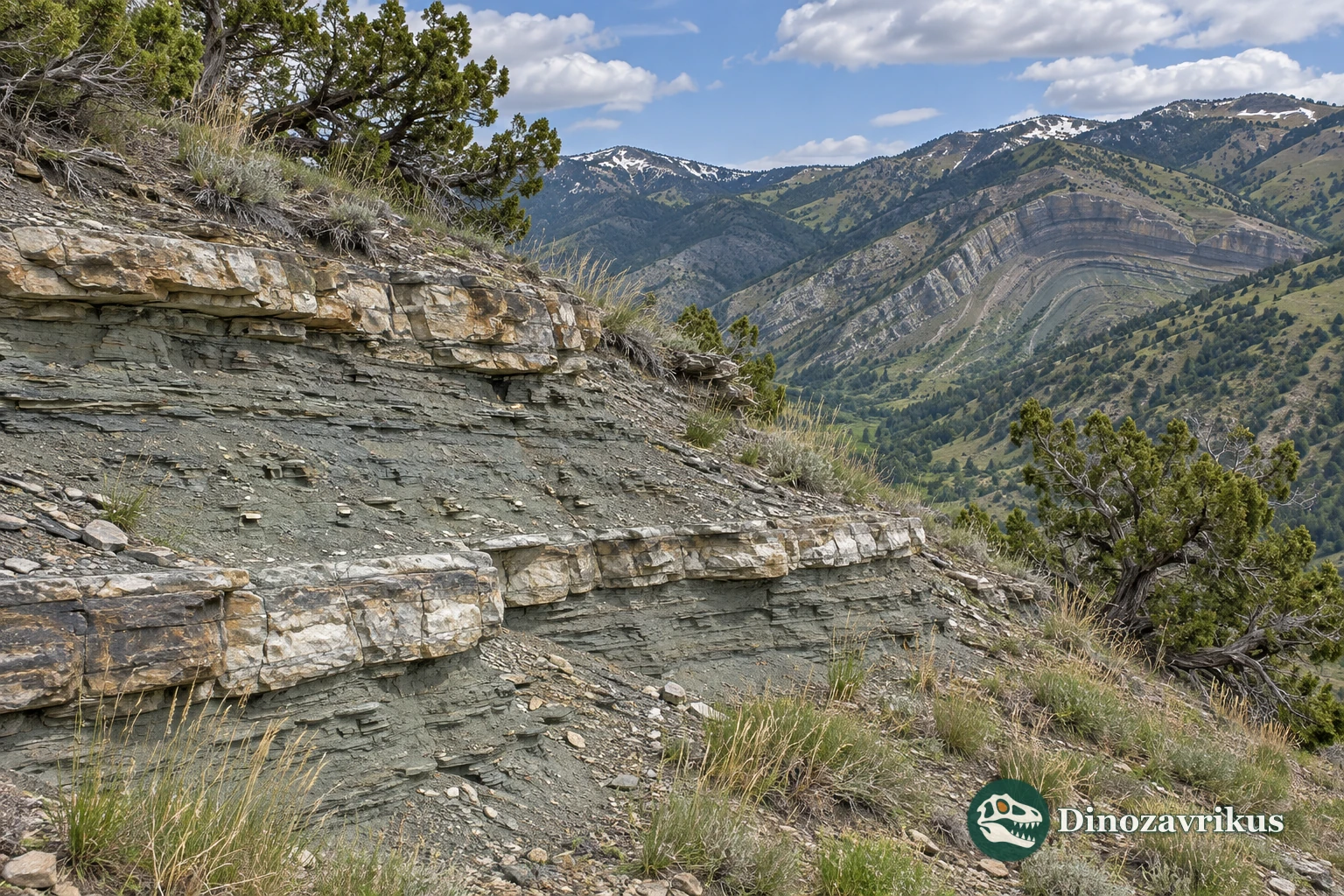
Zacanthoides was a Cambrian trilobite with spines on the head, along the sides of the trunk and on its axis. In two species from Canada and Utah, an especially long spine rose from the eighth trunk ring. Utah shale preserves articulated shells as well as a cluster of remains in different postures.
Quick facts
| Group | Zacanthoidid trilobites |
|---|---|
| Age | Cambrian, Miaolingian Series |
| Genus name introduced by | Charles Doolittle Walcott, 1888 |
| Type species | Zacanthoides romingeri |
| Type species locality | Mount Stephen, British Columbia |
| Articulated Utah fossil | Holotype UU 10051.22 |
What can the fossils tell us?
Nine trunk rings and the needle-like spine on the eighth are visible in Zacanthoides romingeri. These fossils do not preserve the soft parts.
The side spines peak in length around the sixth ring in Zacanthoides liddelli. Shape alone does not reveal their function.
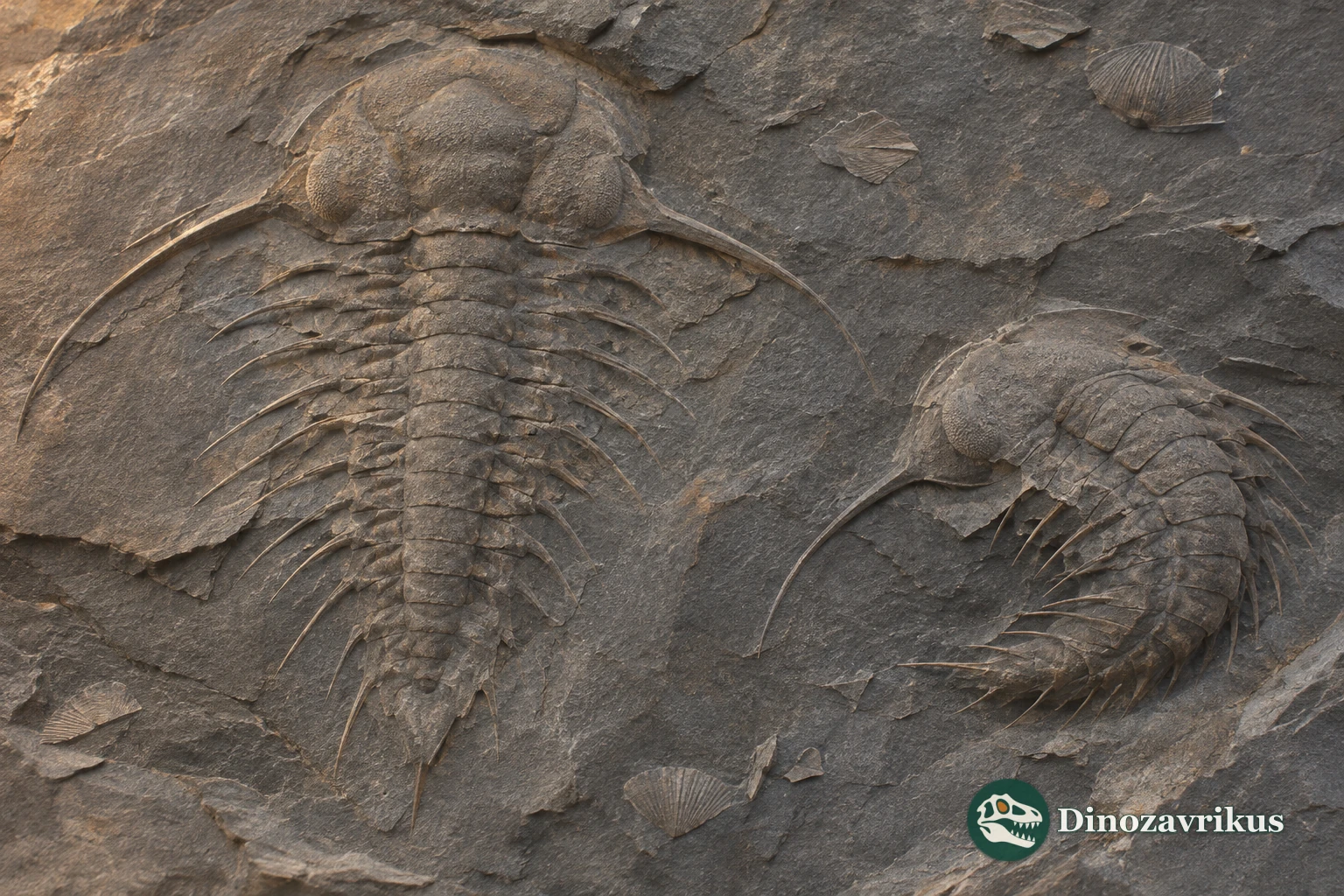
It includes an outstretched shell, partly enrolled remains and a moult. The cluster could include remains transported before burial.
From Rominger's fossil to the modern name
In 1887 Carl Rominger described a spiny trilobite from Mount Stephen, British Columbia, as Embolimus spinosa. The genus name was already occupied. Walcott introduced Zacanthoides in 1888. In 1942 Charles Resser named the Canadian species Zacanthoides romingeri because the combination Zacanthoides spinosus was also in use for a different species.
A needle-like spine on the eighth ring
Zacanthoides romingeri has a broad head with strong cheek spines. Nine movable segments lead back to a small tail shield with five pairs of marginal spines. A slender spine projects from the axial ring of the eighth segment. One nearly complete Royal Ontario Museum specimen, ROM 60663, is 58 mm long.
The holotype of Zacanthoides liddelli from the Spence Shale of Utah also carries a long spine on the eighth ring. Specimen UU 10051.22 is 30 mm long including that spine. The lateral tips lengthen to around the sixth segment and then shorten. The ends of the segments are pointed in Kochiella from other Cambrian beds too, while its conspicuous paired projections are on the tail shield.
Five remains on one slab
One Spence Shale slab holds five remains assigned to Zacanthoides liddelli. One shell is outstretched, two are loosely enrolled, a fourth was identified as a moult and the fifth is a detached head shield. Their varied condition helps researchers examine how the remains entered the sediment. The study also considered transport by currents, so their association alone cannot demonstrate that living animals gathered in groups.
Frequently asked questions
What is the type species of Zacanthoides?
It is Zacanthoides romingeri, originally described as Embolimus spinosa from Mount Stephen.
Which segment carries the long dorsal spine?
The eighth trunk ring in both Zacanthoides romingeri and Zacanthoides liddelli.
How large are the illustrated specimens?
The nearly complete Canadian specimen ROM 60663 is 58 mm long. The Zacanthoides liddelli holotype is 30 mm long including the dorsal spine.
Why are the fossils on the Utah slab in different positions?
The slab holds outstretched and loosely enrolled shells, a moult and a detached head. The remains could have entered the deposit separately or been moved by currents.