

Zhenyuanopterus longirostris was described from a nearly complete Early Cretaceous skeleton with a long, densely toothed skull. A separate smaller skeleton later supplied tail information and a limited comparison of growth. Neither specimen directly records its prey or habitual hunting place.
Quick facts
| Species | Zhenyuanopterus longirostris, Lü, 2010 |
|---|---|
| Holotype | Nearly complete skeleton with skull and lower jaws |
| Other specimen | XHPM1088, a smaller partial skeleton |
| Locality | Beipiao area, Liaoning, China |
| Formation | Yixian Formation, Early Cretaceous |
| Dentition | Over 160 teeth in total, front teeth larger |
| Tail | 15 vertebrae in XHPM1088; holotype tail incomplete |
| Placement | Boreopteridae in the original study |
What can the fossils tell us?
The type preserves toothed jaws and much of the skeleton. Its incomplete tail does not establish a caudal count.
The anterior teeth are larger than those farther back. Their form supports feeding hypotheses but not a proven fish diet.
XHPM1088 has an almost complete tail. It is a separate referred specimen, not a physically recovered missing part of the holotype.
The smaller humerus and femur are slightly more than half the corresponding type lengths. Similar ratios suggest comparable growth, but two individuals cannot define a full growth curve.
The original skeleton
Lü Junchang named Zhenyuanopterus longirostris in 2010 from Yixian Formation material in Liaoning. The holotype retains a skull, lower jaws and most of the postcranial skeleton, although its tail is incomplete. The long low skull carries many sharp teeth, with larger teeth near the front. The author classified it as a boreopterid.
The 2014 study described more than 160 teeth in total. Narrow pointed teeth invite ideas about catching slippery prey, but the bones do not include a documented stomach meal. Boreopterus is a useful comparison within the regional toothed fauna, not evidence of identical diets.
A second, smaller specimen
The later study assigned XHPM1088 from the same Beipiao locality to Zhenyuanopterus based on shoulder anatomy and limb proportions. It is a partial skeleton lacking the skull and much of the vertebral column. Its humerus and femur are slightly more than half the corresponding holotype lengths.
The smaller fossil preserves an almost complete tail with 15 caudal vertebrae. This count comes from XHPM1088, not the broken tail of the type. The two specimens also show a similar humerus-to-femur ratio, while shoulder elements may have grown at a different relative rate. The holotype coracoid is incomplete, so a precise whole-animal growth model would exceed the evidence.
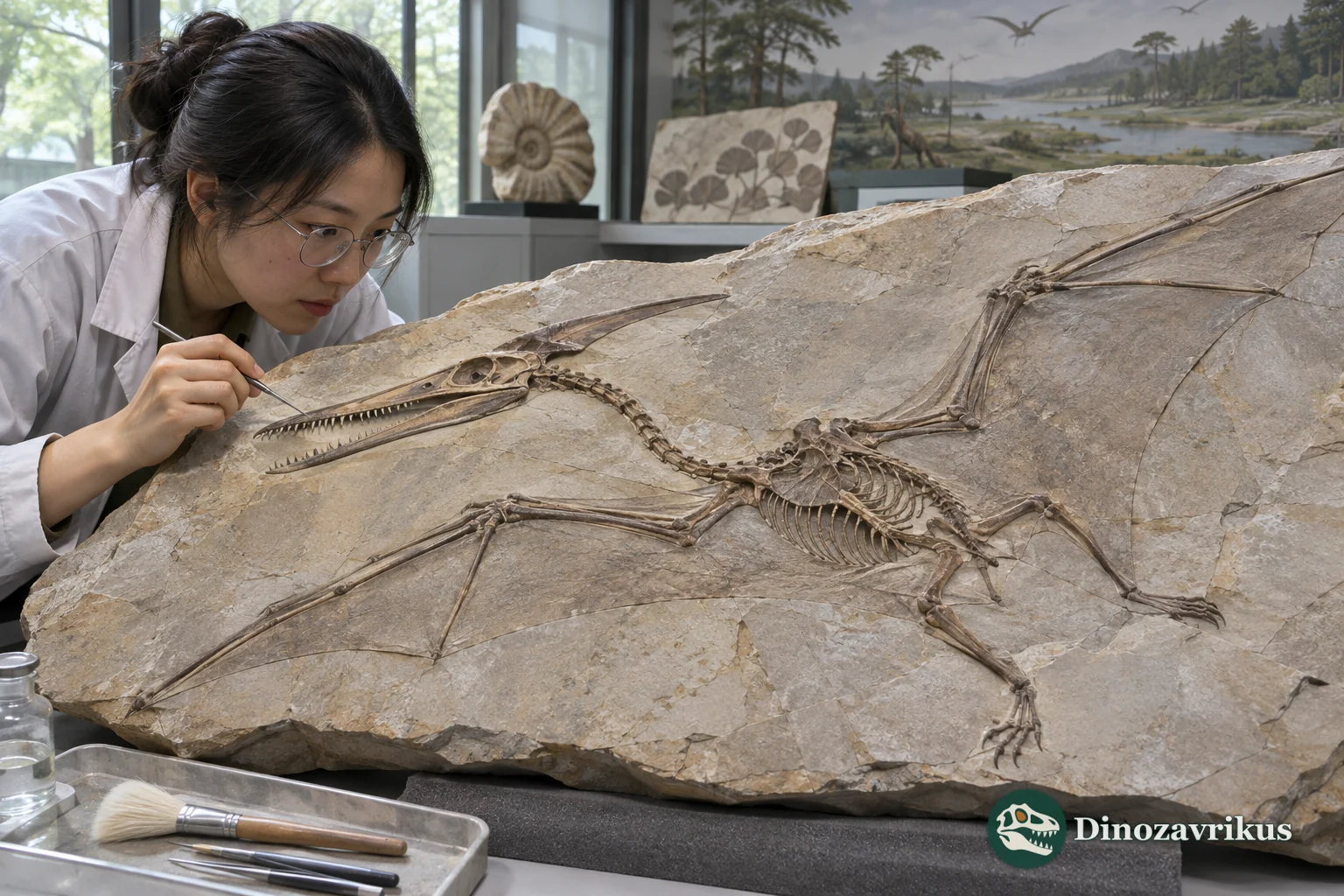
Size and life habits
The 2014 authors estimated an adult wingspan greater than four metres from skeletal proportions. This is not a direct measurement of a complete spread wing. Robust forelimbs and small feet led them to suggest limited time on land, but bones do not measure flight duration or landing style.
Yixianopterus also came from the Yixian Formation. Its revised holotype is a different fossil and must not be combined with either Zhenyuanopterus skeleton.
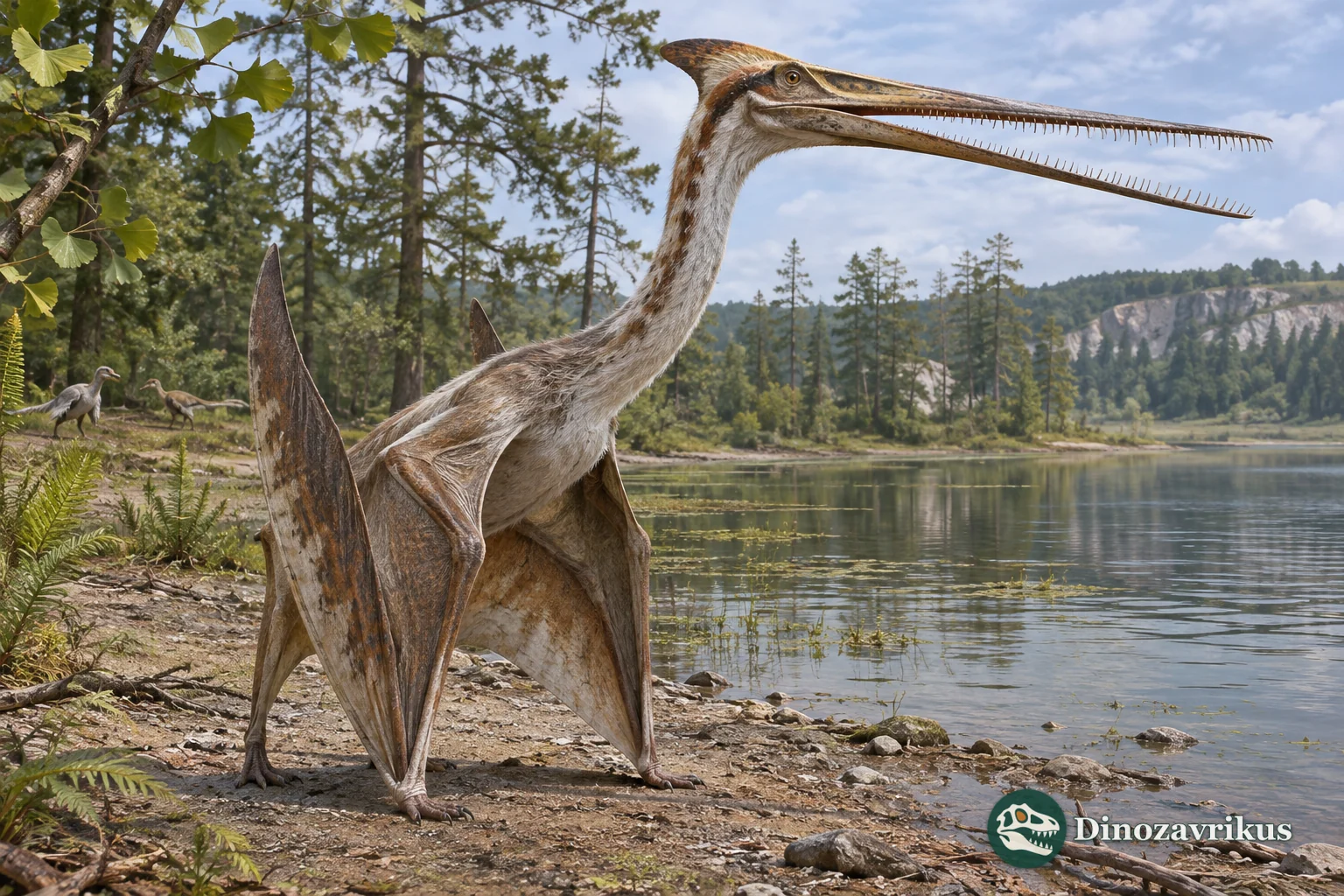
Limits of the scenes
Neither slab preserves original colour, prey remains, reproductive evidence or a specific lakeshore event. The illustrations portray one possible appearance and setting while keeping the holotype and smaller referred specimen distinct.
Frequently asked questions
How many Zhenyuanopterus specimens were described in detail?
The original description used a nearly complete holotype, and a 2014 study added the smaller partial skeleton XHPM1088.
Why is its tail count known if the holotype tail is incomplete?
XHPM1088 preserved an almost complete tail with 15 caudal vertebrae.
Do its many teeth prove that it ate fish?
No. Tooth shape informs feeding hypotheses, but direct food remains were not described for these specimens.
Was a wingspan over four metres directly measured?
No. It was an adult-size estimate from skeletal proportions rather than a complete outstretched wing.