

Yixianopterus jingangshanensis was named from a partial Early Cretaceous skeleton in China's Yixian Formation. A later inspection found relocated jaws and artificial additions to its slab. The 2021 revision excluded those elements from the diagnosis but retained the species using genuine teeth and wing bones. The cover reconstructs a living animal, not the manufactured outline of the display specimen.
Quick facts
| Named species | Yixianopterus jingangshanensis, Lü and colleagues, 2006 |
|---|---|
| Holotype | JZMP-V-12, partial skeleton on a partly altered slab |
| Current repository | Benxi Geological Museum according to the 2021 revision |
| Horizon | Jingangshan bed, upper Yixian Formation, Liaoning |
| Age | Early Cretaceous |
| Reliable teeth | Triangular and flattened; first two longer and slimmer |
| Wing ratio | Second wing-finger phalanx about 93% of the first |
| Placement | Pteranodontoidea; narrower relationships unresolved |
What can the fossils tell us?
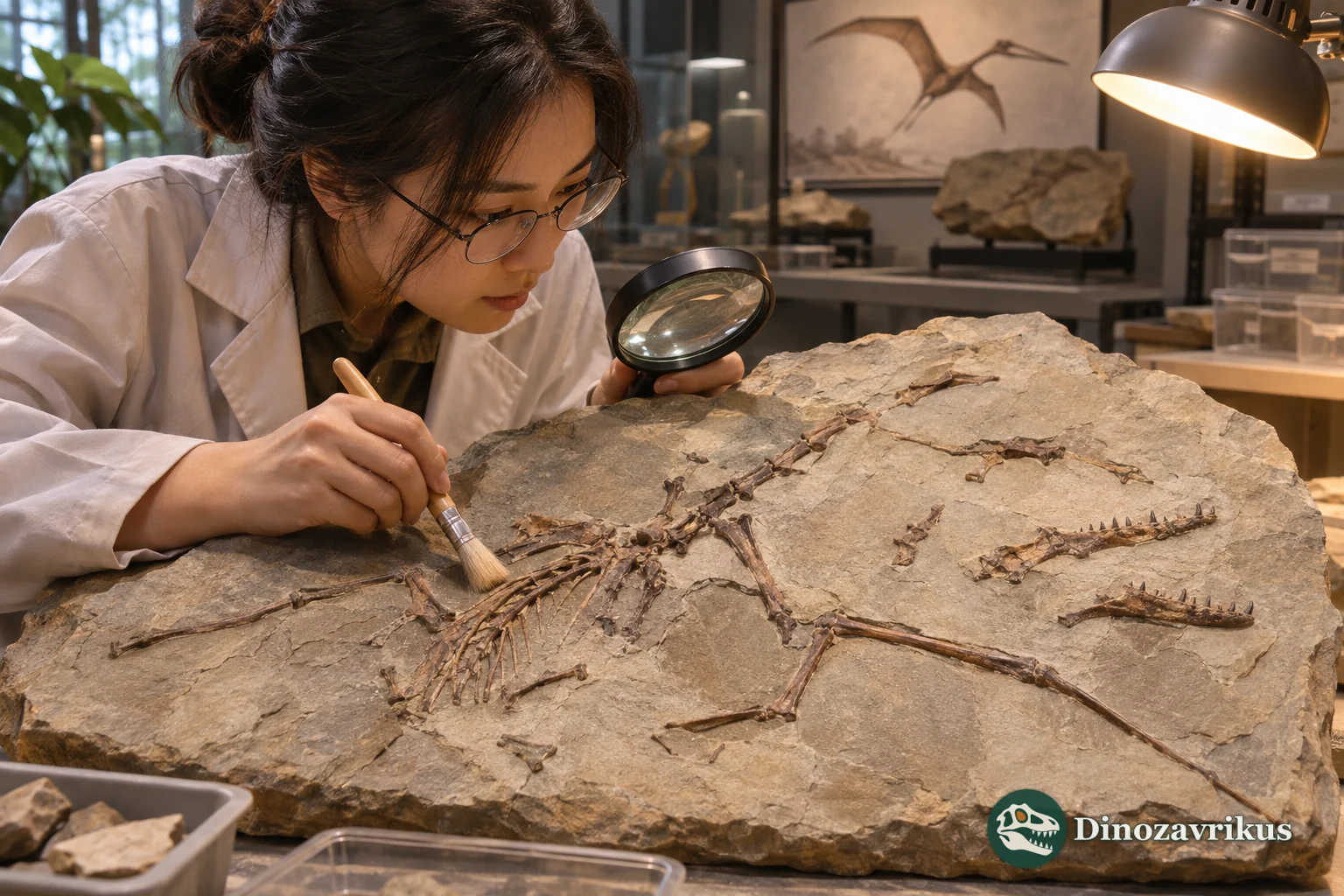
The anterior jaws were moved and other bones used to complete an apparent skull. The display outline is not the undisturbed fossil configuration.
Triangular laterally compressed teeth stand nearly vertically; the first two are longer and slimmer. Their shape does not demonstrate a particular prey.
The second wing-finger phalanx is about 93% as long as the first. An incomplete fourth metacarpal invalidated older ratios that assumed its full length.
IVPP V 26166 came from the same broader horizon but was not part of JZMP-V-12. The authors tentatively treated the finds as different taxa.
Why the holotype needed another look
Junchang Lü and colleagues named Yixianopterus jingangshanensis from JZMP-V-12 in the Jingangshan bed. The genus refers to the Yixian Formation and the species to the named bed. The short original description and limited imagery left questions about the specimen. Researchers later examined it in the Benxi Geological Museum.
Their 2021 revision reported that the front parts of the upper and lower jaws had been moved after discovery. Some postcranial bones were arranged to suggest a more complete skull, and fresh shale was added around the fossil. This affects the displayed outline, but it does not mean every bone is fake. The team separated genuine anatomy from manufactured regions and checked earlier measurements again.
A diagnosis built from genuine parts
Authentic teeth are triangular and compressed side to side. The first two are thinner and longer than those behind, and the teeth stand almost vertically to the biting surface. This combination helps distinguish the species from other Yixian pterosaurs. Tooth shape does not directly reveal fish or another exact prey, since no stomach contents were reported.
The second wing-finger phalanx measures about 93% the length of the first. The fourth metacarpal is incomplete, so several original ratios that treated it as complete were removed from the diagnosis. The revision also described a nearly complete foot overlooked in the short original account. A partial tibia limits some additional proportional comparisons.
Relationships and a separate forelimb
The authors placed Yixianopterus among pteranodontoids. In one analysis it fell with istiodactyliforms, but internal relationships remained unresolved. This refined its earlier tentative lonchodectid assignment without establishing a direct ancestral line. Haopterus offers another Yixian pterosaur for comparing teeth and wings.
The same paper described a separate forelimb, IVPP V 26166, from the upper formation. It was not attached to JZMP-V-12. Differences in forearm proportions led the authors to treat the two specimens tentatively as separate taxa. Gladocephaloideus came from the Jingangshan bed too, but sharing a horizon is not proof of close kinship.
Where reconstruction begins
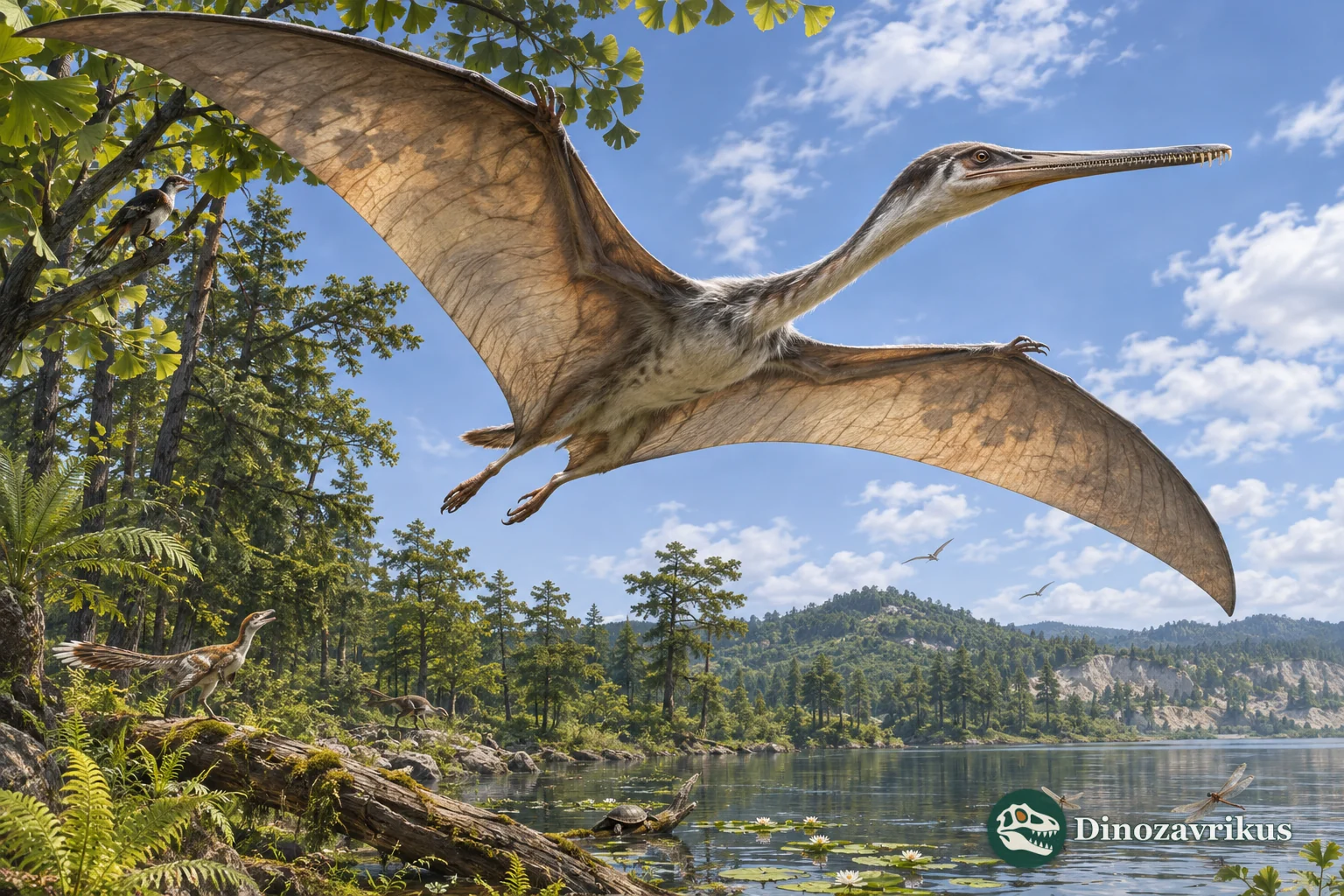
The Yixian Formation preserves lake and land fossils of the Jehol Biota, but the holotype does not document where this animal fed or nested. A fully reliable skull or complete wing is lacking. Body mass, exact wingspan and colour cannot be read off the display slab. Illustrations here are cautious interpretations of a toothed pteranodontoid based on the verified portions.
Frequently asked questions
Was the entire Yixianopterus holotype fabricated?
No. The 2021 team documented artificial additions and displaced parts but also studied genuine teeth, limb bones and other remains.
Why is it still a distinct species?
A revised diagnosis uses verified tooth form and direction together with the ratio of the first two wing-finger phalanges.
Does the newly described forelimb belong to it?
That limb, IVPP V 26166, is a separate fossil. The authors noted differences and tentatively treated the finds as different taxa.
Is its exact diet known?
No. Triangular teeth suggest a way to seize food, but they do not identify specific prey without direct dietary evidence.