

Zholsuchus procerus is known from isolated Late Cretaceous fossils in Central Asia. Its name-bearing specimen preserves only part of a bone from the tip of the snout. Other finds have led researchers to propose a long snout and an early place in the evolutionary branch that includes living crocodilians.
Quick facts
| Species | Zholsuchus procerus |
|---|---|
| Age of holotype | Late Cretaceous, Turonian |
| Type locality | Dzharakuduk, Uzbekistan |
| Rock unit | Bissekty Formation |
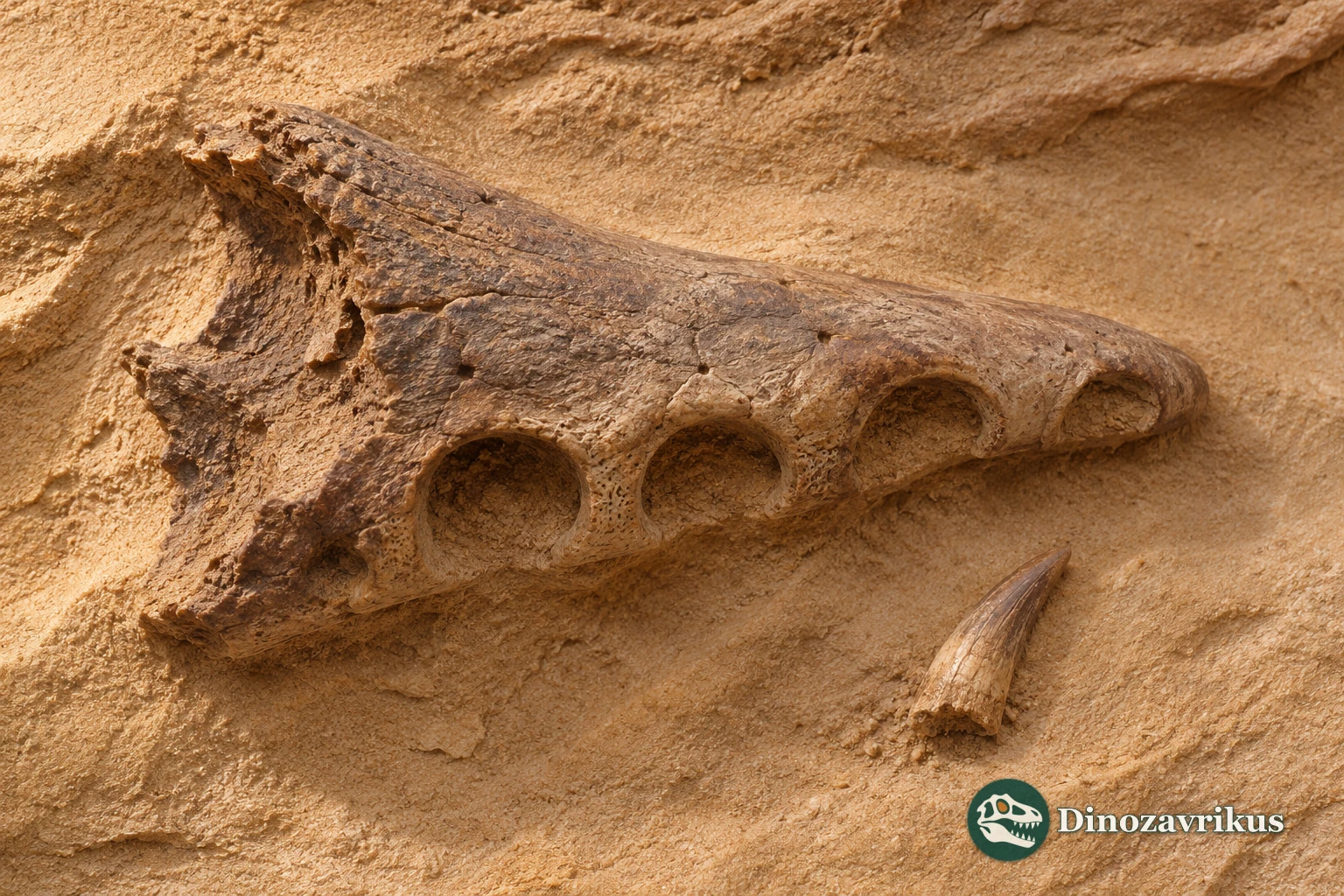
| Holotype | CCMGE 381/12457, partial right premaxilla |
| Relationships | Possible early member of Crocodylia |
What can the fossils tell us?
The right premaxilla preserves the anterior jaw region. The shape of the rest of the head depends on the association of other fossils.
A 2022 study compared additional Dzharakuduk material with the type. The proposed association rests on comparative anatomy and sampling of the assemblage.
Some features are consistent with the crown group that includes living crocodilians and their last common ancestor. Incomplete material makes the exact placement provisional.
The find from Dzharakuduk
Lev Nessov and Gennady Cherepanov described Zholsuchus in 1989. The holotype, CCMGE 381/12457, comes from Turonian rocks of the Bissekty Formation in the Kyzylkum Desert. It is part of the right premaxilla. Jaw fragments and teeth were originally referred to the same species.
Later reviews considered the type too fragmentary to diagnose. In 2022 Ivan Kuzmin examined a larger series of isolated finds from Dzharakuduk. He interpreted their size and compatible features as evidence for a single long-snouted form. His study also referred fragments from other sites in Uzbekistan and Kazakhstan to Zholsuchus.
What the revised interpretation suggests
Kuzmin proposed that Zholsuchus may be one of the early members of crown Crocodylia, the group containing the last common ancestor of living alligators, crocodiles and gharials and all its descendants. Paralligator illustrates the diversity of other Late Cretaceous Asian crocodyliforms close to the ancestry of modern groups.
Sandstones of the Bissekty Formation preserve ancient river channels. They show the setting in which some of the remains accumulated. No articulated Zholsuchus skeleton provides a direct measure of its overall size, and the known teeth do not identify particular prey.
Frequently asked questions
Which part of the skeleton forms the holotype?
Part of the right premaxilla, at the front of the upper jaw.
Where was the type found?
It comes from Turonian rocks of the Bissekty Formation at Dzharakuduk in Uzbekistan.
Why recognise the genus again?
A 2022 revision compared the type with more fragments and proposed that they belonged to one long-snouted taxon.
Was Zholsuchus an early crown crocodilian?
Comparative anatomy supports that possibility. The remains are incomplete, so the hypothesis is provisional.