

Abavornis comes from Late Cretaceous deposits at Dzharakuduk, Uzbekistan. It is one of several birds named from the coracoid, the bone that extends from the shoulder joint towards the breastbone. The right coracoid of the type preserves part of the shaft and its widening lower section.
Quick facts
| Group | Birds, probably Enantiornithes |
|---|---|
| Age | Late Cretaceous (Turonian) |
| Region | Central Asia (Uzbekistan, Dzharakuduk) |
| Diet | Exact diet unknown |
| Type species | Abavornis bonaparti |
| Holotype | TsNIGR Museum 56/11915, part of the right coracoid |
| Deposits | Bissekty Formation |
What can the fossils tell us?
The fragment preserves part of the shaft and the beginning of the broad end that faced the breastbone. It supplies features for comparing shoulder structure.
The incomplete coracoid ZIN PO 4605 has a broad lower section, as do several other birds from these beds. That feature alone cannot demonstrate that the two fossils belong to one species.
The rocks place the find in the Late Cretaceous. Isolated bones from the locality give little direct evidence of this particular bird's flight or diet.
An incomplete bone from Dzharakuduk
Andrei Panteleev described Abavornis bonaparti in 1998. The name is based on specimen 56/11915, held by the TsNIGR Museum in St Petersburg. A later study of the shoulder bones from Dzharakuduk treated the fossil as part of a Turonian assemblage in the Bissekty Formation.
The inner edge of the type coracoid curves markedly, creating a wide area towards the sternum. Panteleev compared outlines and cross sections of several Dzharakuduk coracoids in 2018. Some had much narrower expansions. Others shared the broad outline, with differences elsewhere on the bone.
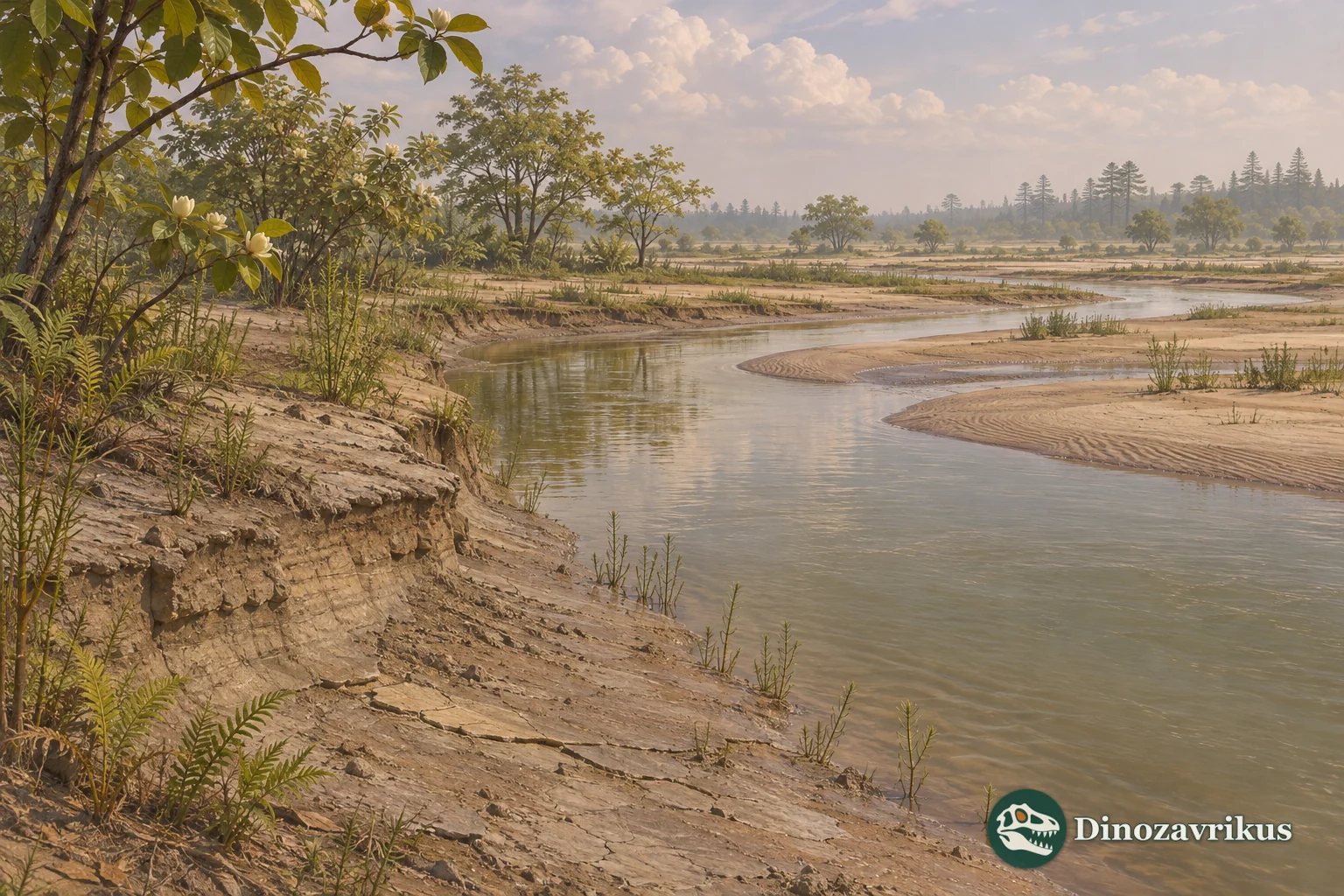
What the coracoid tells us
Another partial right coracoid, ZIN PO 4605, was referred to Abavornis without a species name. It resembles the type in part. Its attribution remains a comparison between incomplete bones, with little independent evidence to test the match.
Explorornis from Dzharakuduk also has comparable shoulder material. The same beds yielded Zhyraornis, whose type material preserves fused vertebrae. Such finds preserve different parts of anatomy. The Abavornis fragment leaves the shape of the head and wings and the details of its diet unresolved.
Frequently asked questions
Which bone defines Abavornis?
The type is part of the right coracoid. In a bird, the coracoid connects the shoulder region to the breastbone.
Where did Abavornis live?
The type was found at Dzharakuduk, in the central Kyzylkum of Uzbekistan, in rocks assigned to the Turonian.
Was Abavornis an enantiornithine?
Panteleev studied it among enantiornithines. The attribution is based on the shape of the surviving coracoid fragment.
Does Abavornis have a second fossil?
ZIN PO 4605 has been assigned to the genus without a species name. It shares some features with the type, and the identification remains tentative.