

Acostasaurus pavachoquensis is a pliosaurid plesiosaur from the Lower Cretaceous Paja Formation of Colombia. The holotype UNDG R-1000 preserves a nearly complete, three-dimensional skull with delicate structures, together with an associated, largely articulated skeleton. The 2017 description focused on the prepared skull and anterior neck; much of the rest of the fossil has not yet been fully prepared and described. A precise total length should therefore not be treated as established.
Quick facts
| Type species | Acostasaurus pavachoquensis |
|---|---|
| Group | Pliosaurid; a short-necked plesiosaur |
| Age | Lower Barremian, Early Cretaceous |
| Geological unit | Arcillolitas Abigarradas Member, Paja Formation; segment A |
| Locality | Near Sutamarchán, Boyacá, Colombia |
| Holotype | UNDG R-1000, nearly complete skull and associated skeleton |
| Prepared material | Skull and anterior cervical vertebrae; much of the body remains unprepared |
| Total length | No reliable published estimate from a fully prepared skeleton |
Evidence guide
UNDG R-1000 is largely articulated. The nearly complete skull and anterior neck were prepared and described; much of the associated skeleton remains embedded or undescribed.
A 2019 geological overview attributes the recovery near the Santo Ecce Homo Convent to a French technical-cooperation team working with Colombia's Ministry of Public Works. Contemporary collection records are absent.
The 2017 description documents the sclerotic plates, basicranium, olfactory region and mandibular symphysis. These are skeletal observations, not preserved soft tissue or direct evidence of behaviour.
Only the skull and anterior cervical vertebrae had been prepared for the detailed account. Until the remaining bones are studied, exact body proportions and total length remain uncertain.
A fossil recovered near Sutamarchán
The type specimen UNDG R-1000 was recovered in 1967 near the Santo Ecce Homo Convent, in the Sutamarchán area of Boyacá, Colombia. A later geological overview reports that a French technical-cooperation team working with the Hydrology Section of Colombia's Ministry of Public Works collected it. No contemporary collection records survive, so the discovery history relies on later documentation.
The fossil came from a large concretion containing ammonites that helped establish the age of the enclosing strata. It is assigned to lower Barremian segment A of the Arcillolitas Abigarradas Member of the Paja Formation. The age belongs to the rocks around the fossil; the bones were not directly dated radiometrically.
Marcela Gómez-Pérez and Leslie F. Noè described the genus and species in 2017. The genus name honours Colombian priest and geologist Carlos Eduardo Acosta Arteaga; the species name refers to the Pavachoque locality. These names document people and place, not anatomical features.
A three-dimensional skull
The prepared holotype includes a nearly complete skull and lower jaw. Its three-dimensional preservation retained fine anatomical detail in regions that are often poorly known in pliosaurs, including parts of the olfactory region, otic capsules, basicranium and sclerotic plates. Sclerotic plates are bony elements associated with the eye; they are not preserved eyeballs and do not by themselves demonstrate visual acuity.
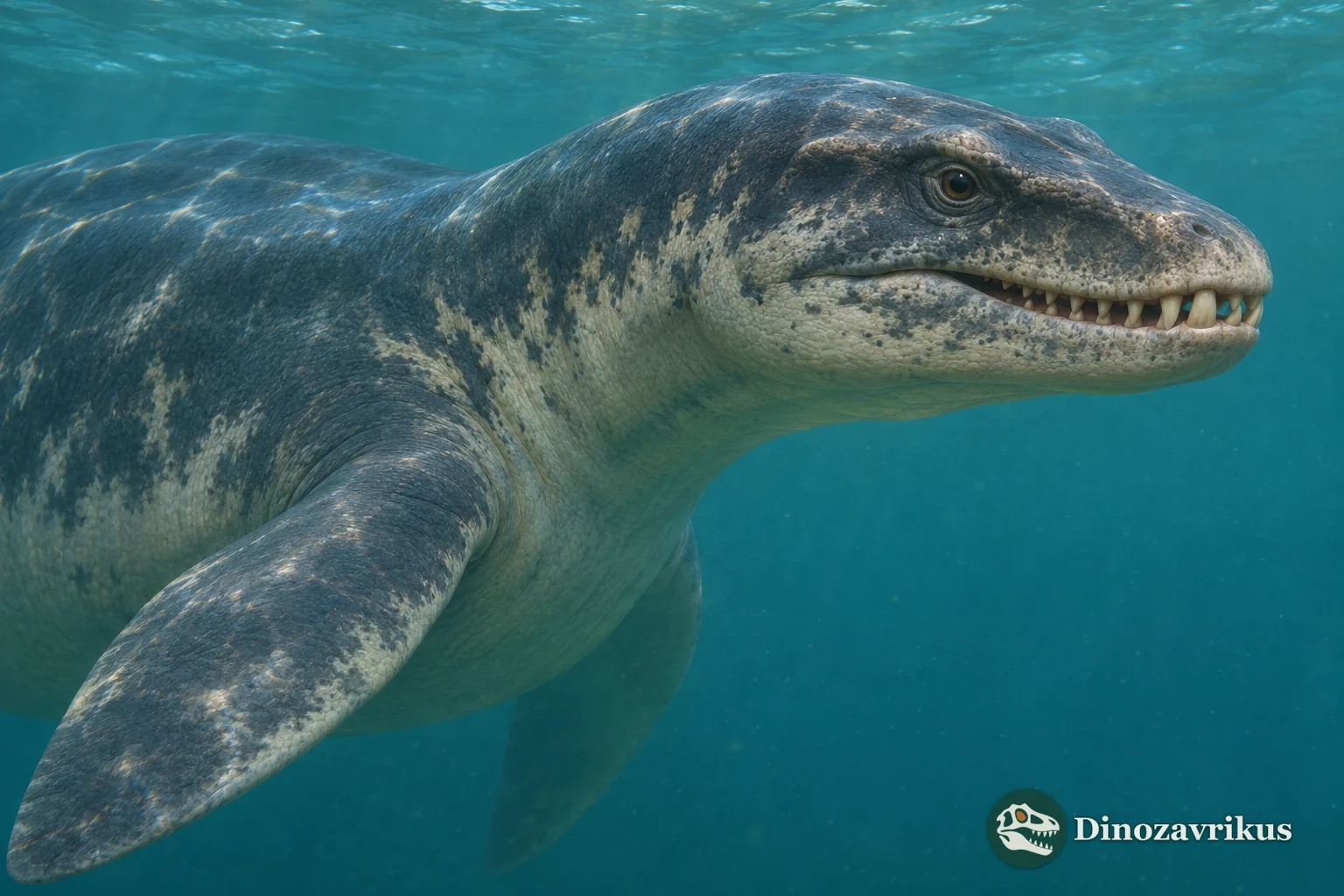
The description identified a relatively short preorbital snout, distinctive tooth heterodonty and a combination of skull characters. It records four pairs of premaxillary tooth positions and about five and a half pairs in the mandibular symphysis. Tooth position and shape inform anatomy, but do not identify a complete species-specific menu. Compare the Colombian record with Stenorhynchosaurus and the more distant Libonectes; these comparisons do not imply that the animals lived in exactly the same bed or that one was a direct ancestor of another.
The rest of the skeleton is not yet fully described
Geological accounts characterize UNDG R-1000 as a largely complete and articulated pliosauromorph. The 2017 anatomical study, however, concentrated on the skull and anterior cervical vertebrae that had been prepared. Other postcranial elements remain to be prepared or described in detail. A fossil can preserve more anatomy than has yet been made available for scientific measurement.
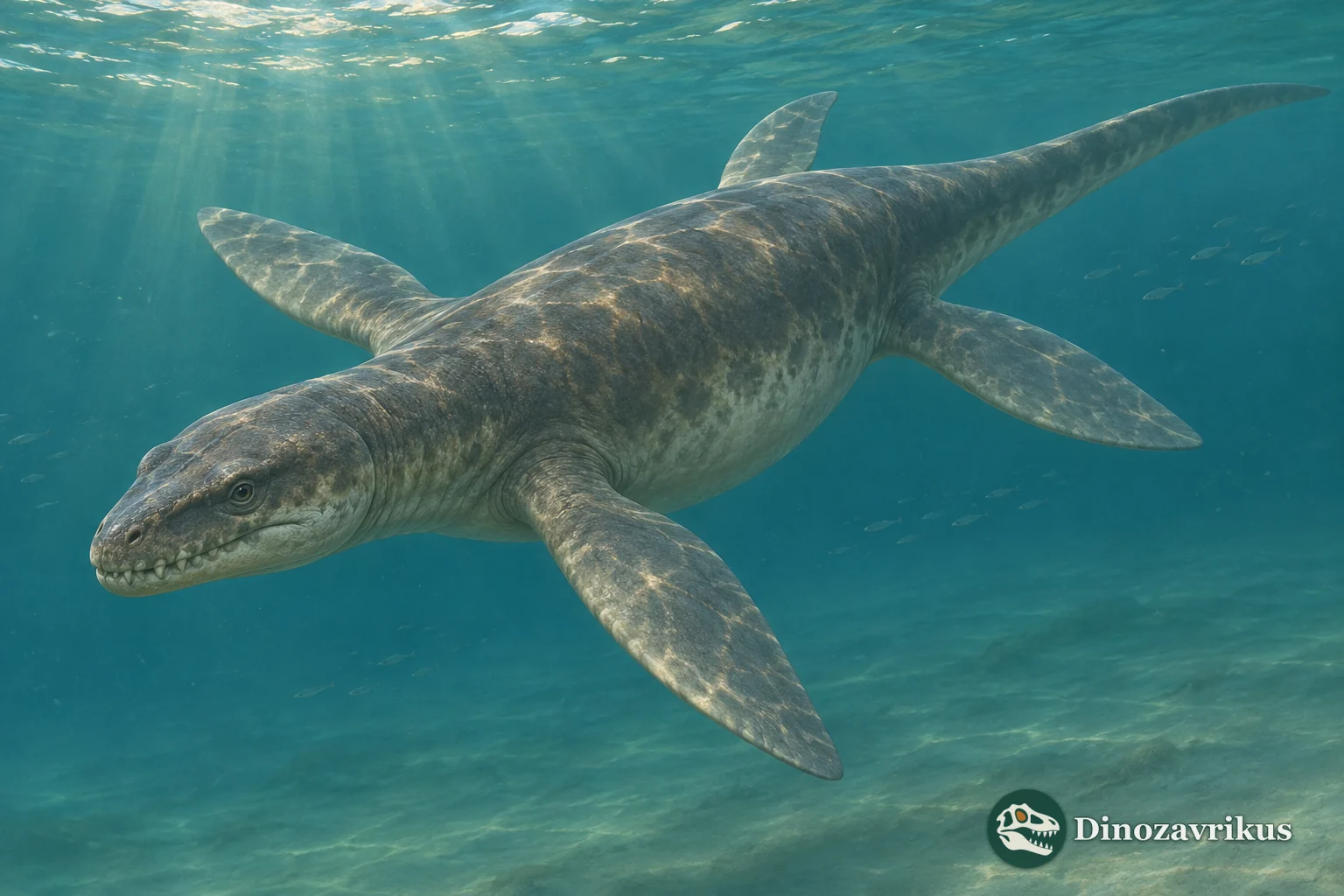
This distinction affects estimates of size. Secondary summaries sometimes give a length of about four metres, but the detailed primary account does not establish a whole-body measurement from a fully prepared skeleton. Here, total length is left unresolved rather than presented as a precise observed value. Mass, growth rate, and adult proportions are likewise uncertain.
Classification, teeth and likely feeding
Gómez-Pérez and Noè classified Acostasaurus as a pliosaurid within Pliosauroidea. Their analysis placed it close to the base of Thalassophonea with less confidence than its broader pliosaurid position. Later analyses have discussed its relationship to brachauchenines. Such placements depend on character coding and sampled taxa; they are hypotheses of shared ancestry, not direct ancestor–descendant records.
The robust skull and differentiated teeth are consistent with a predatory pliosaur. No stomach contents or associated prey establish what this individual ate, and the teeth alone cannot specify prey species or hunting technique. The fossil also does not record swimming speed, diving depth, or social behaviour. Other plesiosaurs such as Morenosaurus broaden comparisons of the group without proving direct evolutionary links.
What palaeoart can show
The published skull supports a detailed reconstruction of the head's bony proportions. The associated body is less well documented in prepared material, and colour, skin, muscles and soft-tissue outlines are not preserved. Full-body images therefore use comparisons with other pliosaurids and should be read as plausible palaeoart, not as a measured tracing of UNDG R-1000.
The secure record consists of a three-dimensionally preserved skull, anterior neck elements, and a broader associated skeleton whose remaining anatomy awaits preparation and detailed study. New work on those bones could refine the animal's proportions and size. Until then, the skull provides the strongest basis for identifying Acostasaurus.
Frequently asked questions
Where was Acostasaurus found?
The holotype came from lower Barremian deposits of the Paja Formation near Sutamarchán in Boyacá, Colombia.
Which fossil is the holotype?
UNDG R-1000 is the type specimen. It includes a nearly complete three-dimensional skull and an associated, largely articulated postcranial skeleton.
Why is the skull important?
Its three-dimensional preservation retains fine features, including sclerotic plates and details of the basicranium and olfactory region, which are rarely available in pliosaur fossils.
How long was Acostasaurus?
A reliable total length has not been established from a fully prepared and described skeleton. Frequently repeated rounded figures should be treated as provisional.