

Archaeomanta is a fossil ray genus described from small isolated teeth. Its name evokes living mantas, but the known fossils do not establish broad fins, filter feeding or a modern manta's body form. The cover shows a speculative ray-like silhouette; the direct evidence lies in dental details.
Quick facts
| Genus | Archaeomanta Herman, 1979 |
|---|---|
| Type species | A. melenhorsti |
| Type fossil | Tooth 53 W 71-3 from Egem, Belgium |
| Age of type locality | Early Eocene |
| Other species | A. priemi and A. hermani |
| Principal evidence | Small isolated teeth |
| Manta affinity | Uncertain |
| Wingspan | Not measurable from the teeth |
What can the fossils tell us?
Herman's 1979 type tooth 53 W 71-3 came from Egem, with other small Belgian dental finds described in the same work.
A. priemi was described from Morocco and teeth assigned to A. melenhorsti were reported from Mississippi.
A 2020 study noted dental features inconsistent with a confident assignment to living Mobulidae. No body skeleton is available.
A name founded on Belgian teeth
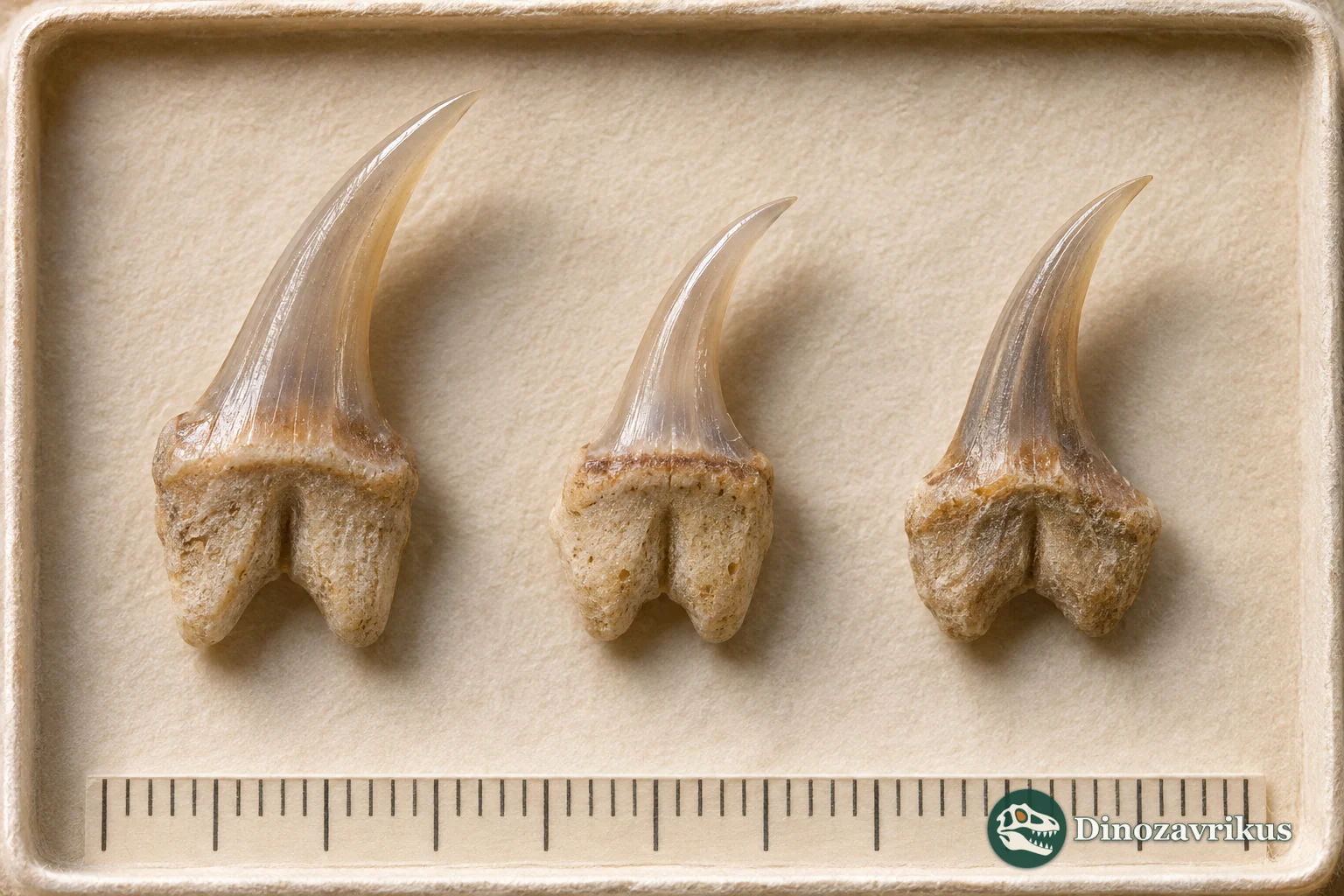
Jacques Herman described Archaeomanta in 1979. The A. melenhorsti holotype, tooth 53 W 71-3, came from the Egem clay pit and the Megacardita planicosta horizon. Other teeth came from Egem and the Schepdael area. They are separate specimens, not parts of an articulated individual.
The type species has an elongated curved crown and a root with a median groove. These small details are examined under magnification. As with the shark Paratriakis, a single detached tooth carries less information than associated body parts, although the two animals belong to different lineages.
Other species and distant occurrences
Herman also named A. priemi from a tooth at Sidi Daoui in Morocco's Ouled Abdoun Basin. The Paleocene material differs in crown and root details. Subsequent discussions list A. hermani from the middle Eocene as another named form.
Case reported fewer than two dozen teeth referred to A. melenhorsti from the early Eocene Bashi Formation in Mississippi in 1994. Some teeth were a few millimetres high. Those numbers refer to teeth and their size, not to individuals or wingspan.
Is it truly related to modern mantas?
The original name drew attention to a manta-like dental resemblance. Teeth alone, however, cannot preserve fin span or a filter-feeding apparatus. A 2020 study of North African Eocene elasmobranchs considered placement within Mobulidae uncertain. A large pulp cavity reaching toward the cusp tip counts against a confident assignment, although other dental features allow comparisons with mobulids or gymnurids.
Thus the manta-like body in the cover should not be read as an established anatomical reconstruction. Haimirichia offers a contrast in evidence because an articulated anterior skeleton preserves more than teeth.
Later finds and the limits of the record
Eleven fragmentary teeth referred to Archaeomanta were reported from middle Eocene Tunisia. None has a complete crown. Their context supports a dental occurrence but does not measure the whole body or demonstrate a particular diet.
Teeth, their structure and their rock layers are direct observations. Relationships to living ray families remain a research interpretation. The color, swimming posture and broad fins in art are not confirmed by the fossils.
Frequently asked questions
Where was the Archaeomanta type tooth found?
The A. melenhorsti holotype 53 W 71-3 came from Egem, Belgium.
Is a complete skeleton known?
The principal descriptions report isolated teeth rather than a skeleton that would establish the shape of the body or fins.
Was it a modern-style manta?
That is not established. Its exact relationship to living mantas is disputed, and the known teeth do not demonstrate filter feeding.
Can its wingspan be estimated?
Not reliably from the published isolated teeth. Tooth measurements are not whole-animal measurements.