

Batrachosuchus is a genus of brachyopoid temnospondyls known chiefly from skull material in South Africa and Zambia. Robert Broom named the type species, B. browni, in 1903 from a skull found near Aliwal North. Its broad head and robust jaws inform anatomical comparisons, but do not reveal the exact proportions of the whole animal.
The genus is included in the ancient amphibian catalogue. Its species list needs care: authors have questioned some historical referrals and proposed that B. watsoni may be a junior synonym of B. browni.
Quick facts
| Type species | Batrachosuchus browni |
|---|---|
| Group | Brachyopoid temnospondyl |
| Age | Early to Middle Triassic, in the Cynognathus Zone record |
| Range | South Africa; a questioned Zambian referral |
| Key specimen | SAM-PK-5868, a skull from near Aliwal North |
| Complete skeleton | Not known for the type species |
What can the fossils tell us?
The type specimen is a skull from the Aliwal North area of South Africa. Its incomplete front does not preserve an articulated body, so it cannot directly establish total length or mass.
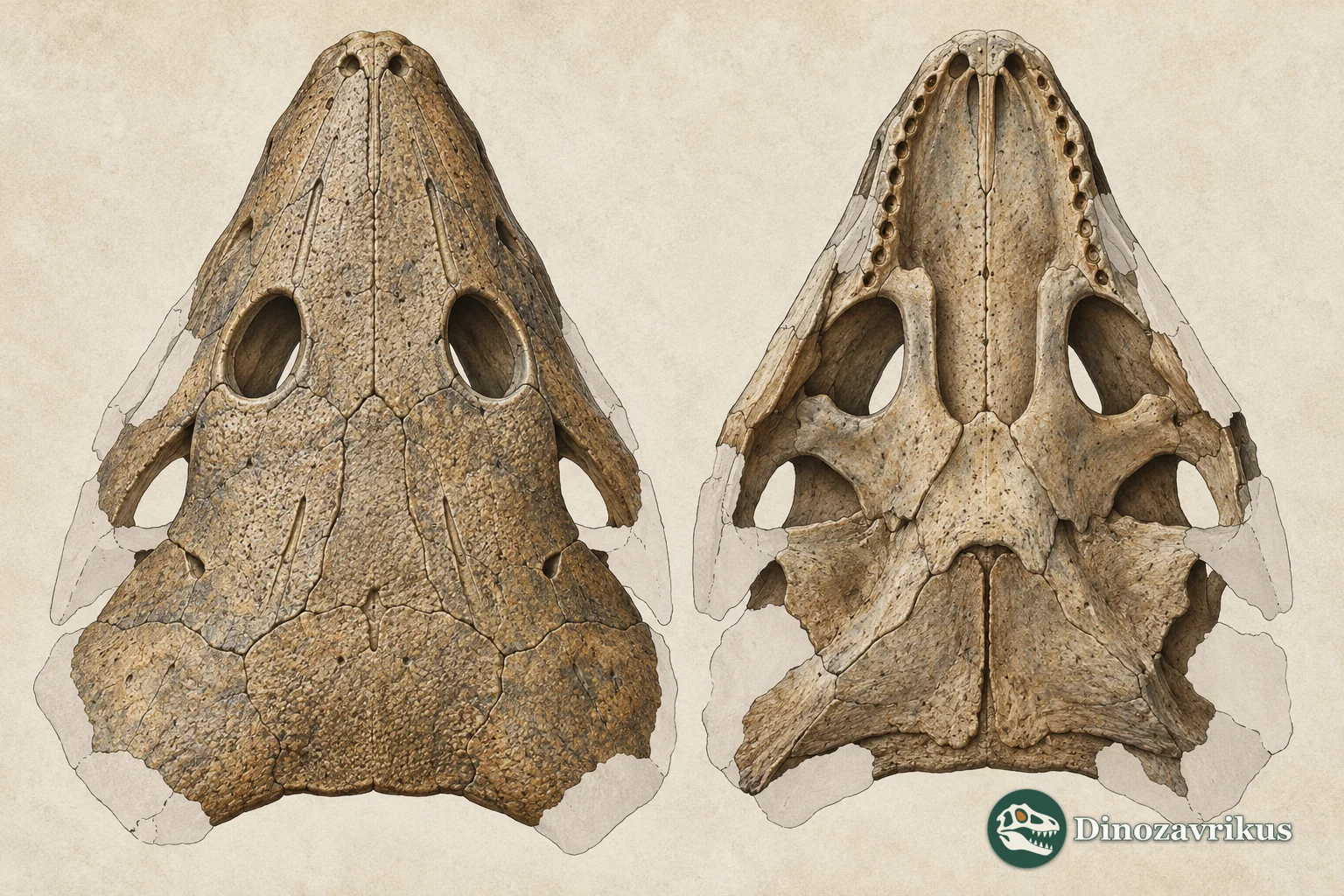
Researchers compare the sculptured skull roof, interfrontal region and sensory-canal pattern. Identification depends on a suite of characters and preservation quality, not one groove by itself.
Warren and Marsicano treated B. watsoni as a possible junior synonym of B. browni after their phylogenetic comparison. This is a taxonomic proposal, not a universally settled change.
South African specimens are associated with the Cynognathus Zone of the Beaufort Group. Chernin described B. concordi from Zambia’s Ntawere Formation, but Warren later questioned whether it belongs in Batrachosuchus. Its original assignment and later reassessment should both be kept visible.
The skull that anchors Batrachosuchus browni
The name B. browni is tied to specimen SAM-PK-5868 from the Aliwal North area of South Africa. The skull is incomplete, especially toward the front, and is not part of a complete articulated skeleton. Its value lies in the cranial characters that later workers could compare with other brachyopoid material.
Published descriptions discuss the sculptured skull roof, interfrontal bone and sensory-canal pattern. These features help distinguish forms when they are preserved together. A fragmentary skull can obscure a margin or groove, so a confident identification should account for missing and damaged regions rather than fill them in as if observed.
Species names and a proposed synonym
Batrachosuchus watsoni was compared with B. browni in a 2000 phylogenetic study by Anne Warren and Claudia Marsicano. They suggested that the differences might not justify keeping the two as separate species, making B. watsoni a possible junior synonym. A proposed synonymy can be evaluated and adopted differently by later authors; it should be reported as a taxonomic interpretation rather than an unquestioned fact.
B. concordi was described from the Ntawere Formation in Zambia. Its record extends the named genus beyond the South African material, but it comes from a separate geological setting. Other historical assignments have also been reconsidered. In particular, the poorly preserved type of “B. henwoodi” was judged too uncertain for a secure placement in the genus in a later reassessment.
Age and distribution across southern Africa
The South African material is associated with the Cynognathus Zone of the Beaufort Group in the Karoo Basin. That biozone spans part of the Early and Middle Triassic, so “Triassic” is safer than assigning every specimen to one precise stage without its local stratigraphic context. The original locality information for the type is not detailed enough to make a more exact claim.
The name B. concordi links a described fossil to Zambia’s Ntawere Formation, but its placement in Batrachosuchus was later questioned. The locality remains relevant to the history of the taxonomic proposal; it should not be presented as an uncontested range extension for the genus.
What the fossils say about its way of life
A broad skull and strong jaws are consistent with a predatory temnospondyl, probably associated with freshwater environments. That is an anatomical and ecological inference. The material does not supply a named prey item, stomach contents or a preserved hunting event, so a detailed diet should not be presented as directly observed.
The skull record is more informative than the body record. Additional postcranial bones have been discussed, but they do not provide a complete skeleton of B. browni. Exact body length and mass therefore remain unknown. The cover presents one plausible body form to make the animal easier to picture; it is not a measured reconstruction of the type specimen.
Related fossils such as Xenotosuchus help compare Triassic temnospondyl skulls, while the Permian Konzhukovia belongs to a different time and lineage.
Frequently asked questions
What is the type specimen of Batrachosuchus browni?
SAM-PK-5868 is an incomplete skull from the Aliwal North area of South Africa; it does not preserve the whole body.
Is Batrachosuchus watsoni a separate species?
Warren and Marsicano proposed in 2000 that it may be a junior synonym of B. browni. The proposal should be treated as a taxonomic interpretation.
Where was Batrachosuchus found?
The type species is from South Africa, and B. concordi was described from Zambia’s Ntawere Formation. Other old referrals vary in reliability.
How long was the animal?
A reliable total length is not established because the best-known diagnostic material consists of skulls, not a complete articulated skeleton.