

Borealonectes russelli is a plesiosaur from the Callovian rocks of Melville Island in the Canadian Arctic Archipelago. A specimen collected at Cape Grassy in 1985 preserves the skull, anterior cervical vertebrae and right forelimb. Its unusually informative skull allows comparison with other Jurassic plesiosaurs, while the absent body regions prevent a direct measurement of total length.
Quick facts
| Type species | Borealonectes russelli |
|---|---|
| Group | Plesiosaur; assigned to Rhomaleosauridae in the 2008 description |
| Age | Callovian, Middle Jurassic |
| Formation | Hiccles Cove Formation |
| Locality | Cape Grassy, Melville Island, Canadian Arctic Archipelago |
| Holotype | CMN 40729 |
| Known material | Skull, anterior cervical vertebrae and right forelimb |
| Measurement | Skull about 455 mm; total body length unknown |
Evidence guide
CMN 40729 preserves the skull, anterior neck vertebrae and right forelimb. The rest of the neck, trunk and tail are not a complete measurable skeleton.
The published snout-to-occipital-condyle length is about 455 mm. Deformation of the fossil complicates reconstruction of its original proportions.
The Cape Grassy specimen comes from the Hiccles Cove Formation. Its Middle Jurassic age follows the geological context rather than a direct date measured from bone.
Sato and Wu assigned the genus to Rhomaleosauridae in 2008 using anatomical comparisons. The result does not establish a direct ancestral line.
Discovery on Melville Island
The fossil was collected in 1985 at Cape Grassy on Melville Island. It came from the Hiccles Cove Formation, assigned to the Callovian Stage of the Middle Jurassic. The specimen is held by the Canadian Museum of Nature as CMN 40729. That catalogue number identifies the holotype, the particular fossil on which the species name is based.
Tamaki Sato and Xiao-Chun Wu named Borealonectes russelli in 2008 after describing the skull and forelimb. An earlier tentative identification had compared the material with Cryptoclidus richardsoni. The new name reflects the authors' judgment that the combined anatomy warranted a distinct genus and species. The species epithet honours palaeontologist Dale Russell.
The locality is important because well-preserved Middle Jurassic plesiosaur skulls from the Canadian Arctic are rare. A single specimen, however, cannot establish how common the animal was, how far it ranged or whether the burial site was part of its usual habitat.
What the skull and forelimb show
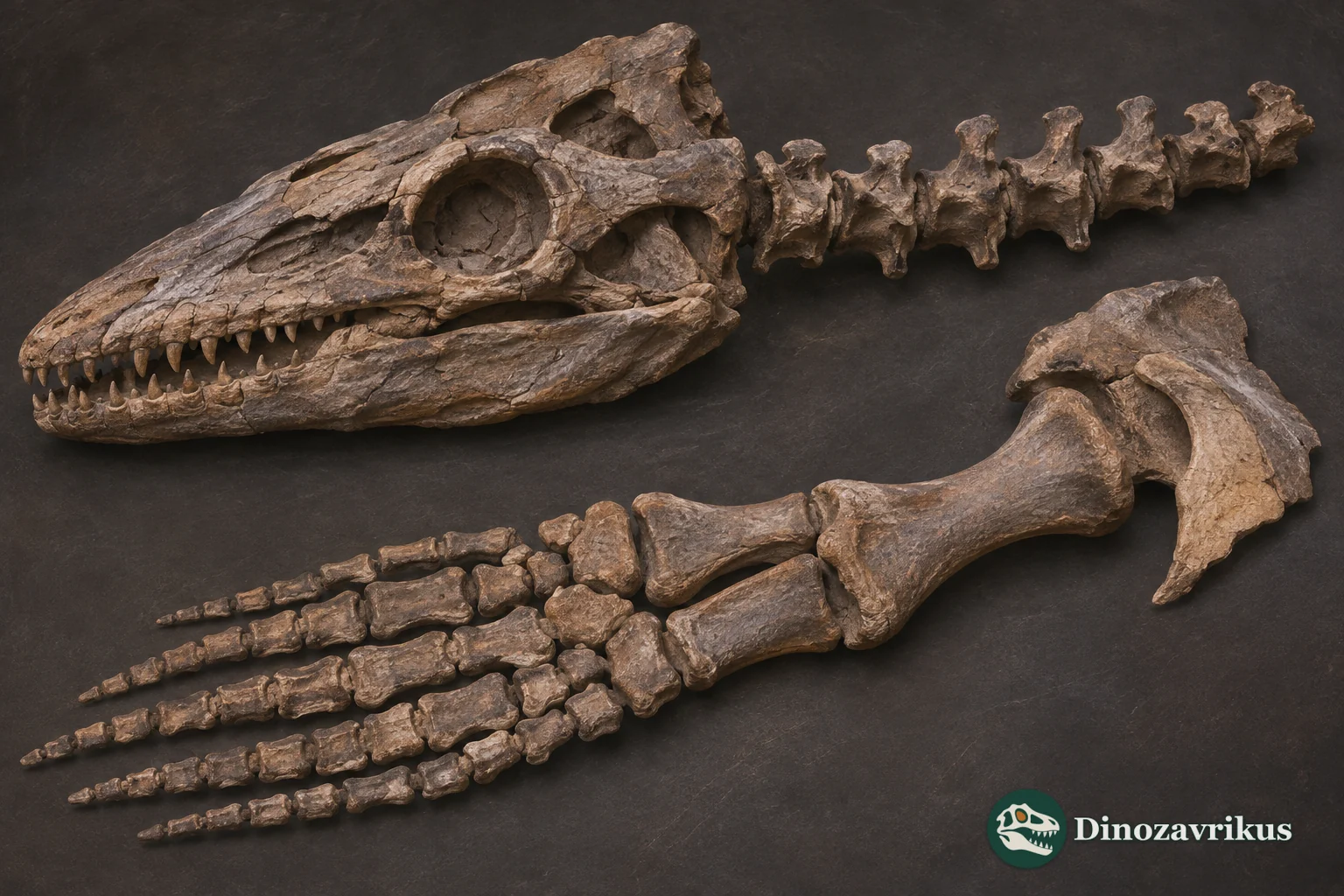
The holotype preserves a skull and lower jaws. Its published length from the tip of the snout to the occipital condyles is about 455 mm. Deformation means that original proportions must be restored cautiously. The figure measures a head, not an entire animal.
The authors identified details around the orbit and temporal region, including a large prefrontal and relationships among bones behind the eye. These characters matter more to a taxonomic diagnosis than a general outline shared by many aquatic reptiles. The right forelimb supplies another set of comparisons; its humerus measures about 334 mm.
No continuous skeleton from snout to tail is known for this specimen. The left forelimb and much of the axial skeleton are missing. An artistic arrangement of fossil elements can explain which regions were recovered, but it must not be mistaken for a photograph or exact museum layout of CMN 40729.
Age and Arctic setting
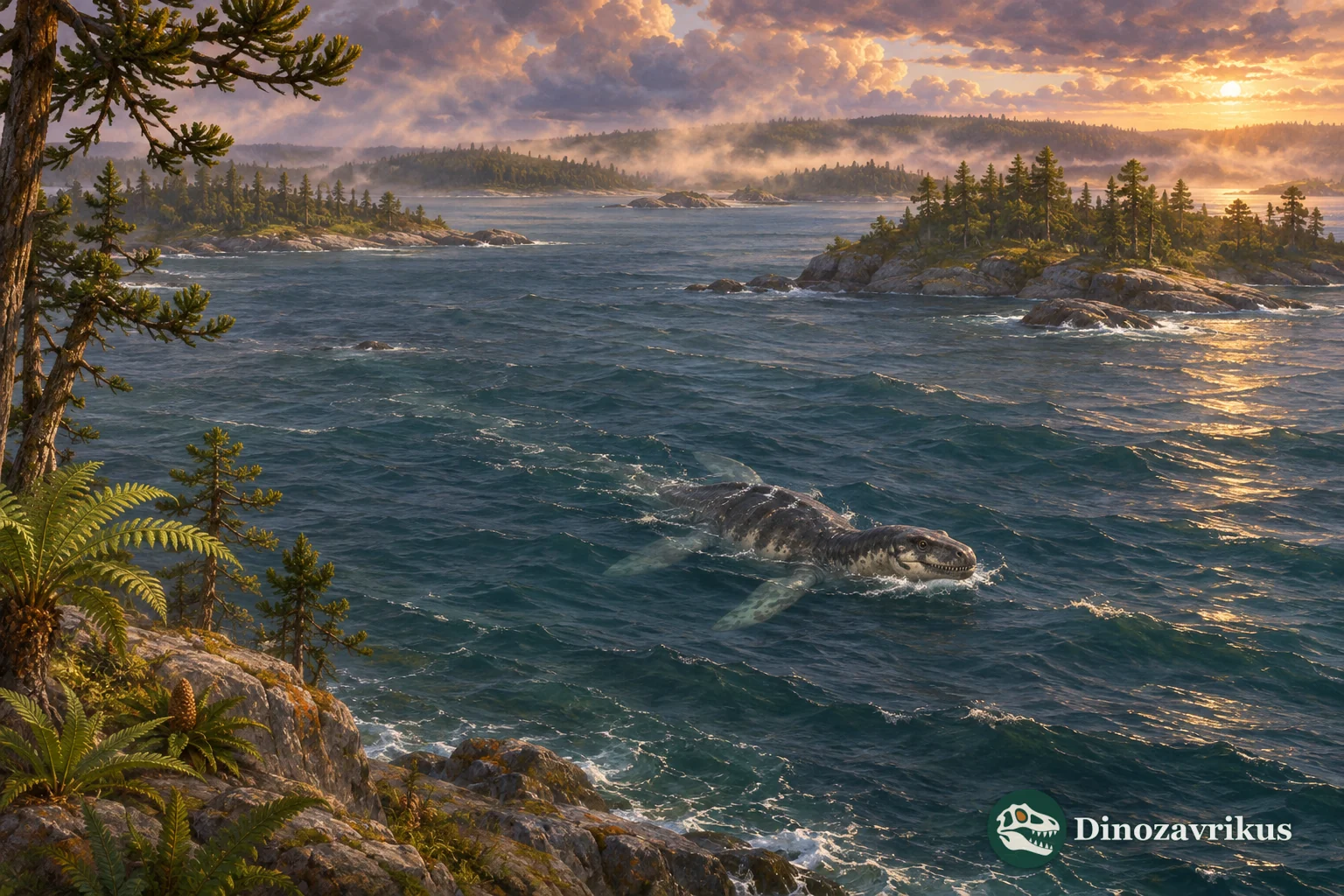
The Hiccles Cove Formation records a Middle Jurassic marine succession on Melville Island. The Callovian assignment comes from the stratigraphic position of the rocks. Today's polar climate cannot simply be projected backward onto a Jurassic high-latitude sea.
The marine sediments and plesiosaur anatomy justify depicting an aquatic animal. They do not reveal its skin pattern, the exact coastline, water temperature, swimming depth or prey. Avalonnectes and Arminisaurus provide comparisons with older Jurassic plesiosaurs from different geological settings.
Measurements and limits
The roughly 45.5 cm skull and 33.4 cm humerus are direct published measurements of preserved parts. A precise snout-to-tail length would require restoring the missing neck, trunk and tail using proportions from other species. The result would depend on the chosen comparison, so this account does not turn those measurements into a definitive body length.
No stomach contents or prey remains have been reported for CMN 40729. Jaw shape can inform comparisons with other plesiosaurs, but it does not identify a species-specific menu. The fossil also does not establish swimming speed, colour, growth or reproductive behaviour.
Classification from preserved bones
The 2008 description placed Borealonectes within Rhomaleosauridae based on a comparison of skull and limb characters. Phylogenetic positions are inferred from a selected anatomical dataset, and they can change as new specimens or revised character interpretations become available.
Comparisons with another early plesiosaur, Thalassiodracon, help show the range of forms in the group. They do not document a direct ancestor-descendant sequence. For Borealonectes, the defensible evidence begins with the bones actually preserved in CMN 40729.
Frequently asked questions
Where was Borealonectes found?
The holotype CMN 40729 was collected at Cape Grassy on Melville Island in the Canadian Arctic Archipelago in 1985. Its rocks belong to the Middle Jurassic Hiccles Cove Formation.
Which parts of the skeleton are known?
The described material includes the skull and lower jaws, anterior neck vertebrae and the right forelimb. It is not a complete skeleton.
How long was Borealonectes?
Its total length is not securely measured. The published skull length of about 455 mm covers only the head.
Did it live among Arctic ice?
The fossil comes from Callovian marine rocks. Modern polar ice conditions should not be assumed for the Middle Jurassic, and the exact local water conditions are not established by one skeleton.