

Burgessia bella was a small Middle Cambrian arthropod from the Walcott Quarry of British Columbia's Burgess Shale. Unlike most fossils known only by a body outline, some Burgessia slabs preserve paired, kidney-shaped extensions of the digestive tract beneath a thin dorsal shield. The museum catalogue records at least 3,000 specimens from the quarry, making it a frequent member of the assemblage rather than a rare one-off.
Charles Doolittle Walcott named the species in 1912. Later studies by Andrea Simonetta and Christopher Hughes revised its anatomy, while its place among early arthropods remains uncertain. The ancient arthropod catalogue sets Burgessia among animals whose evolutionary relationships depend on combinations of preserved characters.
Quick facts
| Scientific name | Burgessia bella Walcott, 1912 |
|---|---|
| Group | Cambrian arthropod; precise placement remains debated |
| Age | Middle Cambrian, about 505 million years ago |
| Locality | Walcott Quarry, Burgess Shale, British Columbia |
| Type specimen | Lectotype USNM 57676, Smithsonian National Museum of Natural History |
| Measured size | Carapace 4–17 mm; ROM 61123 is about 30 mm including telson |
| Notable anatomy | Paired kidney-shaped gut diverticula are visible on some slabs |
What can the fossils tell us?
The lectotype USNM 57676 and ROM specimens 60758 and 61123 preserve different views. ROM 61123 has a 12 mm carapace and measures about 30 mm with its telson; the museum's 17 mm maximum refers to carapace length.
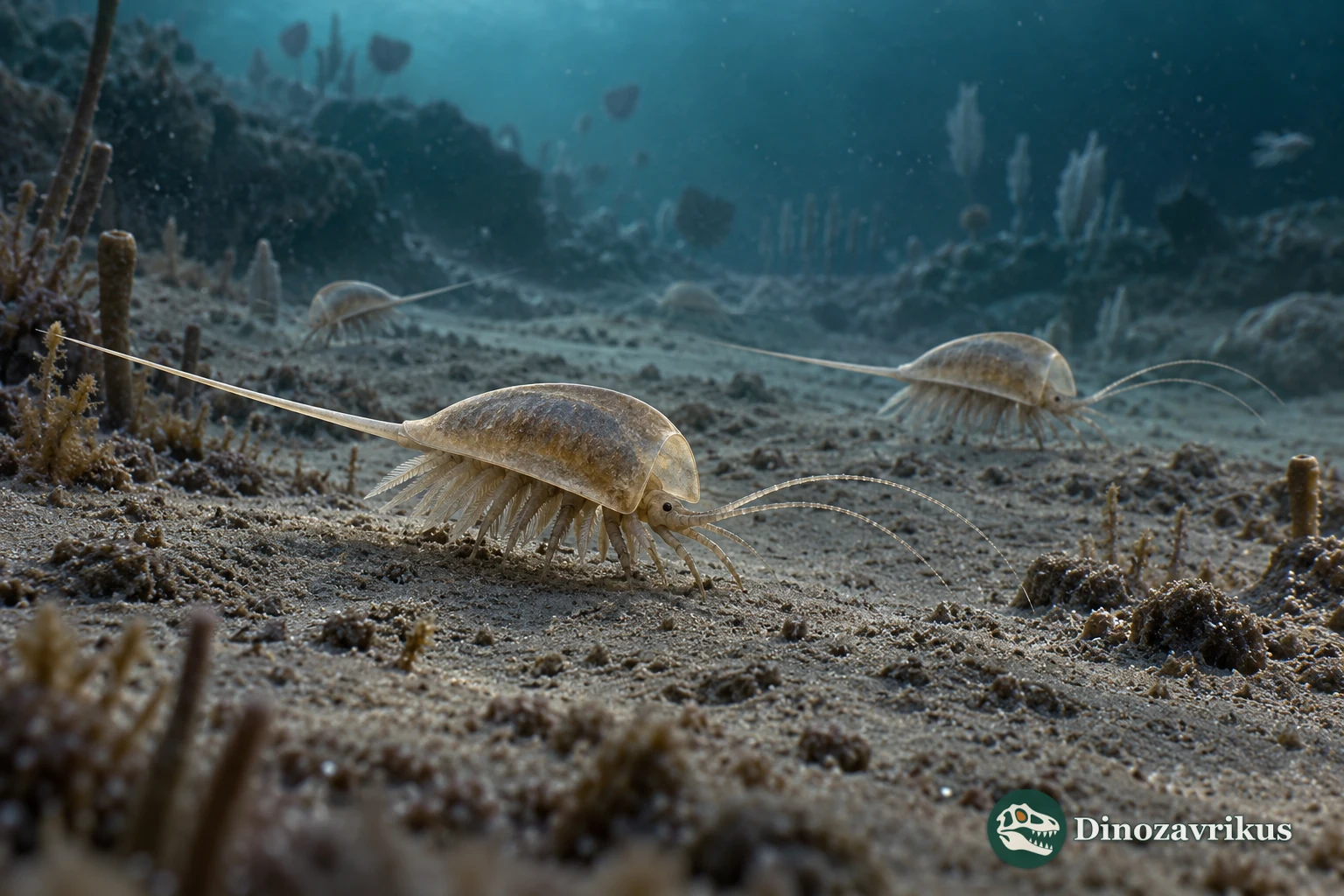
The fossil shows a thin semicircular carapace, antennae, ten pairs of appendages and a long terminal spine. Compression can wrinkle the shield and obscure the exact arrangement of limbs.
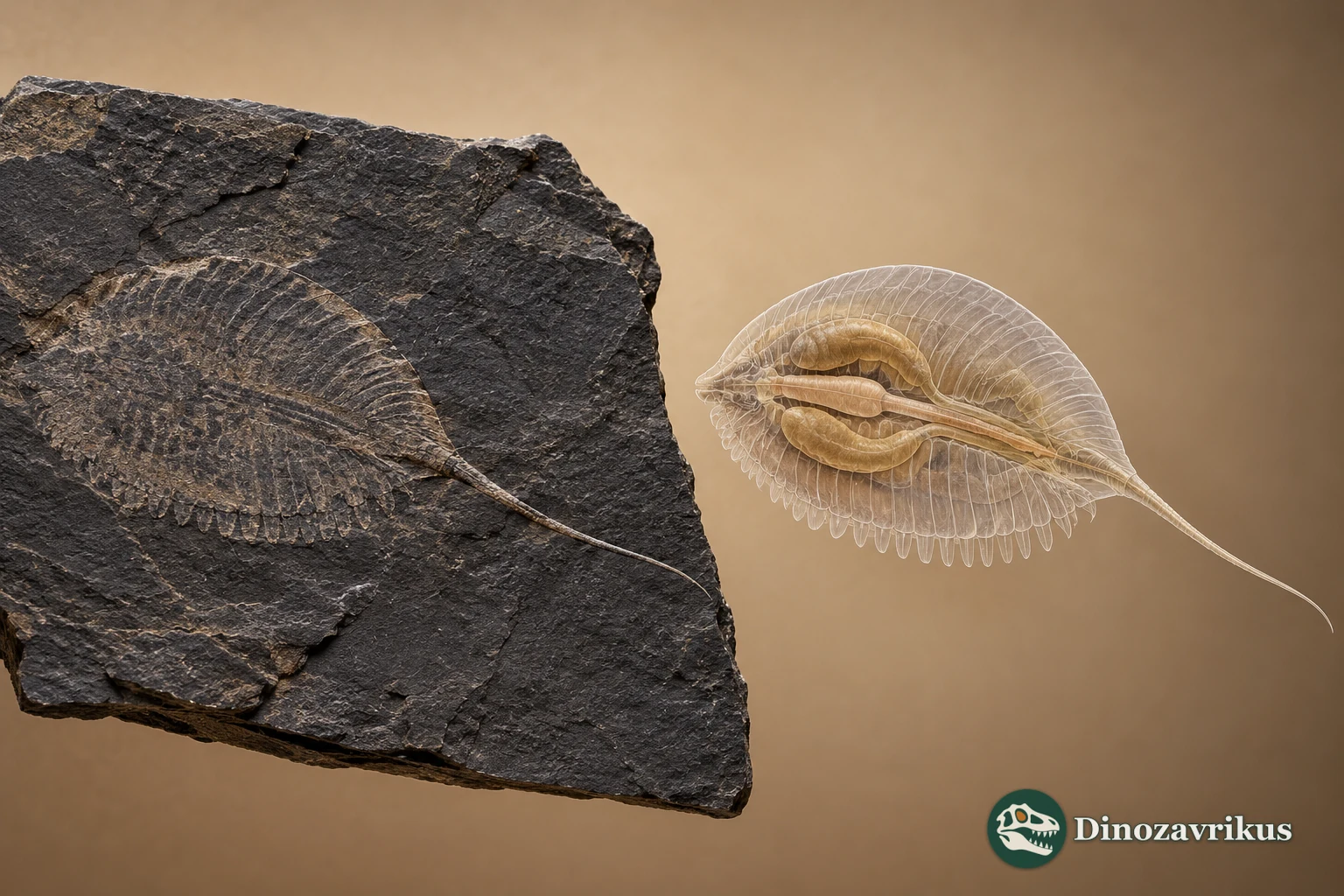
Some fossils preserve paired kidney-shaped gut extensions connected to a central canal. Their outline is direct evidence; their precise physiology and diet are not.
Mud in the gut region has been interpreted as evidence for deposit feeding, but preservation may account for some of it. The telson's function has also been examined through biomechanical models.
Walcott's type and the redescription
Walcott described Burgessia bella in his 1912 account of Middle Cambrian fossils. Its lectotype, USNM 57676, is held at the Smithsonian National Museum of Natural History in Washington, D.C. The genus name refers to Mount Burgess in Yoho National Park; the species name comes from Latin bellus, meaning beautiful. Simonetta revised the material in 1970, and Christopher Hughes published a detailed redescription in 1975 using old and newly prepared specimens.
The Royal Ontario Museum's Burgess Shale project provides useful comparisons among specimens. ROM 61123 preserves a 12 mm carapace and a total outline of about 30 mm including the telson; ROM 60758 is another complete specimen. Measurements must identify which part is being measured: the largest carapace in the museum description is about 17 mm, while total length with the spine is greater.
A delicate shield and a long terminal spine
The dorsal carapace is a thin, gently convex semicircle with a notch at the rear, where the body emerges from beneath it. Compression wrinkled some fossils enough to make the shell look bivalved, but Hughes described one continuous carapace rather than two separate valves. A pair of flexible antennae projects from the front. Beneath the shield, the animal had ten pairs of jointed, biramous appendages: three associated with the head and seven with the trunk. The inner branches are interpreted as walking limbs, while the outer branches of trunk limbs have been compared with gills.
The telson is a single, unsegmented spine that may be straight or bent in different specimens. Its length is about 1.4 times the carapace length in the museum's summary. Jun-Pin Lin's 2009 study examined its mechanics and hydrostatics, testing how a long narrow structure could affect an animal in water. A defensive role or a way to escape burial remains speculative.
The kidney-shaped gut and possible feeding
Some slabs show a central alimentary canal and two lateral diverticula that give the digestive region its kidney-shaped outline. These are fossil traces of the gut, not kidneys. Their presence is direct anatomical evidence; what the animal ate is a separate question. The Burgess Shale museum account describes Burgessia as a mobile epibenthic deposit feeder, based partly on mud in the gut region and the arrangement of its limbs. The authors explicitly note that sediment could be a preservational artefact.
Small outer branches on the trunk limbs may have limited prolonged swimming, but an animal's burial site does not record every movement it made in life. Burgessia was abundant in the Walcott Quarry census, yet abundance alone cannot establish its exact feeding niche or behaviour.
Why its relationships remain open
Walcott initially grouped Burgessia with crustacean-like forms. Later analyses proposed an arachnomorph position, a broad grouping that has included trilobites and chelicerates, but the Burgess Shale website continues to flag its placement as uncertain. The animal has not received a comprehensive modern re-examination since Hughes's 1970s work, so new preparation or a new character analysis could change the result.
Comparisons with living horseshoe crabs can help test hydrodynamic ideas about the telson; they do not establish close ancestry. This distinction between a functional analogy and a phylogenetic relationship is also useful when comparing Burgessia with fossils such as Habelia and Branchiocaris. The Burgess Shale belongs to the wider marine world of the Cambrian Period, where exceptional preservation reveals structures that would usually vanish.
Evidence, inference and reconstruction
| Direct evidence | Thin carapace, antennae, appendages, telson and paired gut diverticula on fossil slabs |
| Research inference | Walking on the seafloor and possible deposit feeding based on anatomy and gut sediment |
| Uncertain | Exact phylogenetic position, diet, swimming ability and telson function |
| Reconstruction | Colour, soft tissues and a specific living posture |
Frequently asked questions
When did Burgessia live?
Burgessia bella is known from the Middle Cambrian Burgess Shale, about 505 million years ago.
How large was Burgessia?
Its carapace measured about 4–17 mm. A complete ROM 61123 specimen is about 30 mm long including the telson, so carapace and total-body measurements should not be confused.
What are Burgessia's kidney-shaped structures?
They are paired diverticula of the digestive tract visible in some fossils, not kidneys. Their outline does not by itself identify the animal's diet.
What did Burgessia eat?
Deposit feeding on organic particles in soft sediment is one interpretation. Mud in the gut region supports it, but sediment may also reflect preservation.