

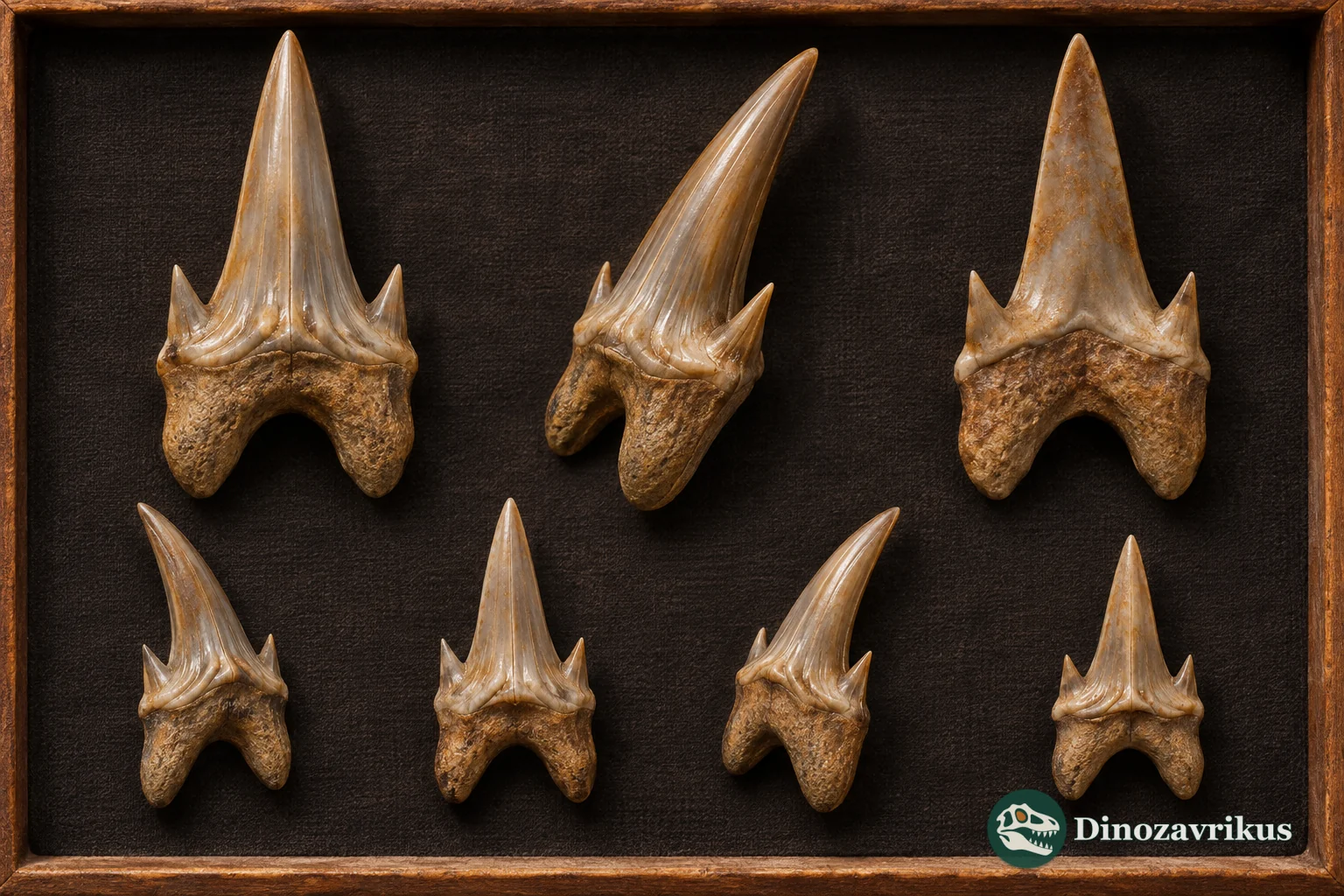
Cenocarcharias is a genus name applied to some Cretaceous sharks known mainly from isolated teeth. A narrow central cusp, lateral cusplets, basal enamel folds and root details guide identification. Whether the type species warrants a genus separate from Carcharias is debated. The cover is a generalized artistic shark, not a fossil-based body measurement.
Quick facts
| Type species | Cenocarcharias tenuiplicatus |
|---|---|
| Original combination | Odontaspis tenuiplicatus, 1975 |
| Genus proposed | Cappetta and Case, 1999 |
| French species in 2007 revision | C. rochebrunei |
| Material | Isolated teeth |
| Taxonomic question | Some authors retain tenuiplicatus in Carcharias |
| Body length | Not established |
What can the fossils tell us?
Tenuiplicatus was described as Odontaspis in 1975. A separate Cenocarcharias was proposed in 1999 from dental comparisons.
In 2007 rochebrunei was assigned to Cenocarcharias. Its teeth were described as larger and more strongly folded at the labial base than those of tenuiplicatus.
A 2019 synthesis questioned whether tooth differences justify Cenocarcharias. Its Fox Hills teeth were assigned as Carcharias cf. tenuiplicatus, not unquestioned type material.
How the name arose
Henri Cappetta and Gerard Case named the species tenuiplicatus in 1975 as Odontaspis tenuiplicatus from Cenomanian Texas. In 1999 they proposed Cenocarcharias for it. The decision relied on a combination of crown and root traits, not an articulated body.
A 2007 French revision treated tenuiplicatus as the type species and assigned rochebrunei to the same genus. Henri Sauvage had described the latter in 1880 from three teeth near Angoulême. The original specimens were reported lost, so newly collected teeth from the area became important for comparison.
Comparing the teeth
The French revision describes rochebrunei teeth with a relatively narrow central cusp, one or two pairs of small pointed lateral cusplets, basal folds on the labial face and a robust root with a prominent grooved inner projection. An anterior tooth, UM AMA 10, is 11 mm high; lateral UM AMA 12 has a more inclined main cusp. Their different positions matter when comparing teeth.
The authors considered rochebrunei larger and more robust than tenuiplicatus, whose compared teeth were generally no more than about 7–8 mm. They reported the French form reaching about 11.5 mm. These figures measure teeth, not the full sharks.
Cenomanian seas
The type species comes from Cenomanian Texas. In the Charentes of western France, teeth referred to tenuiplicatus occur in lower Cenomanian units, while those assigned to rochebrunei occur in upper Cenomanian material. Their stratigraphic positions do not prove direct ancestry.
Sediments and associated shark and ray finds point to warm coastal waters in the French localities. Other Cretaceous sharks, including Cretodus and Carcharoides, offer context for shark diversity, not evidence of kinship from co-occurrence alone.
Why the classification is disputed
A 2019 Fox Hills synthesis favored Carcharias for teeth similar to tenuiplicatus and did not accept a separate Cenocarcharias as necessary. The authors stressed variation in enamel ridges and used the cautious identification Carcharias cf. tenuiplicatus for their own sample.
The dispute concerns generic boundaries, not whether the teeth exist. Neither the Texan nor the French isolated teeth establish the animal's body length, colour, exact fin shape or diet. Pachygaleus offers another example of a fossil shark whose body must be illustrated cautiously from dental evidence.
Frequently asked questions
What is the Cenocarcharias type species?
Cenocarcharias tenuiplicatus, first described in 1975 under Odontaspis.
Why is the same species sometimes placed in Carcharias?
Some researchers regard the dental differences as insufficient for a distinct genus.
How was the French species distinguished?
The 2007 revision described rochebrunei teeth as larger, more robust and more strongly folded at the labial crown base.
Is a complete skeleton known?
The studies considered here use isolated teeth and do not establish a reliable full-body measurement.