

Pachygaleus was an extinct triakid shark recognized from comparatively large, thick teeth. Fossils occur on both sides of the North Atlantic, but the published tooth series discussed here is not a complete skeleton. The animal on the cover is an artistic outline based on relatives, not a measured reconstruction of a particular specimen.
Quick facts
| Species | Pachygaleus lefevrei |
|---|---|
| Group | Carcharhiniformes, Triakidae |
| Original name | Galaeus lefevrei, 1891 |
| Genus named | Cappetta, 1992 |
| Type locality | Saint-Gilles, Belgium, Ypresian |
| Prémontré material | 65 isolated teeth, up to 10 mm wide |
| Range reported | Thanetian–Lutetian |
| Body length | Not established from the teeth |
What can the fossils tell us?
The lefevrei species was described from Ypresian Saint-Gilles; a new genus was later erected for its distinctive thick teeth.
Adnet and Cappetta examined 65 teeth and illustrated anterior, anterolateral and lateral specimens. They were not one articulated jaw.
Tooth shape is directly observable; body proportions, colour, total length and specific prey are not.
How the name changed
The species lefevrei was first described from Saint-Gilles, Belgium, in 1891 as Galaeus lefevrei. Later authors placed similar teeth under other shark genera, including Galeus and Galeorhinus. Henri Cappetta introduced Pachygaleus in 1992, emphasizing the unusual size and thickness of its teeth. These combinations record taxonomic reassessments of one fossil species rather than a series of newly discovered animals.
Triakid sharks have varied dental forms. Identification requires comparing the crown, root, cusplets and position within a probable jaw. Palaeogaleus and Paratriakis demonstrate how other fossil triakids differ in these combinations.
The Prémontré tooth series
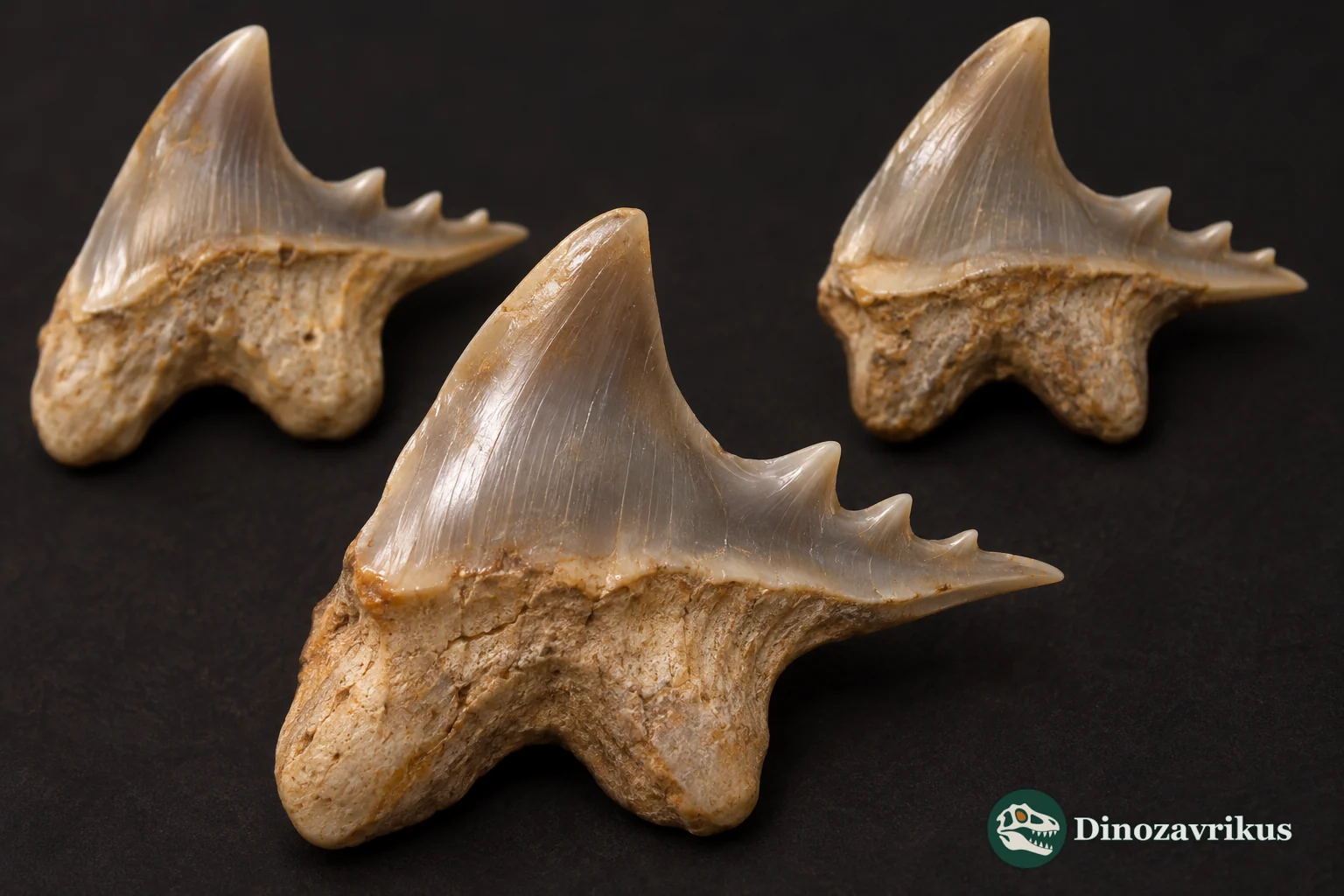
Sylvain Adnet and Henri Cappetta studied 65 Pachygaleus teeth from late Ypresian Prémontré in northern France. They figured UM-PRE 19 as an anterior, UM-PRE 20 as an anterolateral and UM-PRE 21 as a lateral tooth. These are separate specimens illustrating positional variation, not three parts of one preserved skeleton.
Teeth reach about 10 mm in width. Their compressed oblique crown commonly has a gently convex front edge without accessory cusplets. The long distal heel bears several developed cusplets that diminish outward. The robust root widens into two rounded lobes. This combination is more diagnostic than thickness alone.
The fossil setting and distribution
The Prémontré deposit is an estuarine accumulation in which many small shark and ray teeth were recovered by processing and fine-sieving sediment. The work identified a diverse early Eocene assemblage. Premontreia occurs in the same region, but occurrence together does not establish close kinship.
The 2008 review lists teeth referred to P. lefevrei from Thanetian to Lutetian deposits on the western European and eastern American North Atlantic margins. This maps the known dental record, not the route taken by a particular shark. Depositional setting alone cannot fix the exact depth or salinity occupied during every part of its life.
What the animal may have looked like
Triakid affiliation supports a cautious elongated shark-like body outline, but no associated skeleton in this tooth series verifies the proportions of its fins, tail or head. Tooth width is not a measurement of whole-body length. A robust crown may have helped grasp or process prey, yet the cited material does not preserve stomach contents identifying particular food.
The teeth and their geological context are direct evidence. Family placement and geographic range are comparative conclusions. Colour and swimming posture in the cover are artistic choices.
Frequently asked questions
Which is the Pachygaleus type species?
Pachygaleus lefevrei, first described under a different genus name from Belgian material.
Why was a separate genus named?
Its teeth combine unusual size and thickness with distinctive crown and root features compared with the genera previously used.
Do the 65 Prémontré teeth represent 65 sharks?
No. That is the count of teeth studied in the 2008 paper, not individuals or one preserved jaw.
Is its body length known?
A reliable full length cannot be measured from the isolated tooth series discussed here.