

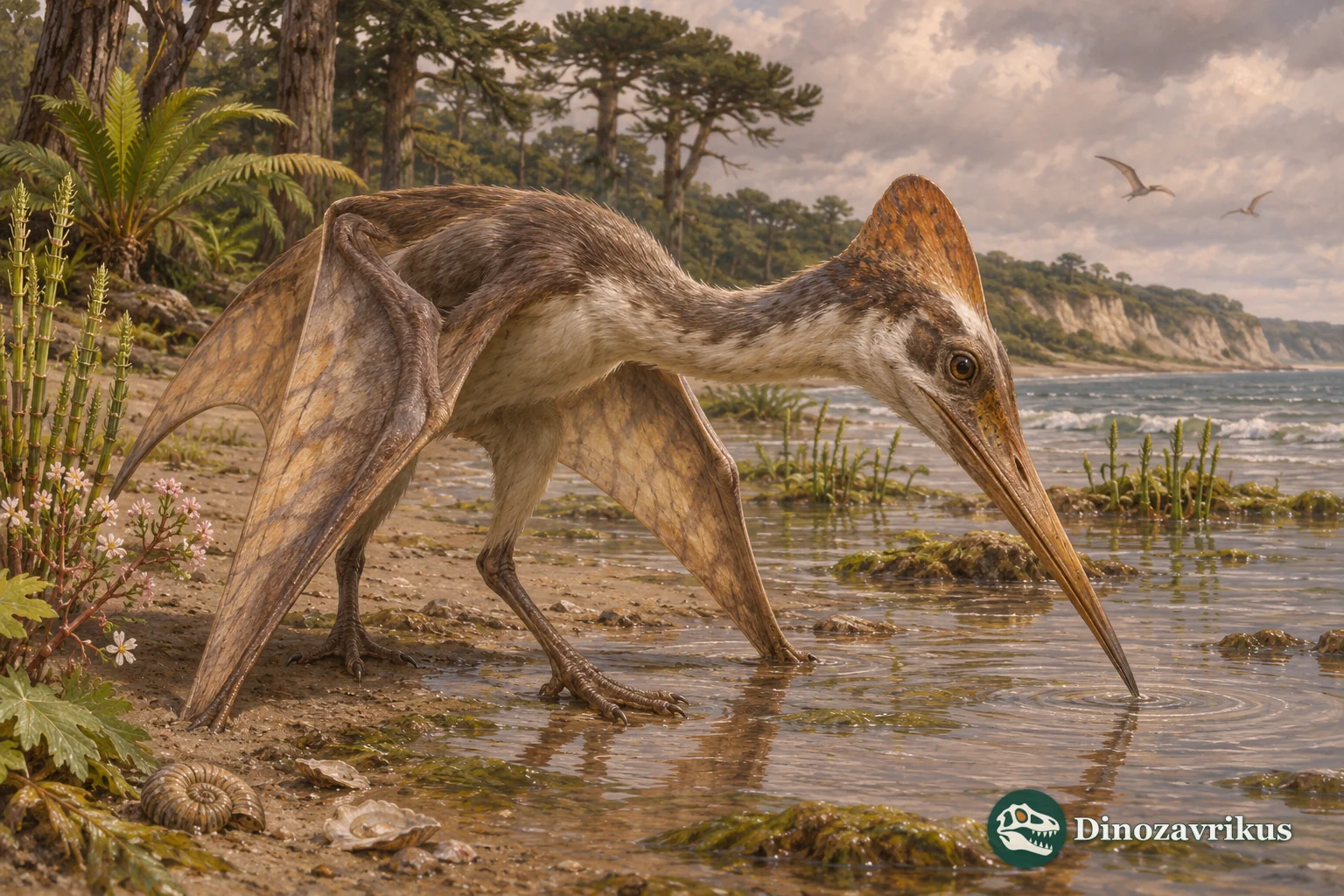
Cretornis hlavaci is based on parts of one left wing from the Turonian of present-day Czechia. The humerus and fragments of other wing bones permit anatomical comparison. The skull, jaws and body were not found, so the animal in the cover is a comparative life reconstruction.
Quick facts
| Scientific name | Cretornis hlavaci, Frič, 1881 |
|---|---|
| Holotype | NMP Ob 10–14 and associated fragments of an incomplete left wing |
| Locality | Žárecká Lhota, Czechia |
| Rock unit | Jizera Formation |
| Age | Middle to late Turonian, Late Cretaceous |
| Preserved bones | Humerus and parts of ulna, metacarpal and wing finger |
| Skull and diet | Unknown from the type specimen |
What can the fossils tell us?
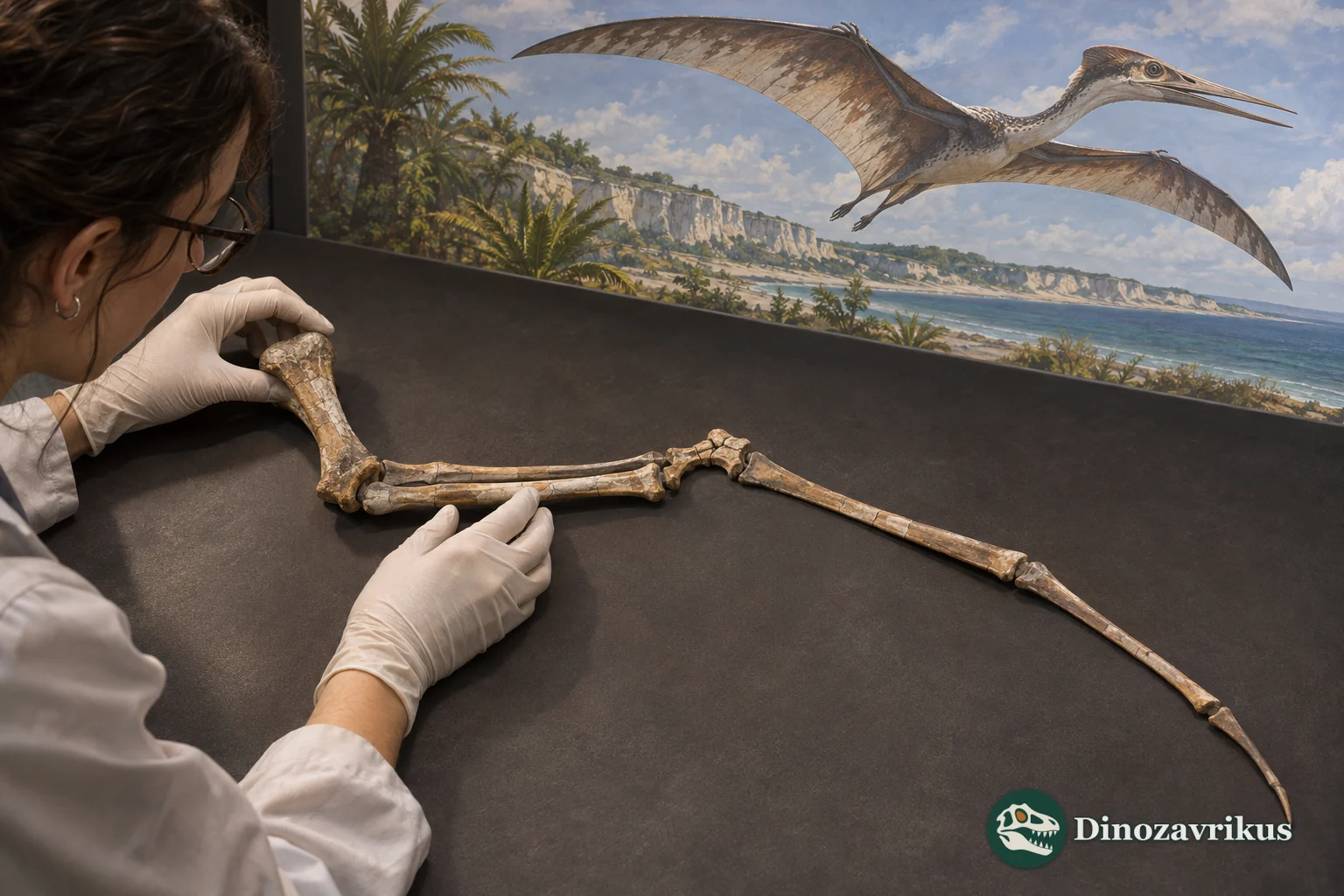
The type includes a near-complete humerus and fragments of the ulna, wing metacarpal and first two wing-finger phalanges. No skull is associated.
The shape of the humeral head, deltopectoral crest and pneumatic openings supplies characters for comparison with other pterosaurs.
A 2015 redescription considered Cretornis diagnosable and assigned it to Azhdarchoidea. Its precise position within the group is less secure.
The head, trunk and full wing span are not preserved. Colour, feeding and flight behaviour in artwork remain hypothetical.
A wing from the Bohemian Cretaceous Basin
Antonín Frič described the fossil in 1881 from Žárecká Lhota in the Bohemian Cretaceous Basin. The locality belongs to the Jizera Formation, dated to the middle to late Turonian. The fragmentary nature of the specimen led to a complicated history of identification and proposed synonymy.
Alexander Averianov and Boris Ekrt re-examined the Prague museum material in 2015. They argued that Cretornis hlavaci can be distinguished from other pterosaurs and belongs among azhdarchoids. That conclusion concerns the bones themselves, not a complete animal inferred from old illustrations.
What the specimen actually contains
The type specimen preserves an almost complete left humerus, pieces of the ulna and wing metacarpal, and fragments of the first two wing-finger phalanges. Several pieces are incomplete. There is no skull, mandible or preserved stomach content.
Features of the humeral joint, its crest and pneumatic openings are useful in taxonomic comparison. Caupedactylus provides a different Cretaceous pterosaur record; its skull cannot supply a missing head for Cretornis.
Relationship and size
The redescription placed Cretornis in Azhdarchoidea using the preserved wing characters. It did not demonstrate that the animal had the proportions of later giant azhdarchids. With so much of the skeleton missing, finer branches of the family tree remain uncertain.
A wingspan may be estimated by comparing the humerus with other pterosaurs, but it cannot be measured directly from two complete wings. Ceoptera illustrates a different evidence gap: more postcranial material is known, while its skull is absent.
A cautious life image
The cover and internal artwork show one possible pterosaur appearance. The wing fossil does not establish the form of the beak, the colours, exact coastal habitat or feeding technique. Those details would require additional fossils.
Frequently asked questions
Where was Cretornis found?
The type wing comes from the Jizera Formation near Žárecká Lhota in Czechia, in Turonian deposits.
Is its skull known?
No. The type specimen is an incomplete left wing without a skull or jaws.
Why is it called an azhdarchoid?
A redescription compared preserved wing characters, particularly the humerus, with other pterosaurs and supported that broader placement.
Can its wingspan be measured?
No complete pair of wings survives. A span can only be estimated through comparisons with other pterosaurs.