

Cryonectes neustriacus is an Early Jurassic marine plesiosaur from Normandy. Its only described specimen preserves an incomplete skull, jaws and ten associated vertebrae. The head and teeth can be studied in detail, while almost nothing from the trunk or flippers permits a reliable measurement of total body length.
Quick facts
| Type species | Cryonectes neustriacus |
|---|---|
| Group | Plesiosaur; basal pliosaurid in the original phylogenetic analysis |
| Age | Late Pliensbachian, Early Jurassic |
| Formation | Calcaire à Bélemnites Formation |
| Locality | Roche-Blain quarry near Fresney-le-Puceux, Calvados, France |
| Holotype | MAE 2007.1.1(J), the only described specimen |
| Known material | Incomplete skull, palate, articulated jaws and ten associated vertebrae |
| Measurement | About 470 mm from snout tip to rear of mandible; total length unknown |
Evidence guide
MAE 2007.1.1(J) preserves skull portions, palate and articulated jaws. The roughly 470 mm snout-to-rear-mandible dimension is not a complete-animal measurement.
About 34 teeth are represented; tooth positions led the authors to infer at least 66 functional teeth. Early acid preparation damaged some crowns and removed enamel.
The Calcaire à Bélemnites Formation spans several Pliensbachian zones. Calcareous nannofossils in matrix still adhering to the specimen support the late part of the stage.
Most observed neurocentral sutures remain open, though one is closed. The authors cautiously inferred a relatively early developmental stage, not a numerical age in years.
A Normandy quarry and a new name
Amateur palaeontologists discovered the fossil in the 1980s at Roche-Blain quarry near Fresney-le-Puceux, roughly ten kilometres south of Caen. The holotype MAE 2007.1.1(J) is held in the Elbeuf museum collection. Peggy Vincent, Nathalie Bardet and Emanuela Mattioli described it as a new genus and species in the 2013 journal volume; an earlier online date explains some references to 2012.
The name Cryonectes combines Greek roots for cold and swimmer, referring to climatic interpretation of the latest Pliensbachian. The species epithet recalls Neustria, an early medieval kingdom in northwestern France. These names describe the authors' chosen references, not a measured body temperature or a fossilized swimming style.
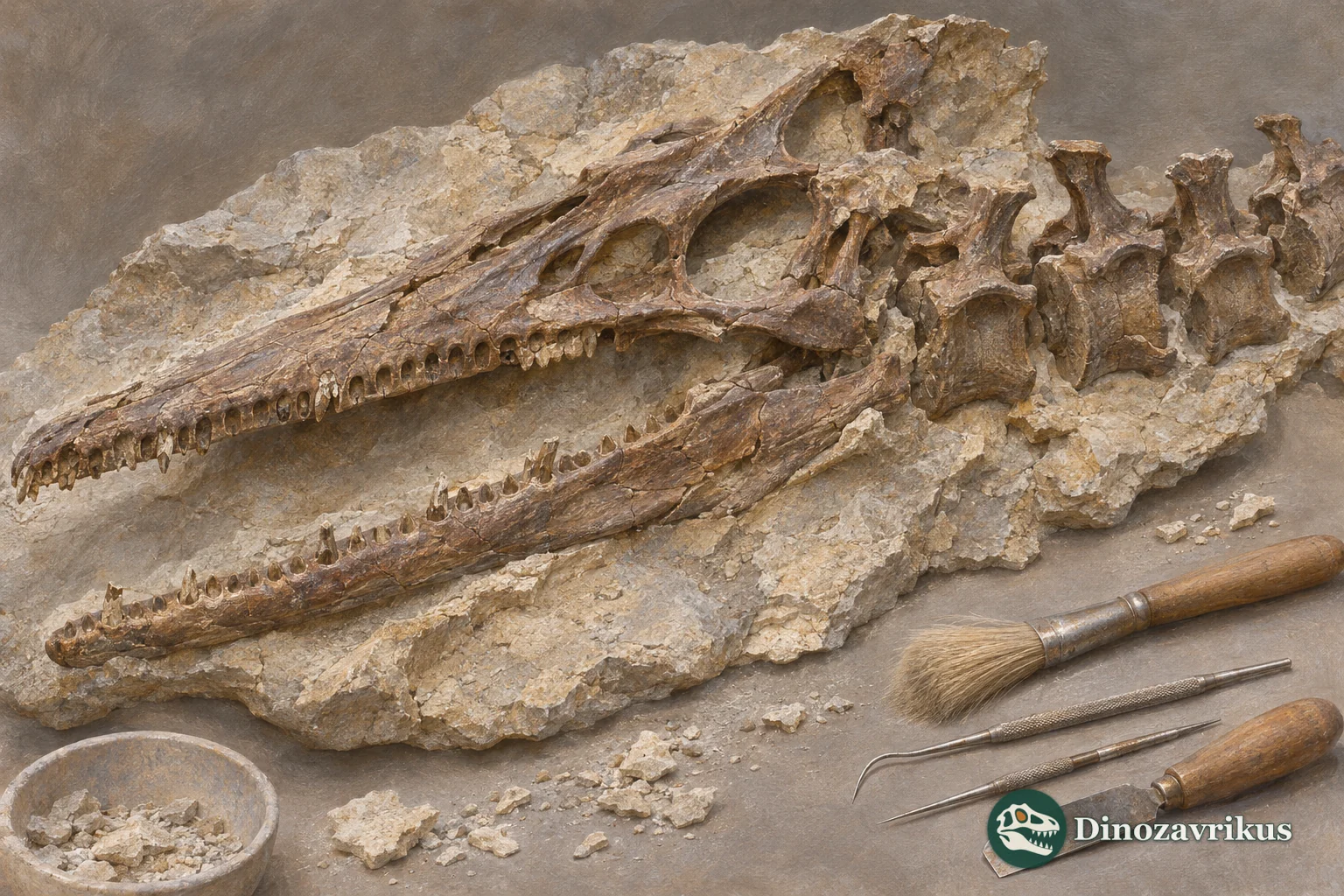
The specimen was initially prepared with acid, damaging portions of the teeth and stripping enamel. Mechanical preparation followed. Skull and lower jaws remain articulated, but the ten associated vertebrae are no longer in their natural anatomical sequence. The fossil illustration below interprets the known regions and is not a photograph of this specimen.
The narrow skull and crowded teeth
The original description gives a distance of approximately 470 mm from the snout tip to the rear end of the mandible. The snout is elongated, with only a slight constriction where premaxillae and maxillae meet. Diagnostic comparisons also use the narrow anterior opening of the palate, features of the pterygoids and a long mandibular symphysis spanning seven tooth positions.
Around 34 teeth are represented in the fossil. Counting exposed sockets and allowing for damaged or hidden jaw sections, the authors inferred at least 66 functional teeth in the living animal. The latter is an estimate, not a count of intact fossil crowns. Five tooth sockets in each premaxilla distinguish Cryonectes from several related forms. Better-preserved crowns are slender, slightly curved and sharp.
The jaws suggest an aquatic predator capable of grasping prey, but no stomach contents are described for MAE 2007.1.1(J). A specific menu of fishes or cephalopods would be conjecture. Arminisaurus offers another Early Jurassic comparison without implying identical feeding habits.
Dating the matrix on the fossil
The Calcaire à Bélemnites Formation spans several Pliensbachian ammonite zones. No diagnostic ammonite was found with the individual specimen, so the quarry alone cannot assign its precise zone. The researchers examined calcareous nannofossils in rock matrix still attached to the skeleton. The assemblage, including Crepidolithus impontus, Bussonius prinsii and Calyculus, supports a latest Pliensbachian age rather than earliest Toarcian.
This inference ties the age more closely to the holotype than a broad formation label. It remains a stratigraphic interval, not a calendar date of the individual animal. Marine limestone supports a sea setting, but the fossil does not specify exact water depth, skin colour or the shape of the ancient coastline.
Growth and phylogenetic position
Most vertebrae with preserved neural arches retain visible neurocentral sutures; one examined vertebra has a closed suture. Vincent and colleagues interpreted the mixture as indicating a relatively early ontogenetic stage. It does not give an age in years or establish the eventual adult body size. No trunk, girdles or flippers are described for the holotype.
Their preliminary analysis recovered Cryonectes near the base of Pliosauridae, implying an earlier radiation of that lineage if the placement holds. Phylogenetic results depend on the sampled species and coded characters, and they do not establish a direct ancestor-descendant chain. Thalassiodracon illustrates another Early Jurassic character combination, while Brancasaurus lived much later in the Early Cretaceous.
What a reconstruction can show
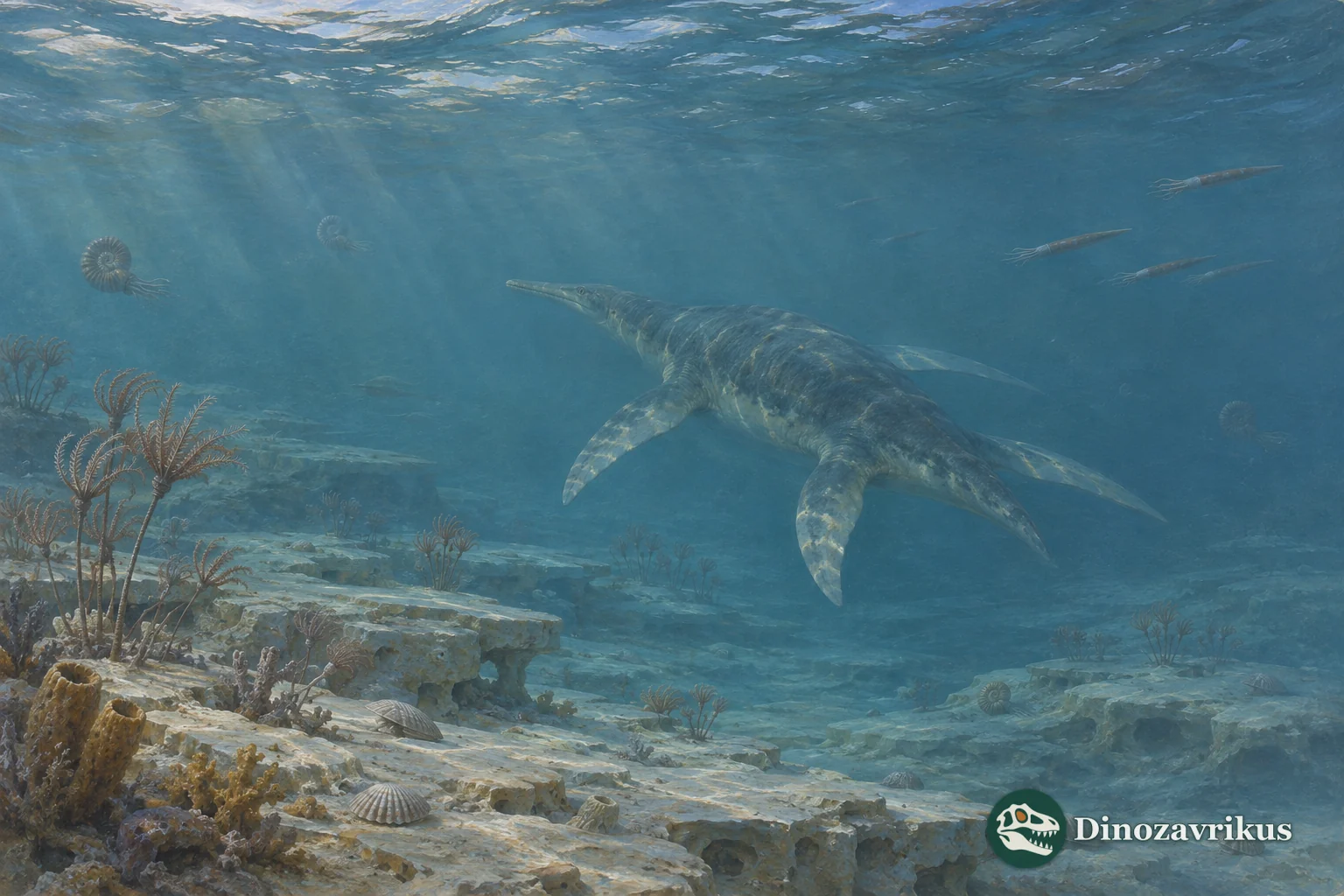
The known jaws and vertebrae support a plesiosaur with a narrow toothed head. A full torso, all four flippers, skin pattern and swimming pose in the cover art are comparative and artistic additions. No precise snout-to-tail length can be read from the roughly 470 mm head measurement without assumptions about missing regions.
The sea scene uses the marine origin of the rocks as its setting. Its lighting, animal colour, particular invertebrates and swimming depth are illustrative rather than observations from the holotype.
Frequently asked questions
Where was Cryonectes found?
Its only described specimen came from Roche-Blain quarry near Fresney-le-Puceux in Calvados, northern France. Amateur palaeontologists discovered it in the 1980s.
What parts of the skeleton survive?
The holotype includes an incomplete skull and palate, articulated lower jaws and ten associated vertebrae. The trunk and flippers are not known from it.
How long was Cryonectes?
Total length is not reliably established. About 470 mm measures from the snout tip to the rear of the jaw, not from snout to tail.
Why was its age narrowed to the late Pliensbachian?
The authors studied calcareous nannofossils in the matrix attached to the fossil. Their assemblage points to the late Pliensbachian despite the lack of an associated diagnostic ammonite.