

Eosiren is an extinct genus of sirenian known from Eocene and Oligocene deposits in Egypt. Its best documented species, Eosiren libyca, is represented by skulls and teeth as well as vertebrae and pelvic bones. Those remains help trace changes in the sirenian skeleton, but they do not establish that Eosiren was the direct ancestor of living dugongs or manatees.
The genus belongs in the ancient mammals catalogue. Comparisons with Protosiren help place Eosiren among earlier sea cows; Prototherium is another sirenian genus, not a species of Eosiren.
Quick facts
| Scientific name | Eosiren Andrews, 1902 |
|---|---|
| Type species | Eosiren libyca Andrews, 1902 |
| Group | Sirenia, family Dugongidae |
| Time | Eocene to early Oligocene across species assigned to the genus |
| Region | Egypt: Fayum, Mokattam and Jebel Qatrani |
| Fossils | Skulls, jaws, teeth, vertebrae, ribs and pelvic bones |
| Size | No reliable body-mass estimate is established |
What do the fossils show?
The type specimen of E. libyca is skull CGM C.10054 from the Fayum. Cranial material supports species comparisons, but it cannot preserve soft tissues or the animal’s exact external appearance.
Pelvic bones from the Qasr el-Sagha Formation represent several individuals and growth stages. The complete right innominate UM 101226 documents a strongly reduced pelvis in E. libyca. It does not, by itself, measure how much the animal could move any residual hindlimb muscles.
Late Eocene E. libyca and E. stromeri are reported from the Qasr el-Sagha Formation. Other species assigned to Eosiren come from different Egyptian units and ages. A genus-wide range should not be substituted for the age of an individual fossil.
Sirenian anatomy supports an aquatic life. Feeding on aquatic vegetation is inferred from comparisons with living sirenians and the depositional setting; no diagnostic stomach contents are known for Eosiren.
Naming and taxonomic history
Charles William Andrews named Eosiren libyca in 1902 in his account of recently discovered Egyptian vertebrates. Because E. libyca was the only species included in the original proposal, it is the type species by monotypy. Andrews returned to the Fayum vertebrates in his 1906 catalogue of material held by the Egyptian Geological Museum and the British Museum.
The genus name does not mean that a direct ancestor of modern sea cows has been identified. Phylogenetic analyses place fossil sirenians according to combinations of skeletal characters, and the position of individual Eosiren species can vary with the taxa and characters included.
Species and changing assignments
The best-supported species is E. libyca, known from the late Priabonian Qasr el-Sagha Formation in the Fayum. E. stromeri, first named as Eotherium stromeri, was later transferred to Eosiren. Other Egyptian fossils have been assigned to names including E. abeli from the Mokattam Hills and E. imenti from Jebel Qatrani. These records belong to different intervals, so the age of one species cannot be used as the age of the entire genus.
Assignments depend on diagnostic anatomy rather than geography alone. Similarity between sirenian fossils from Egypt does not prove they belong to one species or even one genus.
Skull, teeth and the rest of the skeleton
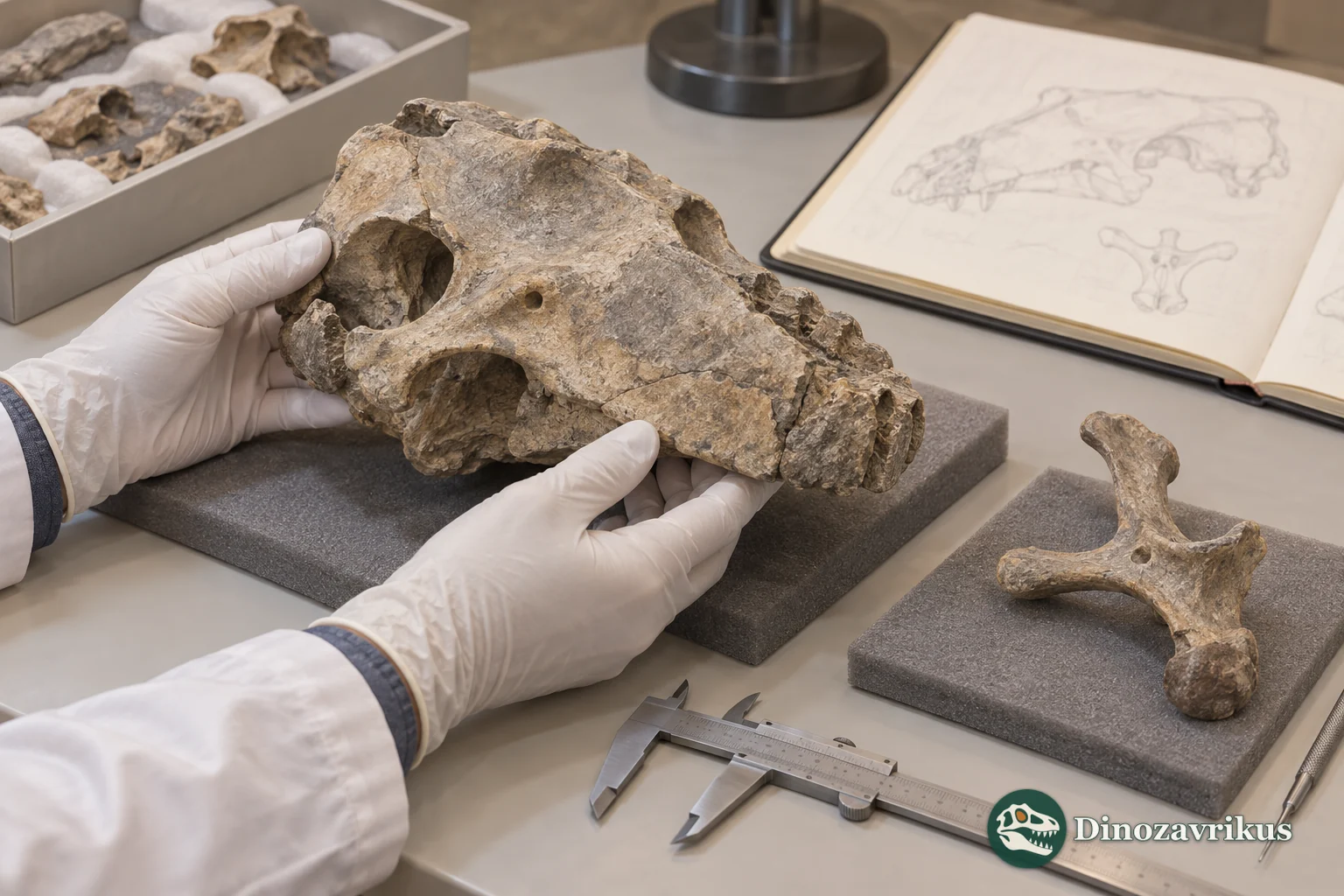
The type skull of E. libyca is catalogued as CGM C.10054 at the Geological Museum of Egypt. Additional skulls and jaws allow researchers to compare the rostrum, palate, tooth rows and areas associated with jaw musculature. Andrews described cranial and mandibular material, while later work documented a broader sample from Qasr el-Sagha.
The pelvis is especially informative. In E. libyca it is much more reduced than in earlier sirenians such as Protosiren. The complete right innominate UM 101226 and other separate bones also show variation among individuals and growth stages. This is direct evidence of skeletal change; the precise locomotor role of the residual hindlimb cannot be read from one bone alone.
Locality and geological age
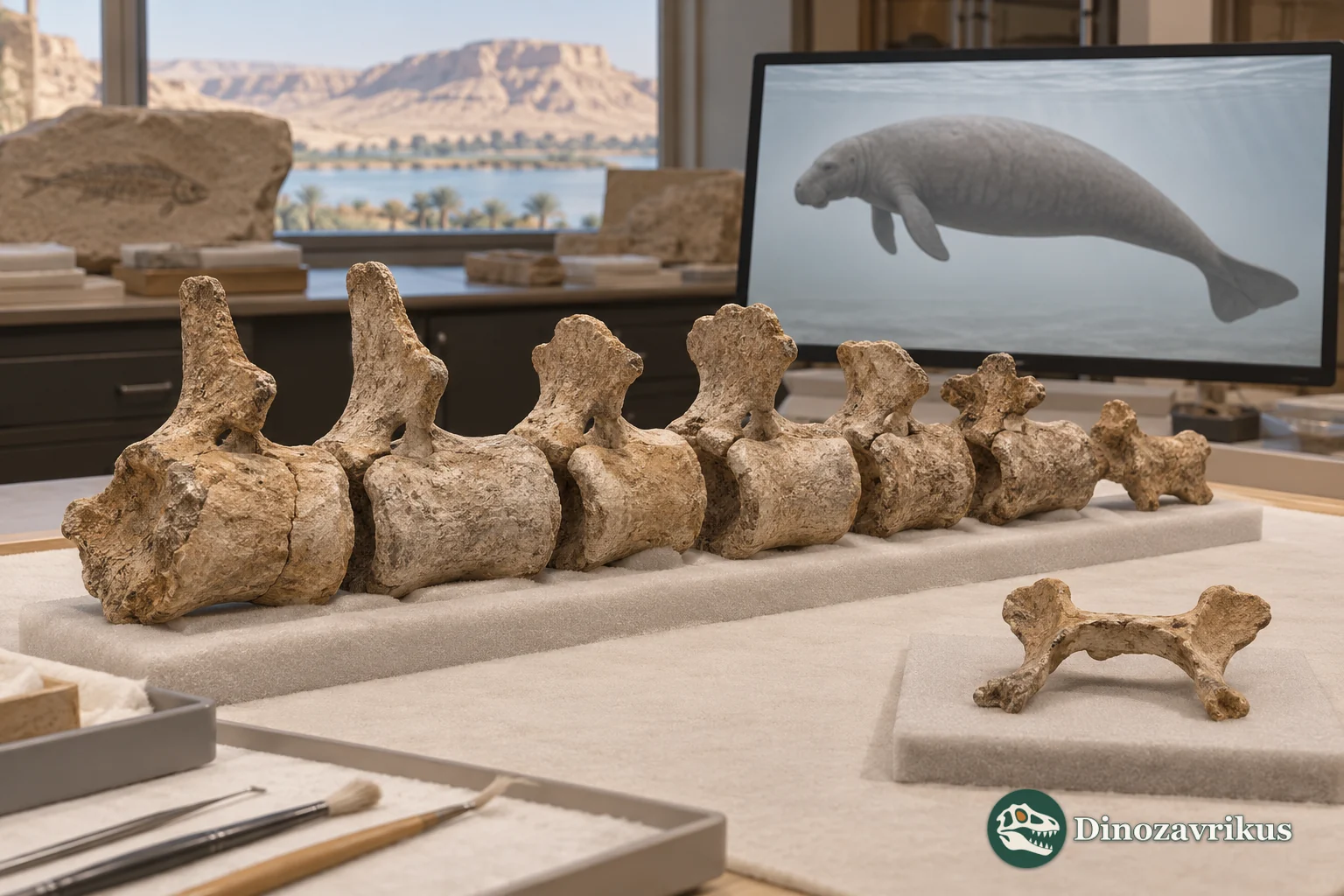
The best-known E. libyca material comes from the Qasr el-Sagha Formation north of Lake Qarun in the Fayum. Its layers are assigned to the late Eocene Priabonian. This dates the geological horizon, not the exact age of an individual animal.
Other Eosiren assignments come from the Mokattam Hills near Cairo and the Jebel Qatrani Formation. The latter is early Oligocene, while the Mokattam material is older Eocene. These records represent different places and intervals, not one continuously sampled population.
What can be inferred about its life?
Eosiren’s placement among sirenians supports an aquatic life. Cranial, limb and axial skeletal features are compared with those of fossil and living sirenians, but soft tissues are not preserved. Skin colour, exact tail shape and other details cannot be observed directly in the fossils.
Plant eating is a reasonable inference from sirenian relationships. No stomach contents, diagnostic plant remains in coprolites, or other direct evidence establish a particular food for E. libyca. The coastal Fayum deposits provide environmental context, not a record of an individual meal.
Reconstruction and limits
A reconstruction can show a sirenian with paddle-shaped forelimbs and a strongly reduced pelvis in E. libyca. Body proportions, skin, colour and other soft details remain artistic choices. The cover is an illustration, not a photograph or a portrait derived from one complete skeleton.
Frequently asked questions
When did Eosiren live?
Species assigned to Eosiren come from Egyptian Eocene and early Oligocene deposits. The best-documented E. libyca is known from the late Eocene Qasr el-Sagha Formation.
Why is the pelvis of Eosiren libyca important?
Its strong reduction documents change in the sirenian pelvic girdle compared with earlier forms. A pelvic bone alone does not establish the full movement or function of residual hindlimb muscles.
Was Eosiren the ancestor of living dugongs?
No direct ancestor-descendant link between a named Eosiren species and living dugongs has been established. The genus helps document Eocene sirenian diversity and skeletal evolution.
What did Eosiren eat?
Herbivory is inferred from sirenian relationships and comparison with living relatives. Direct stomach contents or another species-specific record of diet are not known.