

Protosiren is an Eocene sea-cow genus known from skulls and partial skeletons in Egypt and Pakistan. Its pelvis and hind limbs survived alongside vertebral adaptations associated with swimming, making the genus useful for studying how sirenians became increasingly aquatic. Preserved legs do not, by themselves, show how often the animal moved on land.
The genus belongs in the ancient mammal catalogue. Its skull can be compared with the early sirenian Eotheroides, while the European genus Prototherium provides a separate example of Eocene sea-cow diversity. These comparisons do not make their specimens interchangeable.
Quick facts
| Scientific name | Protosiren Abel, 1907 |
|---|---|
| Type species | Protosiren fraasi; holotype skull CGM C.10171 |
| Group | Sirenia; family Protosirenidae |
| Age | Middle Eocene; exact interval varies by species and locality |
| Range | Egypt and Pakistan; some newer fragmentary records are tentative |
| Named species | P. fraasi, P. sattaensis, and P. smithae |
| Known remains | Skulls, teeth, vertebrae, ribs, pelvis and limb bones |
| Main limitation | No single complete skeleton represents every species |
What do the Protosiren fossils show?
The holotype of Protosiren fraasi, CGM C.10171, comes from the Mokattam Hills. Its cranial anatomy was reassessed in a computed-tomography study, but it is not a complete skeleton.
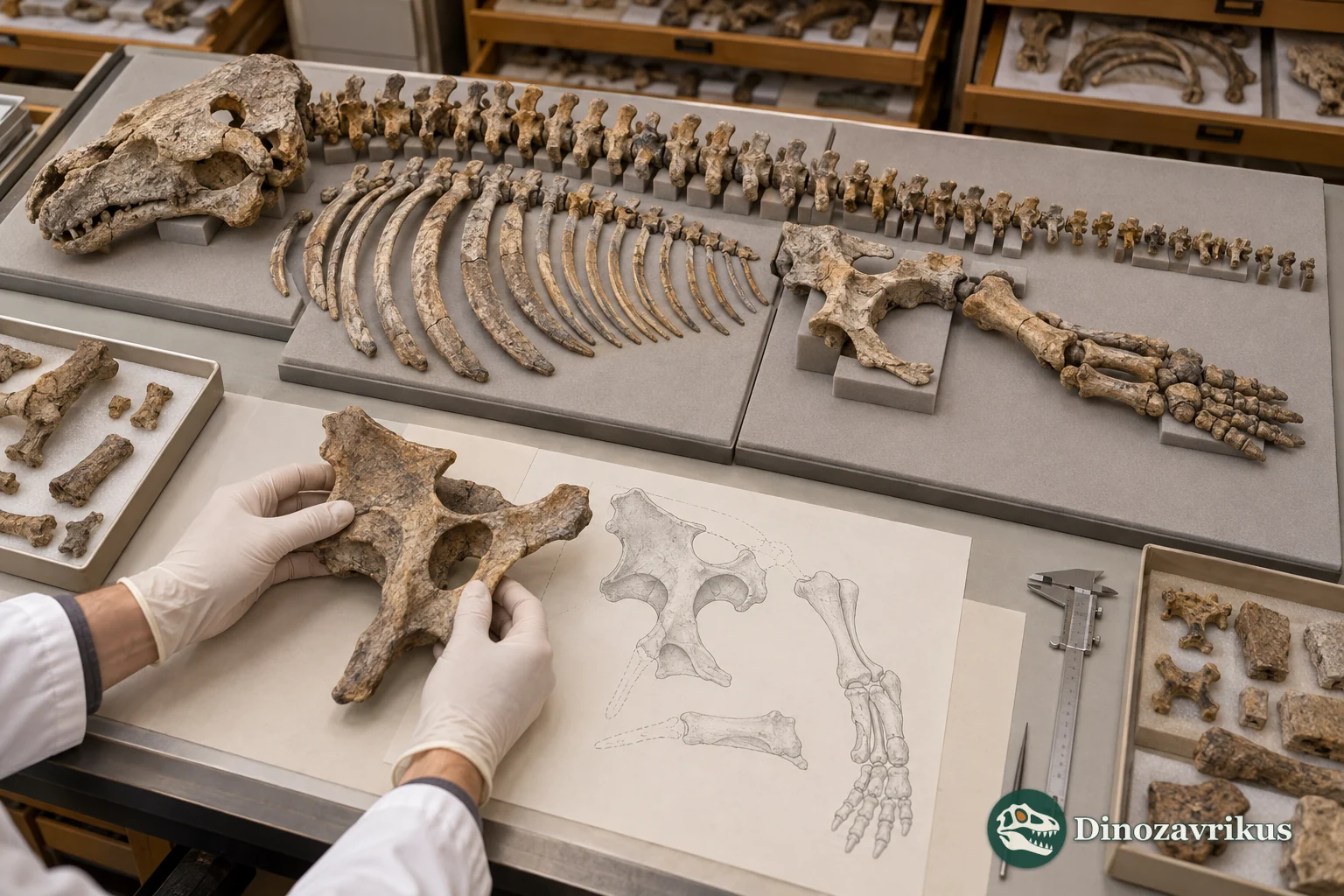
The partial skeleton of P. sattaensis from the Drazinda Formation includes vertebrae, ribs, pelvic bones and hind-limb material. These bones permit anatomical comparisons; they do not establish a terrestrial gait.
CGM 42292 from Wadi Al Hitan includes a skull and lower jaw with teeth, much of the vertebral column, some ribs, and fore- and hind-limb bones. It is extensive evidence, not a fully articulated skeleton.
Vertebral and pelvic anatomy has been interpreted as evidence of swimming and reduced hind-limb support of the trunk. The precise contribution of the limbs to propulsion remains an inference from bones.
The name and the type skull
Charles Andrews described the skull now catalogued as CGM C.10171 in 1906, initially referring it cautiously to Eotherium aegyptiacum. Othenio Abel used the specimen when he validly established the name Protosiren fraasi in 1907. The distinction between its early identification and its later nomenclatural role matters: CGM C.10171 is the name-bearing type of the type species, not a complete animal.
Gingerich, Domning, Blane and Uhen revisited the skull in 1994 using computed tomography. Their study described cranial anatomy and clarified characters that distinguish Protosiren from other early sirenians. Separate descriptions of P. smithae and P. sattaensis later added evidence from the axial skeleton, pelvis and limbs.
Three species and records of different ages
The commonly recognised species are P. fraasi, P. sattaensis and P. smithae. The first is known from the middle Eocene Mokattam Formation of Egypt. P. sattaensis was described from a partial skeleton in Pakistan’s Drazinda Formation. The younger P. smithae is known from Wadi Al Hitan in Egypt.
Calibrations published in the 1990s placed the relevant intervals at approximately 45.5 million years ago for P. fraasi, 43.5 million years ago for P. sattaensis, and about 39.5 million years ago for P. smithae. These are estimates for stratigraphic intervals, not dates for individual deaths; correlations may be refined. The records should not be treated as one contemporaneous population.
The P. smithae holotype CGM 42292 preserves a skull, lower jaw and teeth, many vertebrae, some ribs, and parts of the fore- and hind limbs. Even this comparatively extensive specimen lacks body regions. Later finds broaden anatomical comparisons without turning the genus into a single composite skeleton.
A 2024 report described fragmentary remains from Egypt’s Eastern Desert as Protosiren sp. and P. cf. fraasi. The abbreviation cf. signals resemblance with an open identification. These fossils expand the discussion of the record but should not be counted as a new species or unqualified type-series material.
Pelvis, hind limbs and aquatic locomotion
Pelvic bones and hind-limb elements are known for more than one species, but the preserved combinations differ. The P. sattaensis material includes a pelvis and femur; other species have their own, non-identical sets of bones. Comparisons of the ilium, acetabulum and obturator foramen help describe anatomical variation, but a single measurement cannot automatically be turned into a direct ancestor sequence.
Vertebral anatomy also points toward aquatic movement. Published comparisons describe a long posterior axial region and reduced pelvic connections needed to support the trunk on land. Researchers interpreted this combination as consistent with a capable swimmer. It is a functional interpretation of the skeleton, not an observation of the animal’s exact stroke.
The hind limbs were not simply absent or anatomically meaningless: bones remained, and their form could have contributed to movement in water. The fossils do not establish how much each species used its legs for propulsion or whether individuals could support themselves on shallow shorelines. Living sirenians offer comparison, not a substitute for the fossil evidence.
Diet, environment and what remains unknown
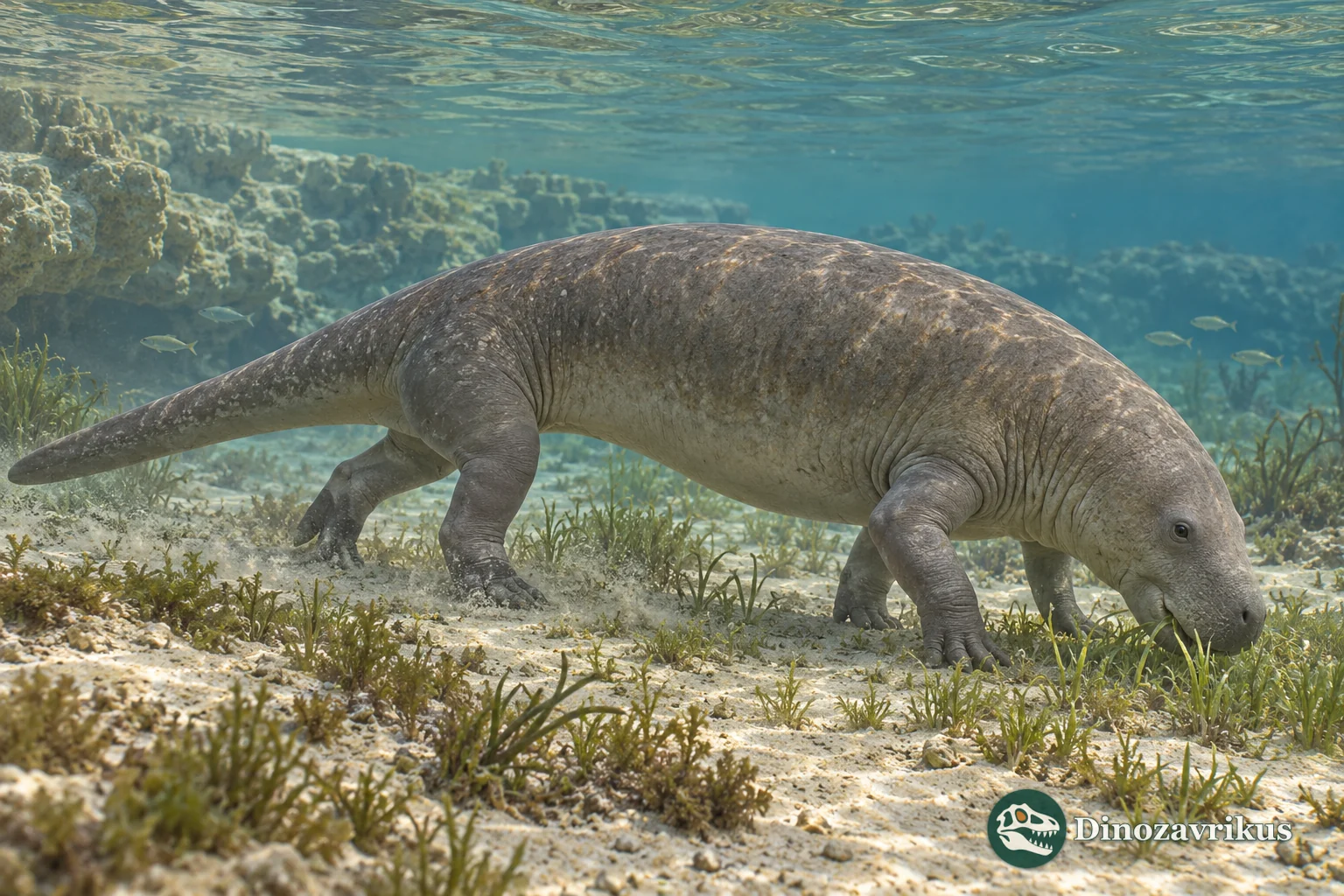
Like other sirenians, Protosiren was an aquatic herbivorous mammal. Coastal vegetation, including seagrasses where present, is a plausible part of the group’s ecology, but the named type specimens do not preserve stomach contents identifying particular plants. Cranial and dental anatomy should not be presented as direct evidence of a specific meal.
The Egyptian and Pakistani formations record marine settings, but not one unchanging habitat shared by every species. Sediments and associated fossils provide regional context rather than a detailed scene of each animal’s life. No reliable genus-wide body length or mass follows from the partial and differently composed skeletons.
The fossils directly show parts of the skull, teeth, vertebral column, pelvis and limbs. An aquatic mode of life is supported by the axial anatomy. Fur, colour, exact body proportions, feeding behaviour and social life remain reconstructions. The cover image therefore illustrates a hypothesis about appearance, not a fossilised portrait.
Frequently asked questions
When did Protosiren live?
The named species are known from the middle Eocene. Published calibrations for their type intervals are roughly 45.5, 43.5 and 39.5 million years ago, but these are stratigraphic estimates rather than exact dates for individuals.
Where were Protosiren fossils found?
The best-studied material comes from the Mokattam Formation and Wadi Al Hitan in Egypt, and the Drazinda Formation in Pakistan. Some newer fragmentary records have tentative identifications.
Could Protosiren walk on land?
It retained hind-limb bones, but the vertebral column and pelvis support an aquatic interpretation. The fossils do not establish how often it moved on land or how capable its terrestrial gait was.
Why is Protosiren important in sirenian evolution?
Its fossils combine aquatic specialisations with a pelvis and hind limbs. That anatomy helps researchers study stages in sirenian evolution, although the genus is not a demonstrated direct ancestor of living species.