

Eostegostoma is a fossil shark genus recognized from isolated teeth. Jacques Herman established it in 1977 for European material previously assigned to another genus. The teeth can be compared in detail, but they do not fix body length, colour or complete silhouette. The cover is a speculative reconstruction.
Quick facts
| Type species | Eostegostoma angustum |
|---|---|
| Genus established | Herman, 1977 |
| Known material | Isolated teeth |
| Well-supported age | Eocene; possible early Oligocene record |
| Alabama tooth height | About 4 mm |
| Body length | Unknown |
What can the fossils tell us?
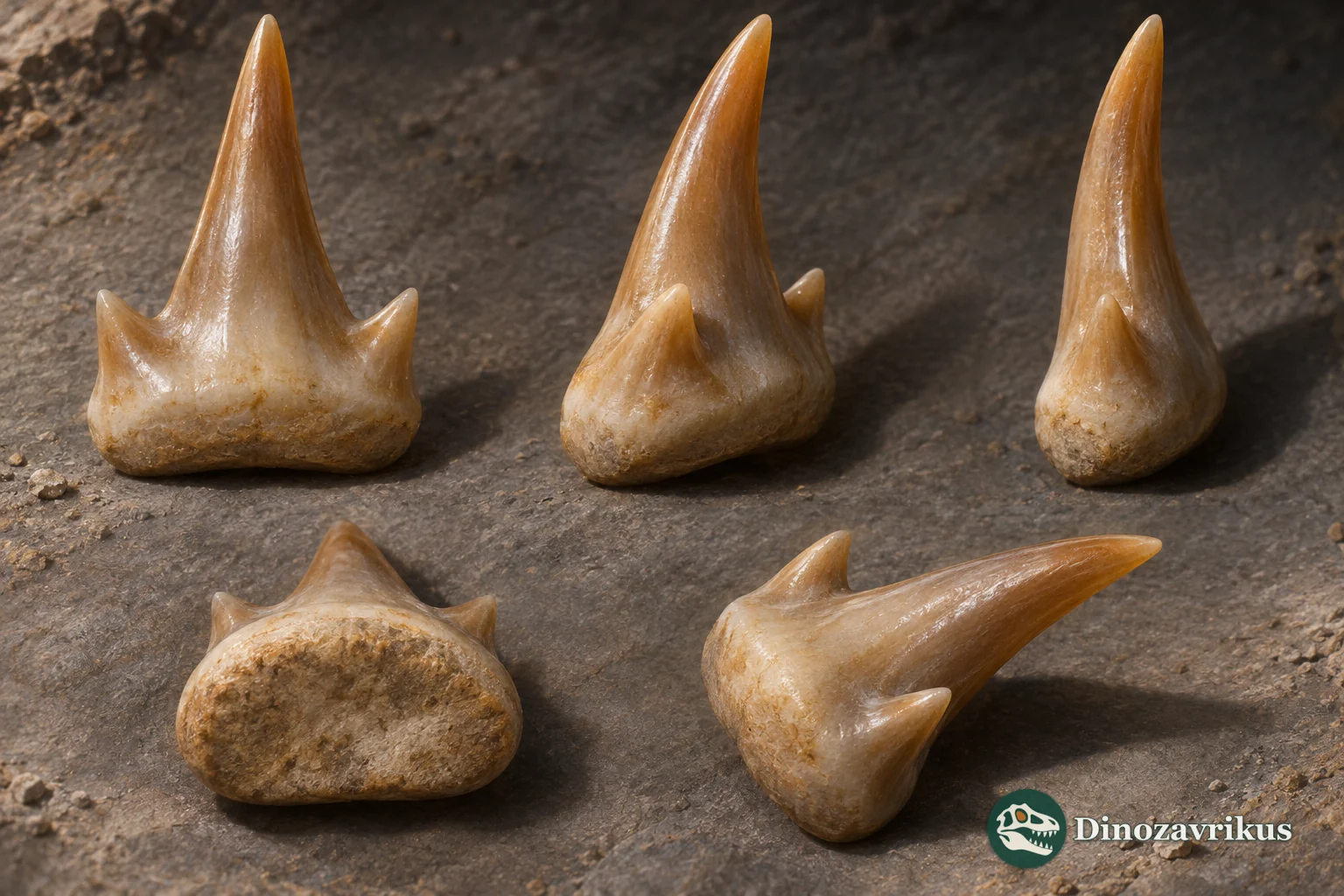
The Alabama tooth preserves a tall central cusp and two broad side cusplets. It can be measured, but a full body cannot be reconstructed from it.
Historical teeth occur in Eocene Europe. The Red Bluff Clay tooth was identified only to genus, and possible reworking complicates its age.
The genus has been compared with zebra and blind sharks. Isolated teeth do not settle its exact position or living appearance.
Naming and European finds
Teeth of the type species were formerly called Ginglymostoma angustum. Herman placed them in Eostegostoma in 1977 after reconsidering their features. This is a taxonomic reassessment of fossils, not an evolutionary transformation of one animal into another.
An additional incomplete E. angustum tooth was reported from the Dongen Formation in the Netherlands, at a borehole depth of 599–604 m. Its root and side cusplets are damaged, limiting comparisons. Belgian and English Eocene occurrences have also been reported, although fossil reworking and the age of individual beds require care.
The Alabama tooth
A 2024 study described isolated tooth MSC 50032 from the Red Bluff Clay of Monroe County, Alabama. It is about 4 mm high and under 2 mm wide. A tall triangular main cusp bends slightly backwards; two broad blunt side cusplets sit lower on the crown, and a labial projection is prominent.
Root structure also informed the identification. The authors assigned the fossil to Eostegostoma sp., without a species name. It is not securely E. angustum. One isolated tooth cannot establish the number of tooth rows, head shape or body length.
Age and range
The principal European occurrences are Eocene. The Alabama Red Bluff Clay is early Oligocene. If its tooth remained in its original bed, it extends the known range of the genus. The authors also considered whether an older Eocene tooth had been reworked into the deposit, although they found widespread reworking of the assemblage unlikely.
The careful summary is an Eocene genus with a probable early Oligocene record, not a proved continuous lineage through the entire interval. Other Paleogene tooth-based sharks include Odontorhytis and Striatolamia; those comparisons do not establish close kinship.
Affinities and body limits
Eostegostoma was once associated with zebra sharks, while later authors compared its teeth with brachaelurid blind sharks. Tooth shape can recur in unrelated lineages, so neither a modern zebra-shark identity nor a direct ancestor relationship is demonstrated.
No reliably assigned jaw, vertebrae, fins or stomach contents establish its prey, swimming style or outline. Palaeobates, by contrast, has a partial jaw with teeth, giving more information on its dentition. The cover portrays one generalized bottom-shark possibility, not a documented specimen.
Frequently asked questions
What fossils identify Eostegostoma?
Isolated teeth; no complete skeleton or securely assigned jaw is known.
What was found in Alabama?
One Red Bluff Clay tooth with a central cusp and side cusplets, identified as Eostegostoma sp. without a species name.
Did the genus survive into the Oligocene?
The Alabama record probably dates to the early Oligocene, although the authors considered possible reworking from older deposits.
Can we estimate its body size?
No. A tooth about 4 mm high does not provide a reliable total length.