

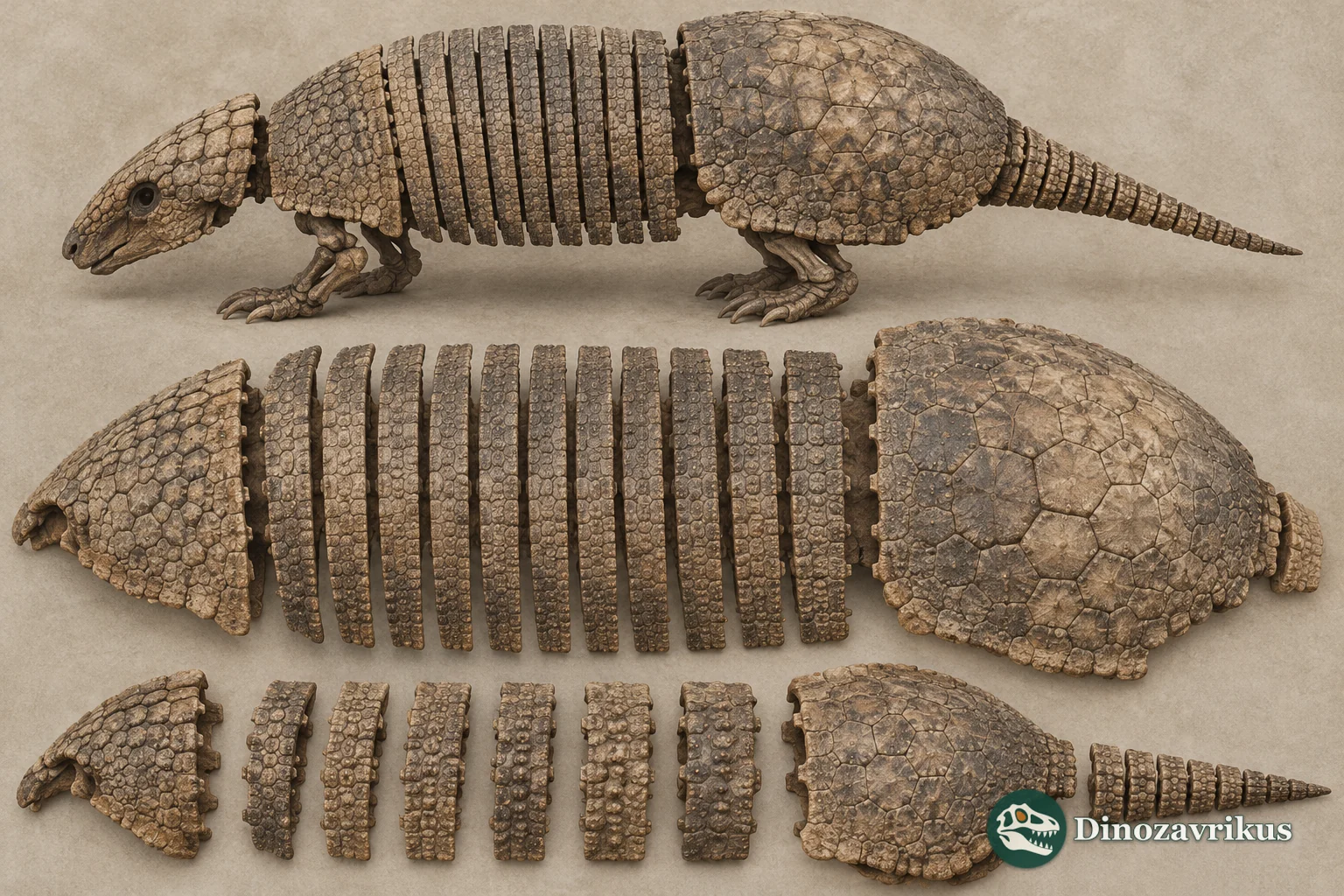
Eutatus was a large South American armadillo whose carapace is unusually informative. Roughly fourteen movable bands covered much of the front two thirds, while a fixed pelvic shield protected the rear. Skulls, limb bones and occasional more complete armor add evidence beyond the many isolated plates found in Pampas deposits.
The type species E. seguini is not a label for every isolated Eutatus osteoderm. The older E. pascuali and a later named Santa Fe species were separated by comparing plates from matching places in the carapace. The Miocene relative Proeutatus offers a useful contrast in jaw form, without being an early specimen of the same genus.
Quick facts
| Group | Cingulata, Eutatini |
|---|---|
| Type species | Eutatus seguini |
| Named | Paul Gervais, 1867 |
| Armor | About fourteen movable bands, rear pelvic shield |
| Fossils | Osteoderms, carapaces, skulls and limb bones |
| Range | South American Pampas, late Pliocene to Pleistocene records |
What can the fossils tell us?
Articulated armor shows many mobile bands over the front of the back and a fixed pelvic shield behind. A small anterior plate should not be compared directly with a posterior plate to name a species.
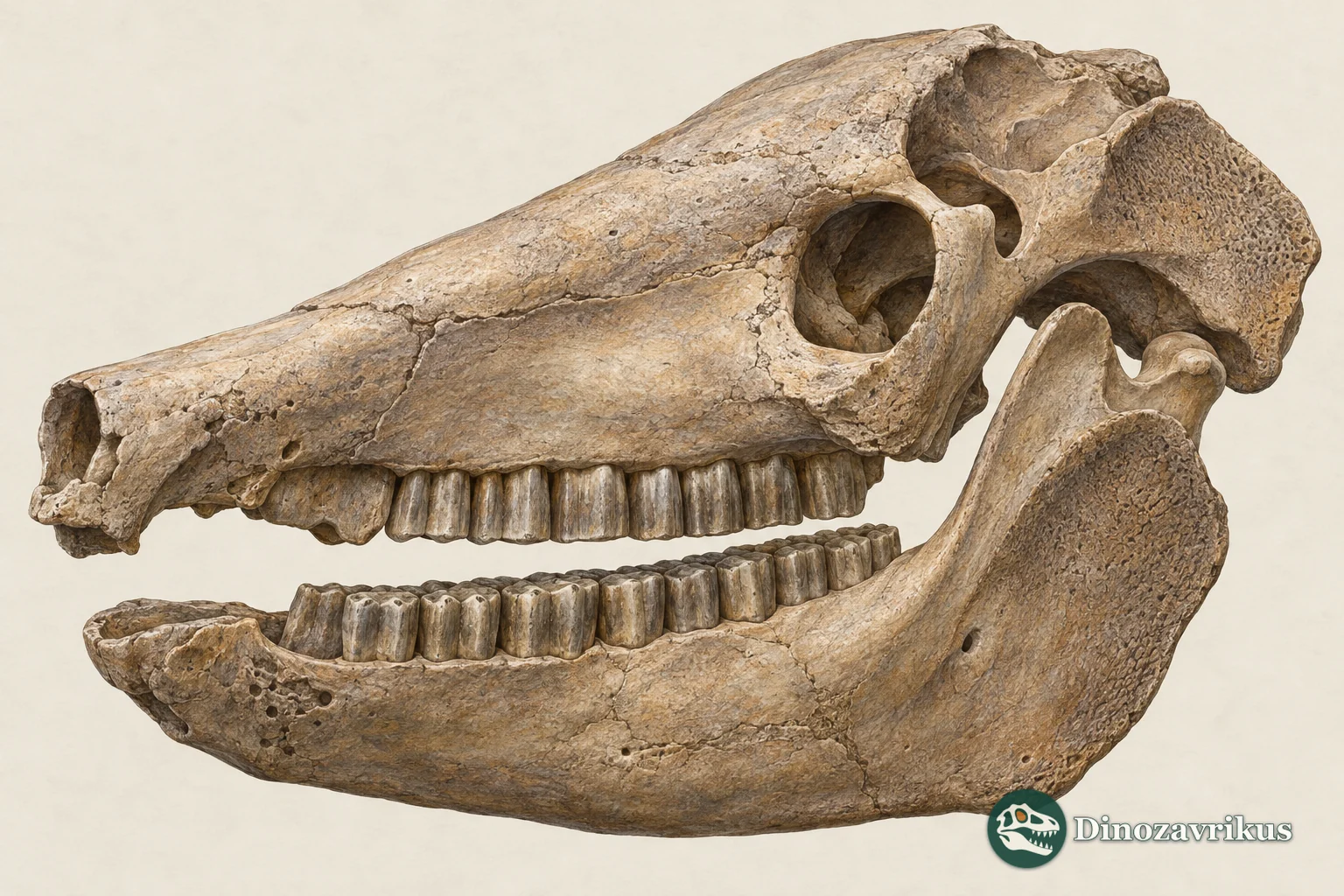
Tooth form, jaw joint and muscle attachment scars support specialized herbivorous chewing. They do not preserve the exact plants eaten by one individual.
A rare E. seguini hind foot retains osteoderms in place. They are thinner and less ornamented than dorsal plates, showing why a detached plate can be misleading.
A carapace with two kinds of movement
Paul Gervais established Eutatus and E. seguini in 1867. Later authors proposed more species from small samples. The revision of pelvic-shield osteoderms showed why plate position matters: an anterior movable-band plate can be much smaller than a fixed posterior one from the same species. The old name E. minutus, once tied to small osteoderms, was reassessed as a position effect rather than necessarily a separate tiny animal.
A 2009 analysis restricted E. seguini to younger Bonaerian and Lujanian faunas and recognized E. pascuali in older Marplatan and Ensenadan deposits. These are regional stage assignments for fossil series, not direct dates of each bone. Partial carapaces occur, but isolated plates far outnumber skulls found in association with armor. The illustration below explains band and shield structure without claiming to reproduce one museum specimen.
A third species and what its plates show
Brambilla and Ibarra described E. crispianii in 2017 from the Saladillo Formation near Rosario in Santa Fe Province. Its holotype MGPV-E1 includes a proximal tibia fragment, a vertebra, osteoderms and rib fragments. The name honours fossil collector Héctor Crispiani. Pelvic plates were compared with homologous plates of E. seguini and E. pascuali using measurements and geometric shape analyses; the new sample had larger plates and additional surface openings around the central figure.
Some openings relate to hair follicles and possibly soft tissues. An interpretation links their abundance with insulation in dry or cold conditions, but fossil plate openings do not directly measure climate or coat thickness. Pachyarmatherium, another armored cingulate, illustrates a very different carapace joint. Similar armor does not make the two animals identical in diet or movement.
A specialized jaw and a protected foot
Vizcaíno and Bargo studied jaw joints, tooth arrangement and muscle attachment scars in Eutatus and related eutatines. Their functional model indicated unusually specialized plant-processing for an armadillo-shaped skull. It is a biomechanical inference, not a preserved list of plants in the stomach. Their comparison with Proeutatus also found differences within the broader eutatine lineage.
A 2023 study described an E. seguini hind foot with small osteoderms still in anatomical position. The foot plates are thinner and rougher than dorsal armor, and have less distinct ornament. That direct association demonstrates foot armor but does not reveal running speed or whether the animal excavated a burrow. A previous body-mass estimate of around 50 kilograms applies to E. seguini in a stated model, not to every fossil assigned to the genus. Coat colour and soft tissue in the cover remain artistic choices.
Frequently asked questions
How was Eutatus armor unlike a glyptodont shell?
About fourteen movable bands covered much of its front carapace; the posterior pelvic shield was fixed.
Which Eutatus species are recognized in the 2017 study?
That study discussed E. seguini, the older E. pascuali and the newly described E. crispianii.
Do the jaws prove that Eutatus ate only grass?
No. Their morphology supports specialized plant processing but cannot identify an exact plant diet.
How do we know it had armor on its foot?
One E. seguini hind foot preserved small osteoderms in their original position.