

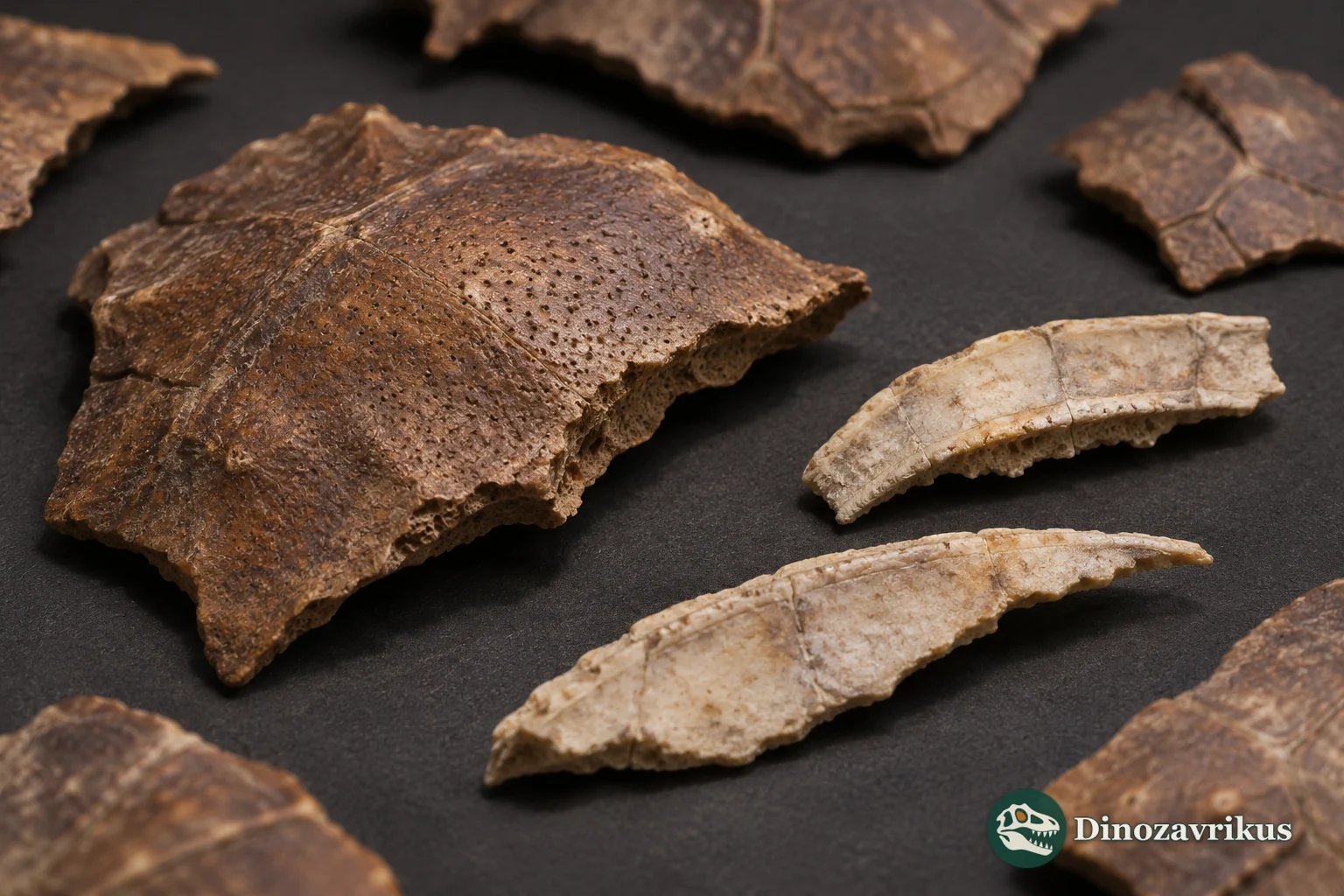
Ferganemys was a small freshwater turtle of Cretaceous Central Asia. Tiny pits ornament its shell bones. Such fragments are the bulk of the known material, and their edges and scute grooves help separate the Fergana species from a larger form described from Uzbekistan.
Quick facts
| Group | Turtles, adocids (Adocidae) |
|---|---|
| Age | Cretaceous (Albian, with disputed Cenomanian material) |
| Region | Asia (Kyrgyzstan, with a disputed species from Uzbekistan) |
| Type species | Ferganemys verzilini |
| Holotype | ZIN PH T/F67-7, partial plastron |
| Scientific name | Ferganemys |
| Diet | Exact diet unknown |
What can the fossils tell us?
ZIN PH T/F67-7 preserves part of the plastron. Reconstruction of the carapace relies on other bones from the type locality.
The lower shell of the type species has a sinuous midline groove. The Uzbek species has a straighter groove and a differently shaped rear lobe.
An analysis published in 2011 left the two species and the Shachemys clade in an unresolved branching arrangement. It did not establish that the two species belonged to one genus.
Fergana's name-bearing specimen
Lev Nessov and Lev Khosatzky established Ferganemys verzilini in 1977 for material from Kylodzhun in the southeastern Fergana Depression of Kyrgyzstan. The holotype is a partial plastron in the Zoological Institute of the Russian Academy of Sciences. It came from the upper Alamyshik Formation, assigned to the early and middle Albian.
About 3,000 shell fragments from the type locality were available for comparison in the subsequent revision. The figure counts pieces, with several bones potentially coming from one animal. Kirgizemys represents a different turtle lineage also known from the Albian of Fergana.
Recognising a small adocid
The published upper estimate for shell length in F. verzilini is about 20 centimetres. The front edge of the carapace turns upward along the nuchal and anterior peripheral bones. The plastron narrows toward the rear, where the midline groove remains strongly sinuous. The combination of small surface pits, modest rib thickenings and the position of the marginal scutes agrees with its assignment to Adocidae.
The younger turtle from Itemir
Nessov named F. itemirensis in 1981 for Cenomanian material from the Kyzylkum Desert. Its type is an impression of the back of a carapace. Elena Syromyatnikova later studied more than 400 isolated shell fragments from several Uzbek sites. One anterior peripheral, ZIN PH 136/87, gave a carapace estimate of about 40 centimetres.
The younger form has thicker central and rear marginal shell bones. It also has a shorter, wider rear plastral lobe and a straight groove along the midline. In the 2011 analysis, the two species fell in an unresolved arrangement with the Shachemys branch. The Uzbek form could belong in Ferganemys or represent a separate lineage. Additional skull material could help test those alternatives.
Frequently asked questions
What part of the animal is the holotype?
ZIN PH T/F67-7 is part of the lower shell, or plastron.
How large was the type species?
The published estimate for its shell length is up to about 20 centimetres.
What kind of fossil named the Uzbek species?
An impression of the back of the upper shell from the Cenomanian site at Itemir.
Does the genus definitely contain both species?
The relationship of the two forms remains unresolved. The 2011 analysis did not find evidence that they formed an exclusive branch.