

Gengasaurus nicosiai is an ophthalmosaurid ichthyosaur described from a relatively complete skeleton discovered in the Marche region of central Italy. Its diagnosis rests on a combination of skull, shoulder and forelimb features, including an unusual preaxial accessory facet on the humerus. Shark teeth found in association with the fossil led to a suggestion of possible scavenging, but they do not document a feeding event.
Quick facts
| Type species | Gengasaurus nicosiai |
|---|---|
| Age | Late Kimmeridgian to earliest Tithonian, Late Jurassic |
| Locality | Camponocecchio near Genga, Marche, Italy |
| Holotype | MSVG 39617, a relatively complete skeleton on a limestone slab |
| Classification | Ophthalmosauridae |
| Diagnostic anatomy | A distinctive combination including the preaxial humeral facet and a shortened ulna |
Evidence guide
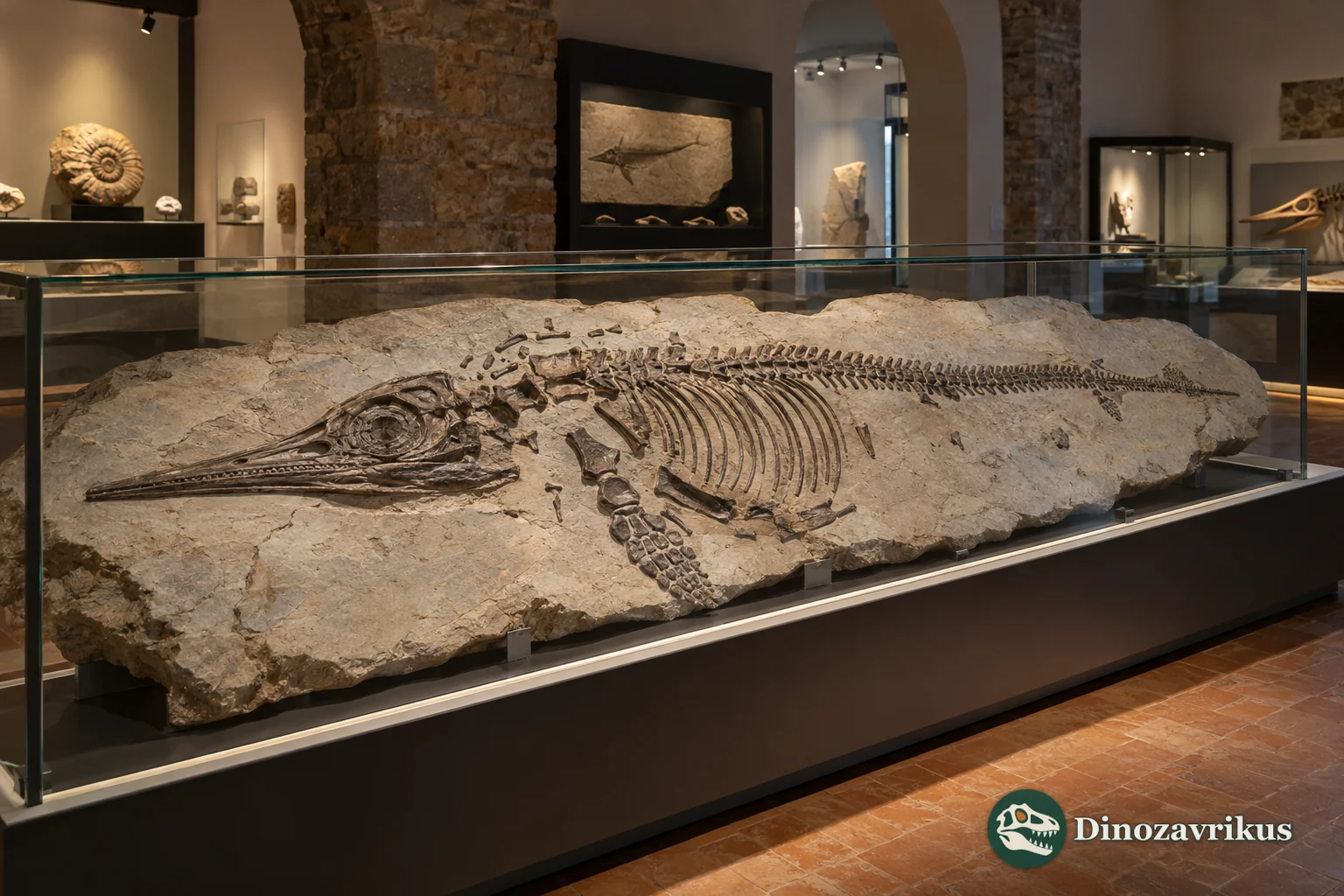
MSVG 39617 preserves many parts of the skeleton, including skull elements, the axial skeleton and forelimb bones. Its relative completeness allows comparisons across multiple regions, though the slab is not a perfectly articulated animal and preservation varies.
The authors noted a peculiar condition of the preaxial accessory facet on the humerus and assessed it alongside other characters. The diagnosis depends on this combination, not on an isolated bone feature alone.
The fauna at the ichthyosaur-bearing level indicates a late Kimmeridgian to earliest Tithonian age. This is a biostratigraphic interval for the horizon, not an exact calendar date for the animal.
Two hexanchiform shark teeth were recovered in association with the ichthyosaur. The authors suggested that scavenging may have occurred, but the association does not show when or how the animals interacted.
A Jurassic skeleton from Genga
Holotype MSVG 39617 was discovered in 1976 near Camponocecchio, close to Genga in the Marche region of eastern central Italy. The fossil was found during earthworks. It is now held at the Speleo-Palaeontological Museum of Genga. The specimen was discussed before its formal description, but Ilaria Paparella and colleagues named the genus and species in 2017.
The skeleton is relatively complete for an Italian ichthyosaur fossil, although some skull bones are disarticulated and preservation varies across the slab. Its extent permits comparison of several anatomical regions. It does not mean that every bone is in life position or that soft tissues have been preserved.
Age and marine setting
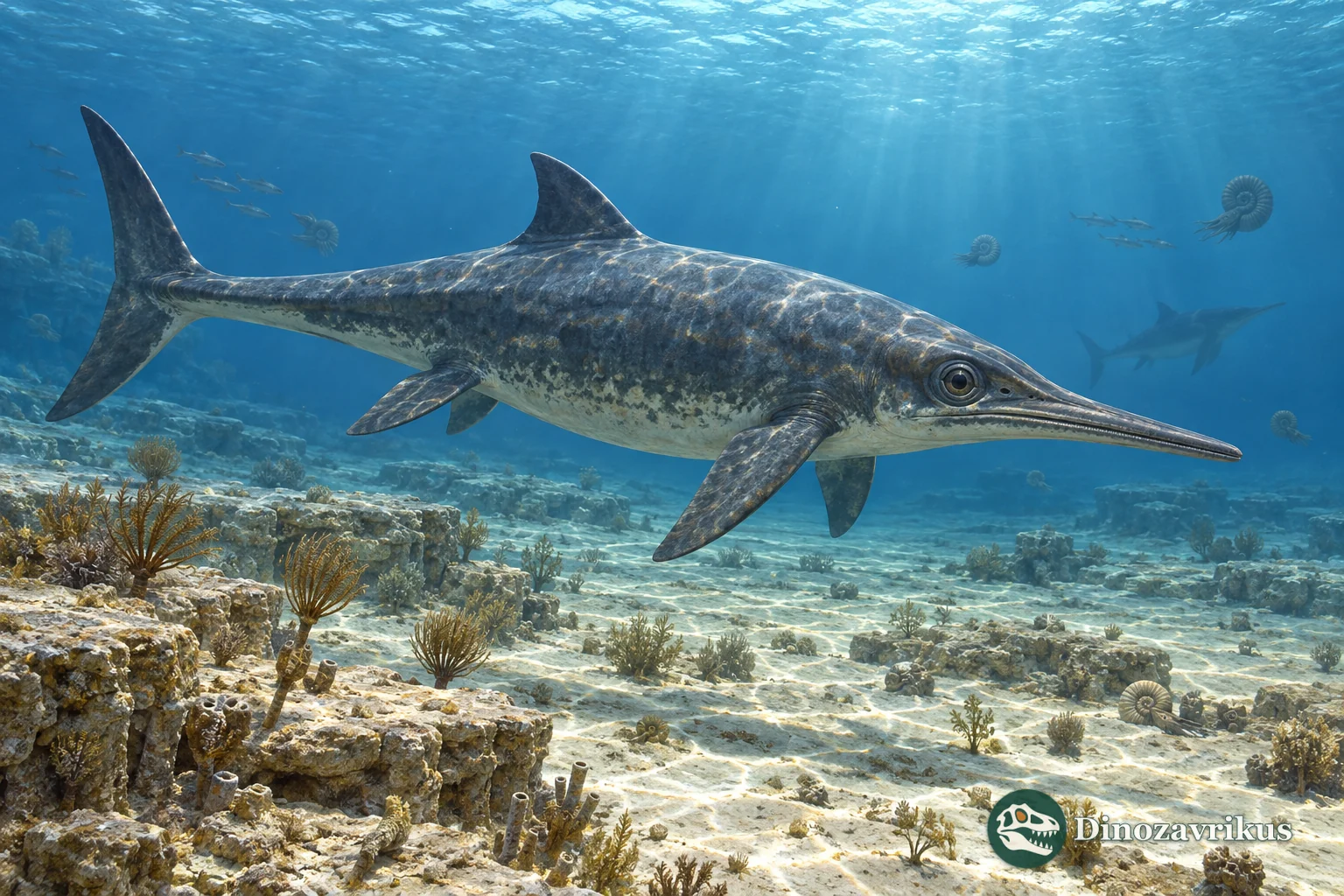
The fossil-bearing rocks belong to the Late Jurassic limestones of the Calcari ad Aptici e Saccocoma Formation. Associated fauna indicates a late Kimmeridgian to earliest Tithonian age. That biostratigraphic interval dates the horizon broadly; it is not a precise date for the death or burial of one individual.
During this interval, carbonate sediments accumulated in the western Tethys. Ammonites and other marine fossils help establish the geological context. Their presence in a regional assemblage should not be turned into an imagined moment when every listed animal met the ichthyosaur.
Anatomy and evolutionary relationships
The description diagnosed Gengasaurus from a unique combination of characters, including the unusual preaxial accessory facet on the humerus. This is a surface involved in the anatomy of the forefin. The shape and orientation of the facet differ from those in several related ichthyosaurs, but its meaning is assessed alongside other features.
A reduced extracondylar area of the basioccipital and the presence of a preaxial digit support referral to Ophthalmosauridae. The animal also shares diagnostic features with more than one major lineage in earlier analyses. Phylogenetic results place it within the family while showing why a single feature cannot tell the whole evolutionary story. Comparisons with Stenopterygius and Acamptonectes provide context, not proof of direct ancestry; fragmentary Dearcmhara illustrates a very different level of fossil completeness.
Shark teeth and a cautious feeding hypothesis
Two teeth assigned to hexanchiform sharks were recovered in association with Gengasaurus. The authors suggested that scavenging on the carcass might have occurred. This is plausible in light of the association, but it does not establish that the teeth belonged to the individual that interacted with the ichthyosaur, nor when any feeding took place.
A bite mark on bone, a tooth embedded in a wound or another direct trace could provide stronger evidence for a specific interaction. Here, the published claim is appropriately limited to a possibility. The fossil record preserves an association, not a witnessed scene.
Frequently asked questions
Where was Gengasaurus found?
The holotype was discovered near Camponocecchio by Genga in the Marche region of central Italy. It is held at the Speleo-Palaeontological Museum of Genga.
How old is the skeleton?
Associated fauna indicates a late Kimmeridgian to earliest Tithonian age in the Late Jurassic. This is a range for the fossil-bearing horizon.
What is unusual about its forefin?
The authors described a peculiar preaxial accessory facet on the humerus, considered together with other skull and postcranial features.
Do the shark teeth prove that sharks ate the ichthyosaur?
No. Two hexanchiform teeth were found in association with the skeleton. They suggest possible scavenging but do not preserve a direct feeding event.