

Glaucopristis is an extinct rhinopristiform ray genus known from small isolated teeth in the North Sea region. Its name was introduced in 2024, when researchers transferred an older species to a newly recognised genus. Later material from Belgium clarified the tooth features used for identification, but no complete skeleton reveals the ray’s proportions, length or behaviour.
Quick facts
| Group | Extinct rhinopristiform batoid, or ray |
|---|---|
| Type species | Glaucopristis bruxelliensis, originally named in another genus |
| Known material | Isolated teeth; no associated full skeleton or jaw is known |
| Age | Eocene; Ypresian and Lutetian occurrences in Belgium |
| Locality | Among other sites, the base of the Asse Clay at Papenboskant |
| Tooth size | About 2 mm high in the described Papenboskant series |
| Body length and diet | Unknown; no direct prey evidence is reported |
What can the fossils tell us?
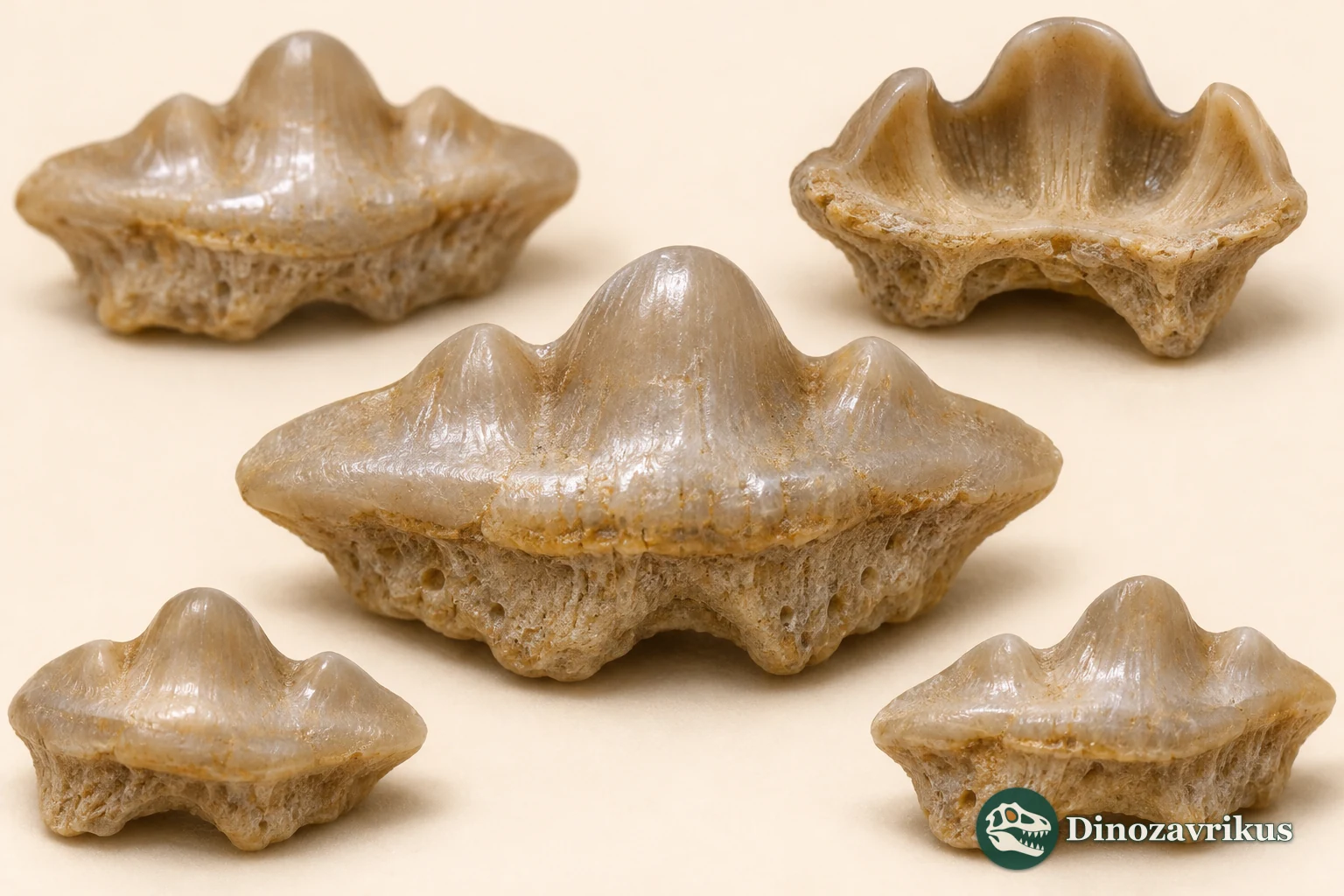
The 2025 Papenboskant series includes teeth around 2 mm high, often wider than tall. Authors noted a thick, relatively long central uvula and prominent lateral uvulae that diverge sideways. These are dental characters, not evidence for a saw-bearing rostrum.
Three complete and ten incomplete specimens were attributed to Glaucopristis bruxelliensis from the base of the Asse Clay Member at Papenboskant. They are registered in Brussels under IRSNB numbers, including P 10791. The sample documents one site and horizon, not the whole geographic range.
No associated skeleton or complete jaw establishes total length, fin proportions or exact feeding behaviour. The 2024 taxonomic transfer changed the genus combination, not the amount of body anatomy preserved.
A species name moved into a new genus
In 1894, Otto Jaekel described the fossil species Rhinobatus bruxelliensis. In 2024, Thomas Reinecke and colleagues erected Glaucopristis in a review of North Sea Basin batoids and transferred the older species into it. The species name remained, giving the current combination Glaucopristis bruxelliensis.
This was a change in classification, not the discovery of a complete animal. The revision compared fossil teeth with the dentition of living rays and proposed several new genera. Its authors also cautioned that some older records of small-toothed taxa and the stratigraphic coverage of particular species need further study. The new name places the historical material in a revised framework while leaving questions about individual specimens open.
The teeth from Papenboskant
In 2025, Pieter De Schutter and Eric Steurbaut reported three complete teeth and ten incomplete specimens assigned to G. bruxelliensis from Papenboskant, near Wolvertem in northern Belgium. The fossils came from the glauconitic base of the Asse Clay Member, part of the lower Maldegem Formation. The paper assigns this interval to the middle Lutetian. One complete tooth is catalogued as IRSNB P 10791 in the Institute of Natural Sciences in Brussels.
The teeth measure around 2 millimetres high and are often wider than tall. The central uvula is thick and comparatively long, while prominent lateral uvulae diverge to either side. These structures, visible on the underside of a tooth, help distinguish it from similar fossil batoid teeth. They do not describe an elongated snout or a saw. Other extinct rays, such as Sclerorhynchus and Schizorhiza, are known for rostral structures that are not documented in the material of Glaucopristis.
To collect the small fossils, approximately 1,200 kilograms of sediment from the horizon were screen-washed through a 0.5-millimetre mesh. The method recovered numerous tiny remains that could be missed by hand collection. The resulting sample helps describe a specific layer and locality; it does not measure how abundant the ray was in every Eocene sea.
An Eocene record in the North Sea region
The genus is reported from Ypresian and Lutetian deposits in Belgium. The 2024 review examined early Eocene batomorph assemblages from the London Clay Formation in England and formations in western Belgium. The 2025 study added the middle Lutetian Papenboskant sample and reviewed the wider Belgian record. Its authors described the species as the most common rhinopristiform in the Ypresian and Lutetian of Belgium, based on the accumulated published finds.
Not all collections sample sediments in the same way. At Papenboskant, fine-mesh washing recovered many teeth under 5 millimetres long. Older collections often relied on hand-picked specimens and therefore favoured larger fossils. A difference between counts at two localities may reflect collection methods as well as ancient ecology. It would be misleading to turn the known finds into a continuous map of a single population or to assume every isolated tooth has an equally secure identification.
What remains unknown
The descriptions do not establish the ray’s total length, disc width, tail proportions or colour. A few millimetres of tooth height cannot be converted into body size without an associated skeleton or a validated relationship between tooth position and animal length. The known material does not include stomach contents or prey fossilised in direct association, so a specific diet is unknown as well.
The cover artwork uses a generalized flattened ray-like outline to help readers picture a batoid. It does not show an animal recovered from the Asse Clay, and details of the body are speculative. The anatomy actually described is much more modest: small oral teeth with a particular crown and uvula configuration. A visual reconstruction should not be mistaken for a complete fossil record.

Frequently asked questions
Why is the genus called Glaucopristis now?
The species was described in 1894 as Rhinobatus bruxelliensis. A 2024 review transferred it to the newly established genus Glaucopristis after comparing batoid dentitions.
How large were the described teeth?
The Papenboskant teeth were around 2 millimetres high and often wider than tall. Those measurements describe teeth only.
Where were the Belgian specimens found?
They came from the base of the Asse Clay Member at Papenboskant near Wolvertem. A 2025 paper recorded three complete and ten incomplete specimens, including IRSNB P 10791.
Do we know its length or diet?
No. Isolated teeth do not establish total body length, prey or hunting behaviour, and no associated skeleton or gut contents are known.