

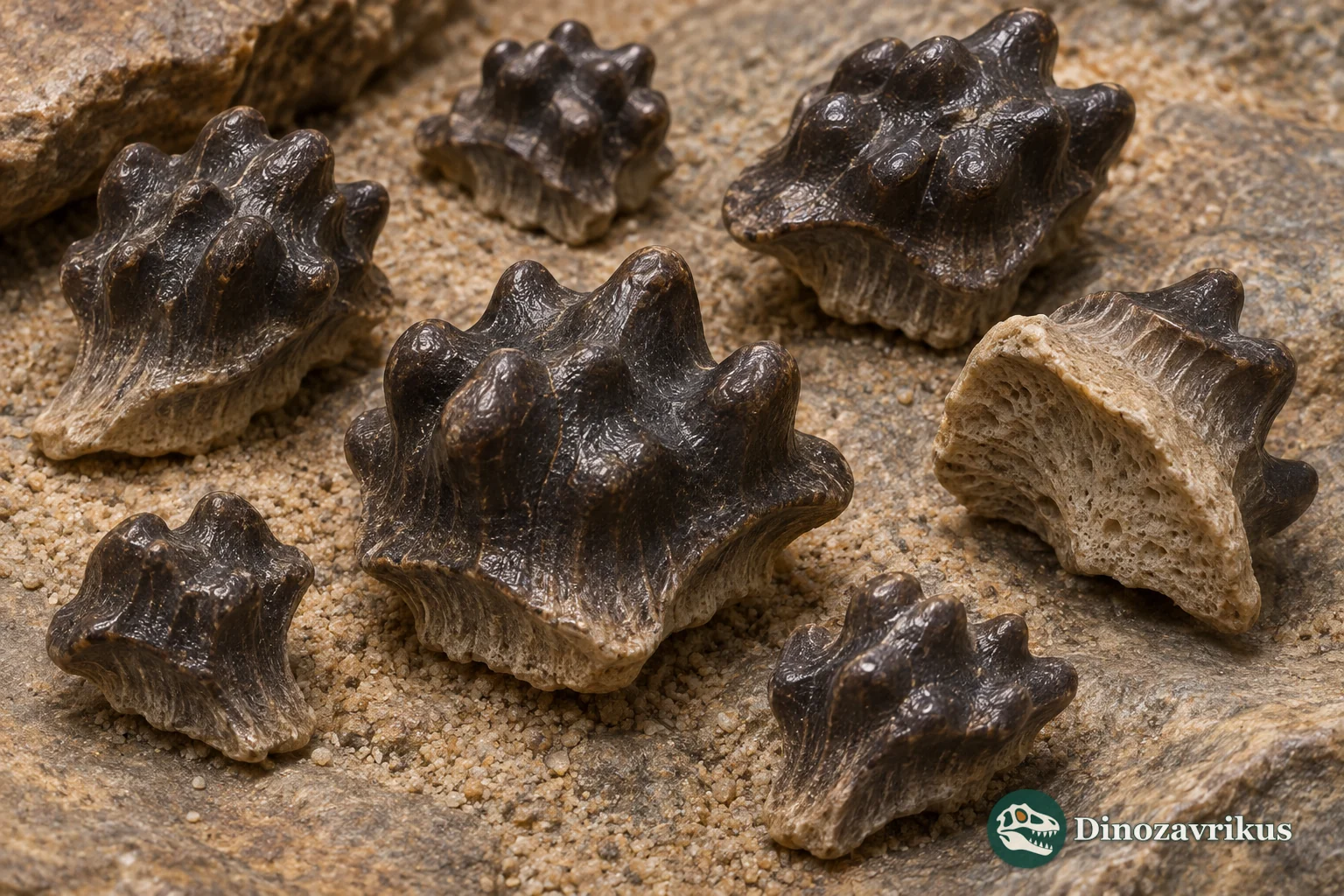
Holmesella names small fossil structures interpreted as skin denticles of a Paleozoic cartilaginous fish. They do not reveal a reliable whole-body silhouette or length. Frank Gunnell named the type species, H. quadrata, in 1931 from Pennsylvanian deposits of Missouri. The fragments were initially placed with conodonts and later reinterpreted as shark-like dermal elements.
Quick facts
| Type species | Holmesella quadrata |
|---|---|
| Named | Gunnell, 1931 |
| Type horizon | Fort Scott Formation, Missouri |
| Type age | Pennsylvanian, Carboniferous |
| Secure material | Isolated dermal denticles |
| Body length | Unknown |
What can the fossils tell us?
Gunnell introduced H. quadrata from the Fort Scott Formation among fossils then considered conodonts. Later study treated the elements as cartilaginous-fish skin denticles.
Individual denticles reveal crown and base morphology, not jaw position, fin arrangement or total body length. Some similar material remains tentatively assigned.
The type came from Missouri; reports also exist from Oklahoma and the Minnelusa Formation in South Dakota. A broad database range is not proof that each occurrence belongs to one biological species.
From conodont to skin denticle
Gunnell introduced H. quadrata in a study of microfossils from the shaly middle part of the Fort Scott Formation in Missouri. Early workers grouped small hard elements by their appearance before their anatomical position was established. Its original placement among conodonts should therefore not be mistaken for a secure modern classification.
Later researchers interpreted Holmesella-like elements as dermal denticles of cartilaginous fishes. Some historical museum records retain the old conodont classification, whereas studies of Paleozoic fishes discuss the genus among elasmobranchs. The change reflects anatomical reassessment, not the discovery of a complete body.
Separate occurrences
Besides the Missouri type material, H. quadrata has been reported from Pennsylvanian strata of Oklahoma. Museum catalogues record individual elements from Pontotoc County. In 2002 David Cicimurri and Mark Fahrenbach included the species in a chondrichthyan assemblage from the upper Minnelusa Formation of South Dakota. These are reports of small fossils, not counts of complete sharks.
Some similar fossils carry a question mark before the genus name, meaning their identification is uncertain. Such records do not establish an exact wider range. A database span from the Mississippian to earliest Permian requires collection-by-collection review; the type material has a secure Pennsylvanian context.
What the covering can show
Dermal denticles are hard components of the outer covering of a cartilaginous fish. Separate crowns and bases permit morphological comparison, including projections and growth patterns. Later authors contrasted irregularly arranged Holmesella projections with more ordered cusp rows in teeth assigned to Protacrodus.
Without a connected skeleton, the exact body position of the isolated elements and variation across one animal remain unknown. Acrodus is chiefly known from jaw teeth, whereas Palaeobates preserves part of a jaw itself. Their evidence differs from Holmesella's skin structures; the contrast does not prove close kinship.
Limits of the living reconstruction
No skull, vertebral column, fins, gut contents or measured total body length has been securely linked with the type denticles. A cartilaginous-fish interpretation does not fix the exact fin shape or proportions of a living Holmesella animal.
The cover shows a generalized shark-like possibility; its colour, size and pose are artistic. The younger Eostegostoma is also incompletely known, although from teeth rather than dermal denticles. Each kind of fossil imposes its own limits on reconstruction.
Frequently asked questions
Why was Holmesella first treated as a conodont?
It was named from tiny loose elements in a conodont study; later anatomical comparison favoured cartilaginous-fish skin denticles.
Where was the type found?
The type species H. quadrata came from the middle Fort Scott Formation in Missouri.
Do we know its body length?
No. Isolated dermal denticles cannot provide a reliable total length.
Does every reported age belong to the same species?
Not necessarily. Broad database ranges and tentative assignments require checking each fossil and its horizon.