

Hypolophodon is a fossil ray whose record consists chiefly of isolated teeth. These preserve crown and root anatomy and suggest aspects of feeding, but they do not provide a full portrait of the animal. Distant localities and changing classifications require each species and horizon to be considered separately.
Quick facts
| Type species | *Hypolophodon sylvestris* White, 1931 |
|---|---|
| Genus established | Henri Cappetta, 1980 |
| Placement | Myliobatiformes; family not securely assigned |
| Type region | Blackheath Beds, Abbey Wood, England |
| Main material | Isolated teeth; no complete skeleton defines the genus outline |
| Studied records | Eocene England and Alabama; Palaeocene Patagonia |
| Tooth size | Alabama specimens generally measure only a few millimetres across |
| Feeding | Crushing teeth imply hard-food processing; exact prey is unknown |
What can the fossils tell us?
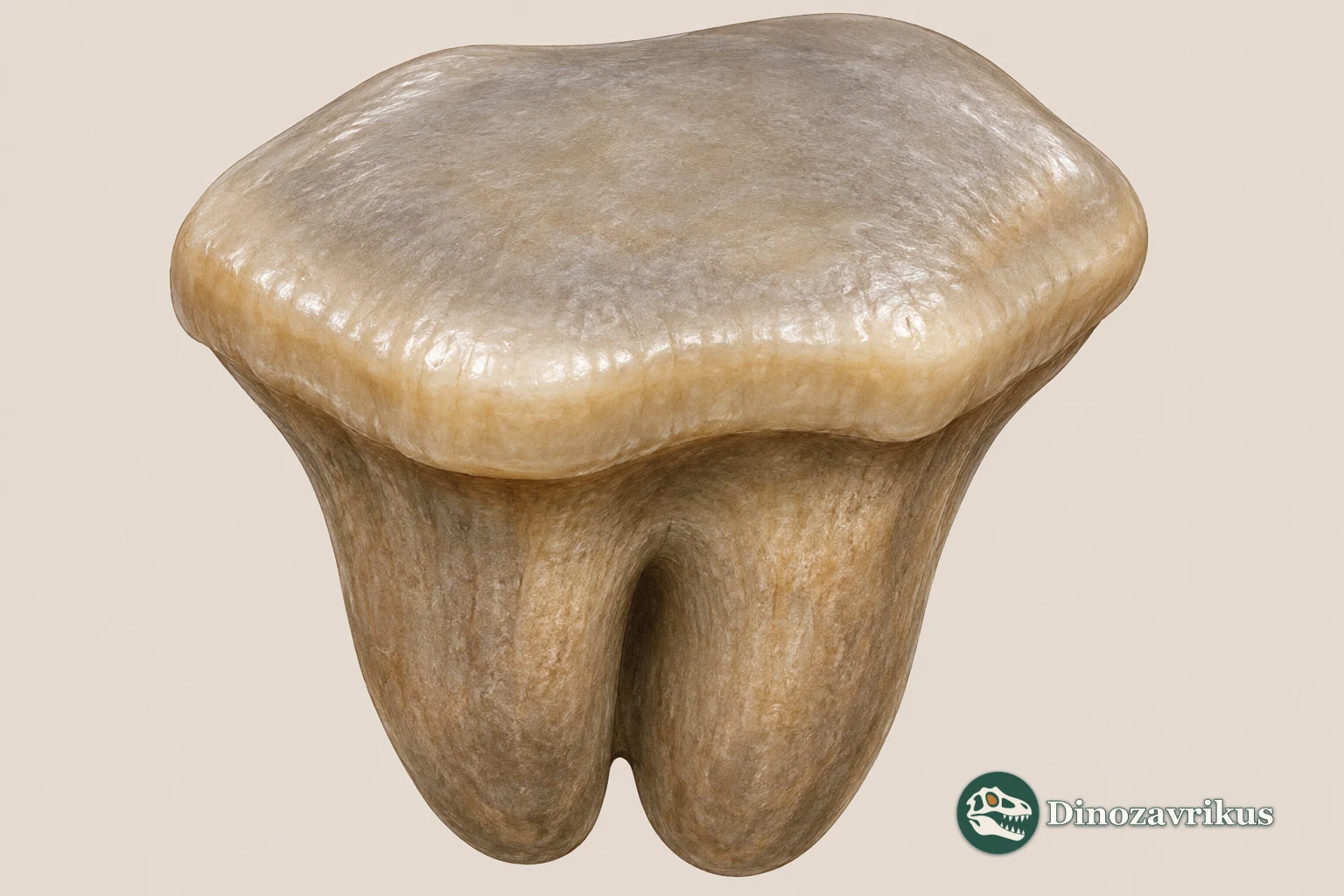
Many teeth have crowns broader than long, often with a transverse crest and a root divided into two lobes. Shape varies with jaw position and growth.
The type material comes from early Eocene deposits in southeast England. Other assignments from Alabama and Patagonia represent distinct faunas and ages.
The genus is generally placed among myliobatiform rays. Revisions have differed on its position within the order, and no family placement is secure.
Naming a genus from teeth
White described *Hypolophus sylvestris* in 1931 from dental material in the Blackheath Beds near Abbey Wood, Kent. In 1980 Henri Cappetta transferred the species to his new genus *Hypolophodon* and grouped several similar tooth forms with it. The name recalls *Hypolophus*, but that resemblance does not by itself establish close relationship to living rays bearing that name.
Cappetta initially placed the genus in Dasyatidae. Later classifications questioned that assignment. The 2012 description of a Patagonian species left its position as Myliobatiformes incertae sedis: a ray whose family is uncertain. It is safest to identify Hypolophodon as a myliobatiform ray without claiming a settled family.
What the teeth show
Typical teeth have a low, broad crown above a substantial root divided into two lobes. Crowns are often broader across than they are long, and a low transverse crest may cross the chewing surface. Details differ among species and tooth positions, while wear can soften the relief. An isolated tooth therefore needs comparison across several characters rather than a general resemblance alone.
In 2019 Ebersole and colleagues described seven *H. sylvestris* teeth from Alabama’s Tallahatta Formation. The greatest width is about five millimetres. That measurement describes the studied sample, not the length of the whole ray. A broad crown and strong root are consistent with crushing or grinding food, but they do not reveal an exact menu.
From England to Patagonia
The type material comes from the early Eocene of England. Alabama records are assigned to the upper Ypresian and lower Lutetian in the cited study. In 2012 Cione, Tejedor and Goin named *H. patagoniensis* from the middle part of the Lefipán Formation in central Patagonia. Its holotype, LIEB-PV 1600, is a single anterior tooth 6.4 millimetres wide, not part of an associated skeleton.
The Patagonian horizon is early Palaeocene and represents a separate South American occurrence. Teeth from the upper Jagüel Formation in Argentina had earlier been referred to *H. sylvestris* as a Maastrichtian record. Later assessments differ, so this early report should be presented as the interpretation of a 2011 paper rather than an uncontested range boundary.
Feeding and limits of reconstruction
Broad crowns support the inference that the animal could crush or grind hard food. Molluscs and other bottom-dwelling invertebrates are plausible, but no specific prey is documented: the cited material does not preserve stomach contents or an unambiguous feeding trace. Similar crushing teeth in other rays indicate a possible function, not necessarily close kinship.
No complete skeleton securely fixes the genus’s disc length, tail outline, colour or swimming style. The cover is a cautious artistic reconstruction of a general ray. Dental anatomy is much firmer evidence than the body portrait; it cannot establish speed, behaviour or exact water depth. Other fossil shark and ray records such as Palaeobates and Eostegostoma likewise show why tooth observations must be kept separate from claims about a whole animal.
Frequently asked questions
Is Hypolophodon known from a complete skeleton?
The studies discussed here describe isolated teeth. No complete skeleton securely establishes the genus’s body and fin proportions.
How large were its teeth?
Teeth in the Alabama sample reach about five millimetres in greatest width. This is not a measurement of the ray’s body length.
What did it eat?
Broad crowns suggest processing hard food. No specific prey or stomach contents are established.
When did the genus live?
The record includes Eocene England and Alabama and an early Palaeocene species from Patagonia. An older Argentine assignment depends on a disputed identification.