

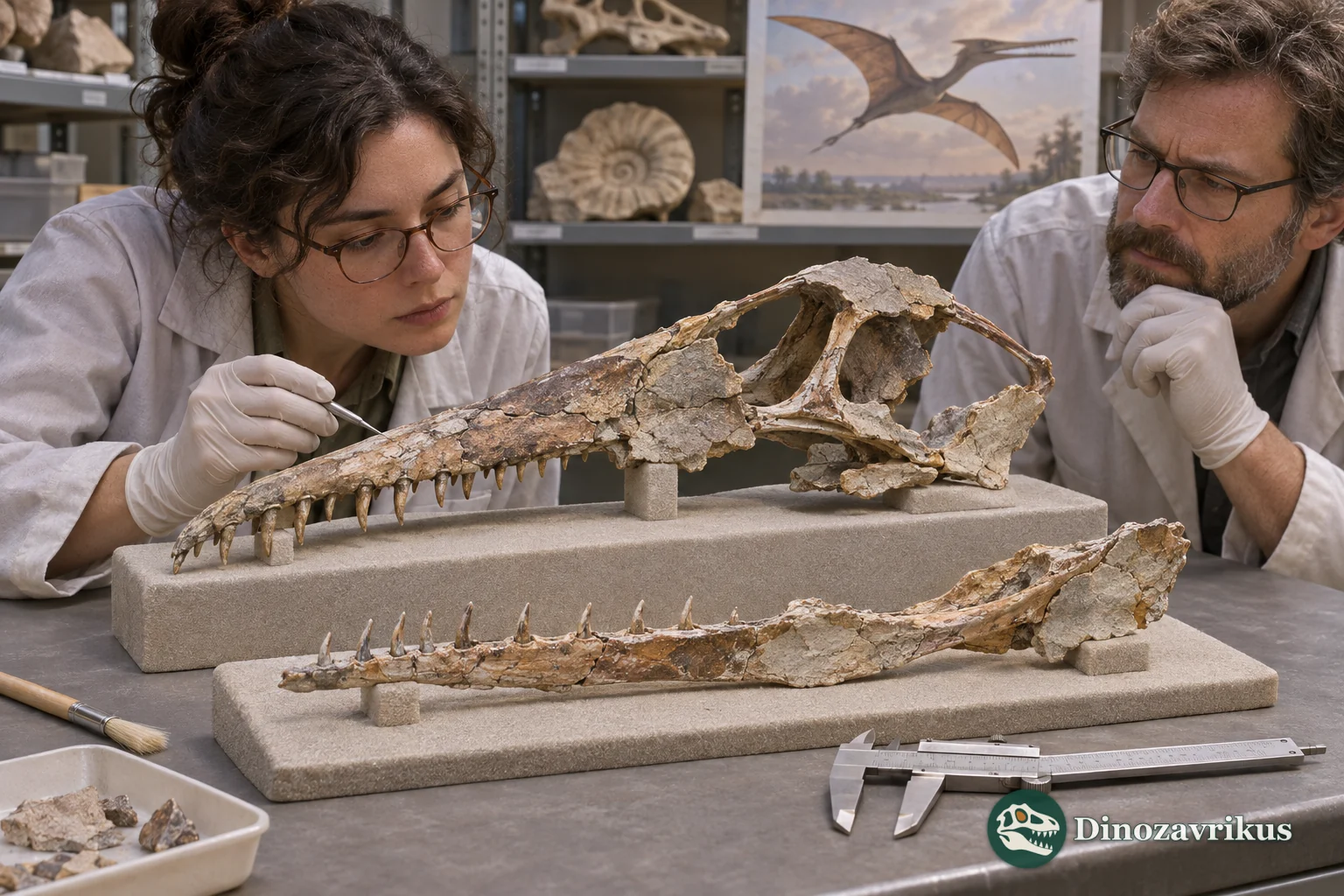
Linlongopterus jennyae is represented by a partial skull and toothed mandible from the Aptian Jiufotang Formation of Liaoning, China. The original description emphasised its relatively low orbit among toothed pteranodontoids. No complete wing or direct evidence of prey survives with the holotype.
Quick facts
| Scientific name | Linlongopterus jennyae, Rodrigues and colleagues, 2015 |
|---|---|
| Holotype | IVPP V15549, partial skull and mandible |
| Locality | Western Liaoning, northeastern China |
| Rock unit | Jiufotang Formation, Lower Cretaceous |
| Age | Aptian |
| Wingspan | Not directly measured from a complete wing |
What can the fossils tell us?
IVPP V15549 includes a partial skull and toothed mandible; it does not reveal the entire animal.
The orbit lies lower than in the other toothed pteranodontoids compared in the 2015 description.
The original authors compared its teeth and skull with Liaoningopterus, Guidraco and Ikrandraco.
The partial skull cannot directly establish a wingspan or prove a particular prey species.
Discovery and name
Taissa Rodrigues, Shunxing Jiang, Xin Cheng, Xiaolin Wang and Alexander Kellner named Linlongopterus jennyae in 2015. Holotype IVPP V15549 came from the Jiufotang Formation and is housed at the Institute of Vertebrate Paleontology and Paleoanthropology in Beijing. The genus name combines Chinese words for forest and dragon with a reference to wings; the species honours Jenny, Elfriede Kellner, who supported palaeontological work.
The Jiufotang Formation dates to the Aptian stage of the Early Cretaceous. Its diverse pterosaurs lived in a broadly shared setting, but a common region and age alone do not establish identical diet or close kinship.
Skull and teeth
The holotype comprises a partial skull and mandible. Its combination of characters differs from other toothed pteranodontoids; especially notable in the description is the relatively ventral position of the orbit. Teeth are preserved in the jaws, allowing comparison of their form and placement with other Jiufotang fossils.
Rodrigues and colleagues compared the taxon with Liaoningopterus, Guidraco and Ikrandraco. Their different jaws and teeth help identify each taxon but do not demonstrate that all captured the same prey.
Relationships and missing evidence
The 2015 authors identified a toothed pteranodontoid and discussed possible relationships to other members of the group. Later phylogenetic analyses differ over the placement of some incomplete Chinese forms. Haopterus provides another dental comparison without guaranteeing an identical position in every evolutionary tree.
No complete wing or body is available to measure a secure wingspan or mass. Teeth suggest ways to grasp food, but no associated prey proves the exact diet. Soft tissues, colour and flight behaviour remain unknown.
Reconstructing the living animal
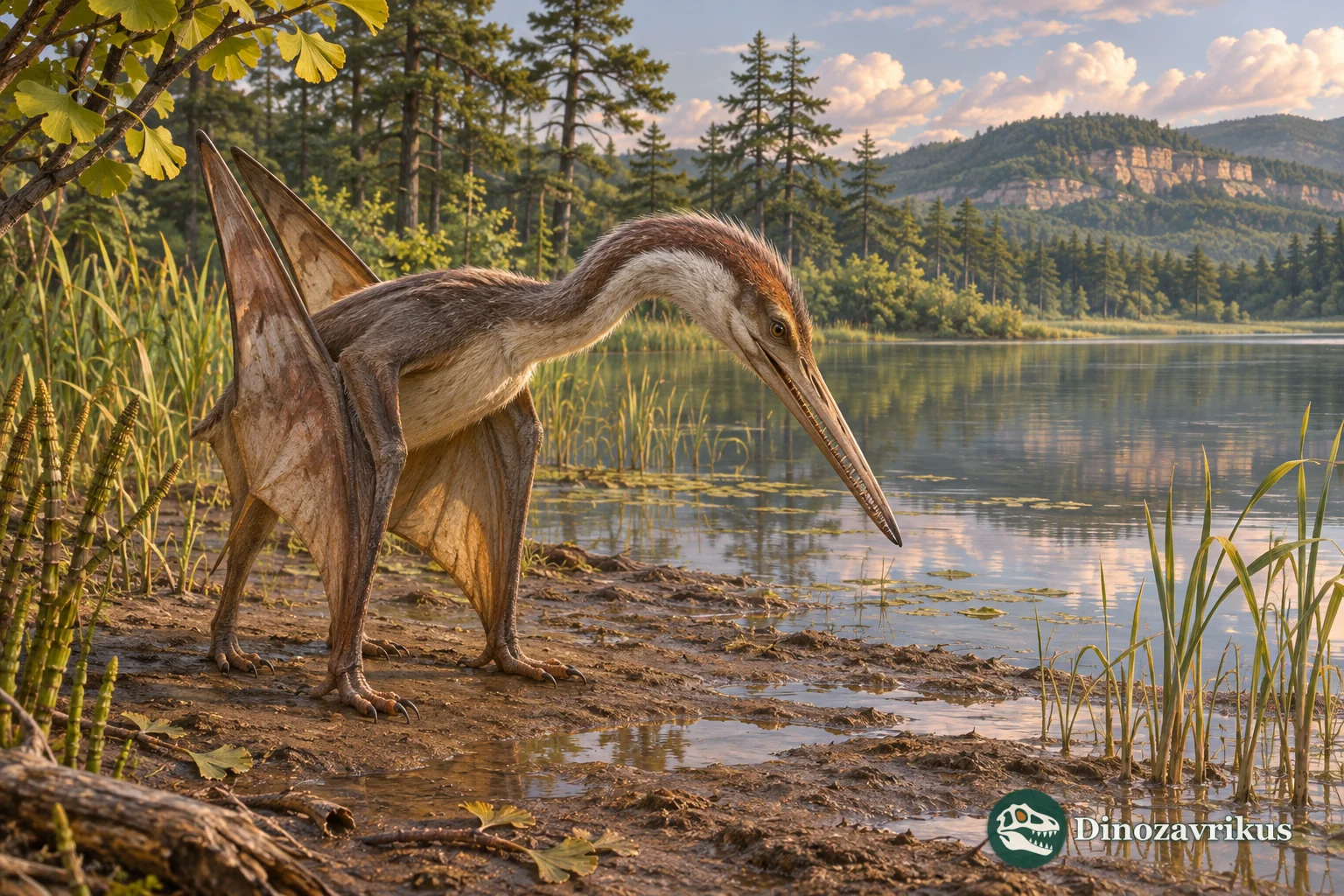
A living scene can illustrate a plausible Jiufotang environment and pterosaur body plan. Its pose, wings and colour are not directly preserved in IVPP V15549.
Frequently asked questions
When did Linlongopterus live?
Its holotype comes from the Aptian Jiufotang Formation of Early Cretaceous China.
What survives of the animal?
A partial skull and toothed mandible, catalogued as IVPP V15549, are known; the whole skeleton is not.
How is it distinguished from regional pterosaurs?
The authors identified a particular combination of skull and dental traits, including a relatively low orbit.
Are its wingspan and diet known?
No complete wing directly measures its span, and no prey remains confirm a particular diet.