

Litaletes was a small Paleocene mammal of North America. The type species, L. disjunctus, was named from jaw material in Montana's Fort Union Formation. Its anatomy is chiefly a story of premolars and molars. No complete skeleton defines the length or body shape of the animal.
In the ancient mammal catalogue, Haplaletes and Litomylus provide comparisons from the same broad Paleocene succession. Their dental differences matter more for classification than the fact that they lived in a similar time interval.
Quick facts
| Scientific name | Litaletes Simpson, 1935 |
|---|---|
| Type species | L. disjunctus |
| Type fossil | USNM V9323, jaw material |
| Collector | Albert C. Silberling |
| Type locality | Gidley Quarry, Fort Union Formation, Montana |
| Age | Middle Paleocene for the type horizon |
| Principal evidence | Jaws, premolars and molars |
What can the fossils tell us?
USNM V9323 from Montana is the holotype of L. disjunctus. It provides dental characters, not the outline of a complete skull or body.
Researchers compare the fourth lower premolar and molar cusps. Tooth wear and position in the jaw complicate an identification based on one loose crown.
Two associated dentary fragments, UCMP 189565, were cautiously compared with L. disjunctus. Similar teeth do not make separate finds one skeleton.
The type fossil and its history
Albert C. Silberling collected the L. disjunctus holotype in Sweet Grass County, Montana, on 5 December 1910 according to the Smithsonian catalogue. Its number is USNM V9323. George Gaylord Simpson introduced the genus and species in 1935 while studying the National Museum's Fort Union mammal collection. His initial paper gave short diagnoses; more extensive comparisons followed.
The specimen came from Gidley Quarry in the Crazy Mountains area. Simpson regarded its Fort Union horizon as Middle Paleocene. The type jaw fixes the species name. Other jaws and loose teeth are comparison material, not parts of a single reconstructed skull.
What the teeth show
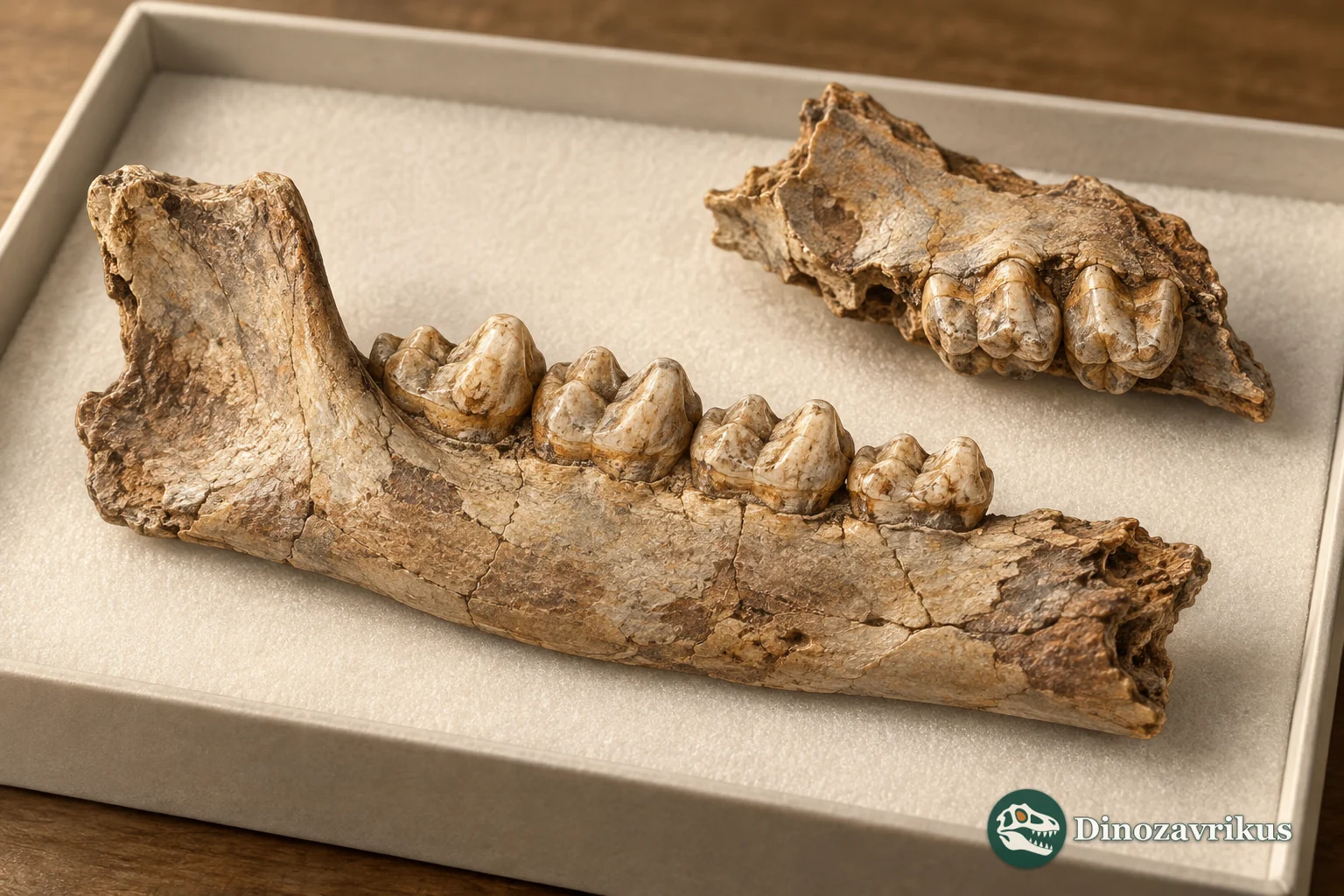
The fourth lower premolar, p4, had developed some molar-like features. Simpson compared Litaletes with Ellipsodon, noting distinctions in the shape of chewing surfaces. Comparative work assesses cusp height, the width of the rear portion of a tooth and the relation between consecutive molars. These characters are more informative than calling the animal simply small.
In L. disjunctus, the last lower molar is not markedly smaller than the one before it. A 2009 study used that feature when comparing jaws referred to L. sternbergi and L. mantiensis. Upper molars add further characters, including a distinct inner cusp, but wear can blur its shape. A heavily worn loose tooth is a weaker identification than an associated row.

Additional jaws and disputed species
UCMP 189565 from northeastern Montana consists of two associated right dentary fragments. One bears p4, the other later molars. The researchers associated them by their proximity, preservation color and wear, then referred them cautiously to L. disjunctus. A worn p4 and an unreduced last molar support the comparison; the fragments are not the original type.
Names such as L. sternbergi and L. mantiensis have moved between taxonomic treatments. One proposal united mantiensis with sternbergi; later authors accepted this only tentatively and asked for more specimens. An abstract reporting a New Mexico jaw broadened the discussion of L. disjunctus, but a conference abstract does not settle every species boundary.
Fort Union habitat and reconstruction limits
The Fort Union Formation covers many localities and intervals. Its floodplain deposits provide a broad environmental setting, not a precise scene for the day USNM V9323 was buried. Records from other states must be checked against their own stratigraphy before being combined into one animal's distribution.
Jaw dimensions indicate a creature far smaller than large Paleocene ungulates, but they do not yield a reliable body mass or length. Teeth can support hypotheses about food processing; no stomach contents identify an exact diet. The fur, ears, color and posture on the cover are artistic choices rather than preserved traits.
Frequently asked questions
Where was the type specimen found?
USNM V9323 came from Gidley Quarry in Montana's Fort Union Formation. The museum identifies Albert C. Silberling as its collector.
Is a full Litaletes skeleton known?
No. The genus is documented mainly by jaws and teeth, so full-body proportions remain uncertain.
Why are molars important in identifying it?
The structure of p4, molar cusps and the size of the last molar help distinguish it from related Paleocene forms.
Is L. mantiensis a separate species?
Its status is debated. A proposed synonymy with L. sternbergi was adopted tentatively by later researchers pending more specimens.